
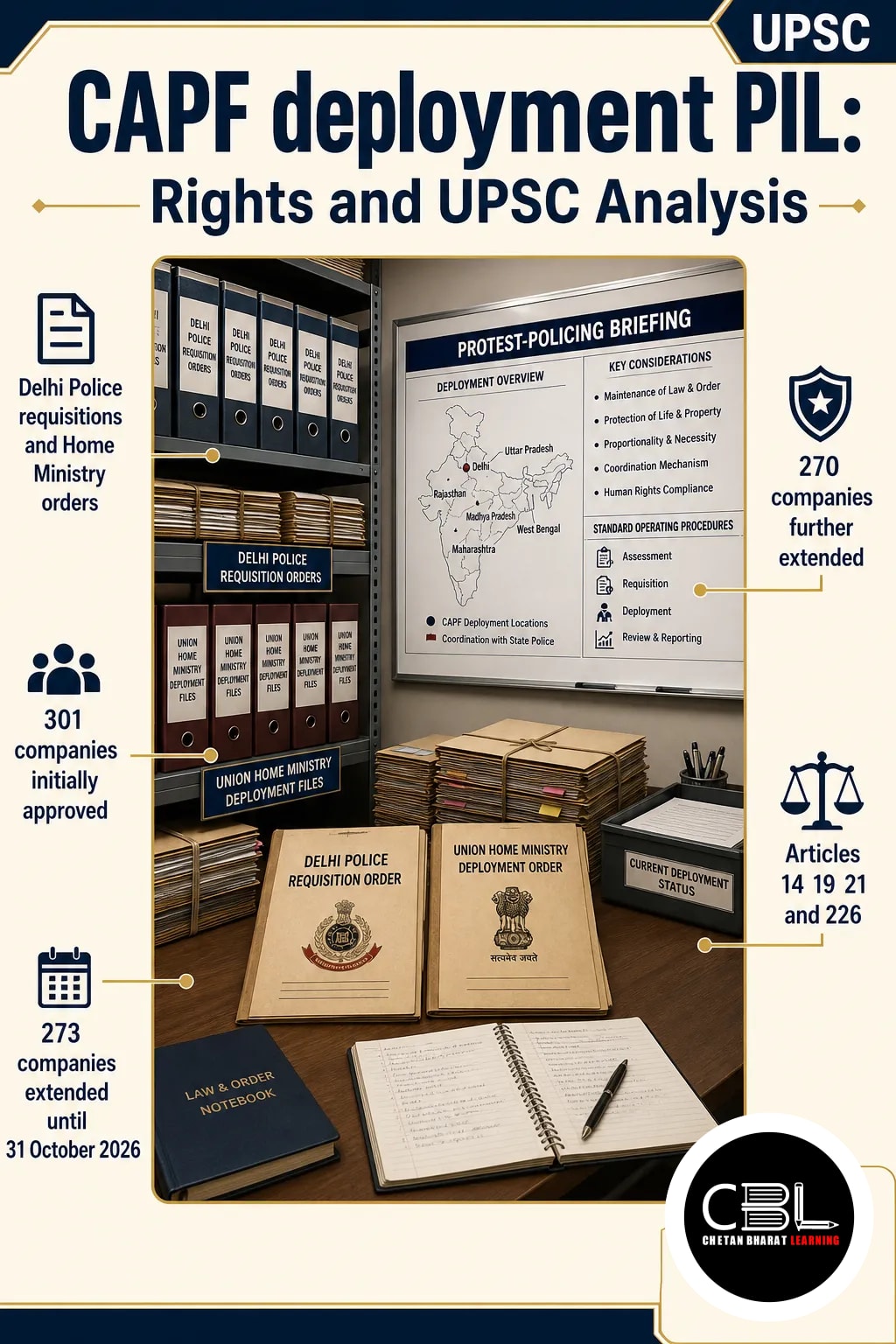
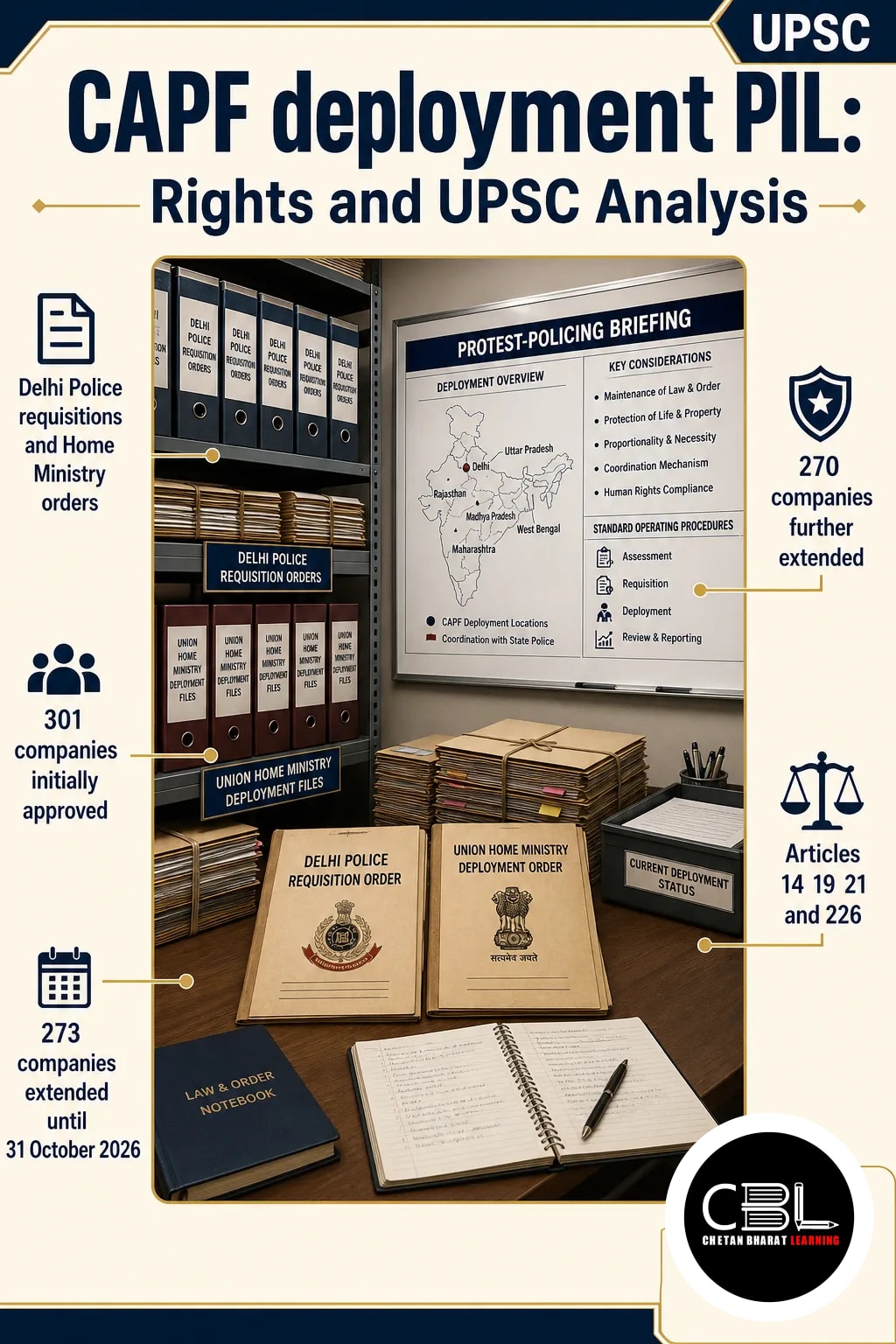
CAPF deployment PIL adds a Delhi security dimension to CBL’s earlier coverage of protest rights and a Madras High Court order. Former civil servant Ashish Joshi has asked the Delhi High Court to examine the basis for deploying central forces during protests.
Quick answer: The CAPF deployment PIL seeks disclosure of Delhi Police requisitions and Union Home Ministry orders for protest-related deployments in Delhi. Joshi cited reports of 301 companies initially approved, 273 extended until 31 October 2026 and 270 further extended until 16 November. The petition raises questions about necessity, proportionality and review.
What has the Delhi High Court held?
The source reports the filing of a petition, not a court ruling on the deployment. Therefore, the petitioner’s claims and requests must not be treated as judicial findings.
The public interest litigation (PIL) concerns the alleged large-scale use of Central Armed Police Forces (CAPFs) for protests and public order in Delhi. Joshi seeks scrutiny of both the original deployment and its repeated extensions.
What does the CAPF deployment PIL seek?
The petition asks authorities to disclose the administrative records behind the deployment and its extensions. In particular, it seeks Delhi Police requisitions, Union Ministry of Home Affairs (MHA) orders and risk assessments.
Joshi cited reports of 301 companies initially approved, followed by an extension of 273 companies until 31 October 2026. He also cited a further extension of 270 companies until 16 November 2026. These are figures cited by the petitioner, not independently established findings in the source.
The petition also requests a force-wise and date-wise reconciliation. It distinguishes approved companies and sanctioned strength from personnel mobilised, those reporting for duty and those assigned to protest-related duties. Consequently, an approval figure should not be equated automatically with actual personnel at protest sites.
Further, Joshi seeks an assessment of effects on counter-insurgency, border security, election preparedness and disaster response. He also asks for a written protocol for substantial protest-related deployments. For context on another central force, see CBL’s overview of Assam Rifles.
Which constitutional provisions matter?
Articles 14, 19 and 21 frame the petitioner’s rights concerns, while Article 226 provides the High Court’s writ jurisdiction. Delhi’s constitutional arrangements also matter when examining responsibility for public order and police.
| Provision | Relevance |
|---|---|
| Article 14 | Guarantees equality before the law and equal protection of laws. |
| Article 19(1)(a) and 19(1)(b) | Protect citizens’ speech and peaceful assembly without arms; Articles 19(2) and 19(3) permit specified reasonable restrictions. |
| Article 21 | Protects life and personal liberty except according to procedure established by law. |
| Article 226 | Empowers High Courts to issue writs for fundamental rights and other purposes. |
| Article 239AA | Excludes public order, police and land from the Delhi Legislative Assembly’s legislative competence. |
These provisions do not make every deployment unlawful. Rather, the constitutional question is whether any action affecting rights has a lawful basis and meets applicable limits. The related analysis of Delhi rally restrictions offers another entry point into this balance.
Why does deployment raise governance concerns?
Deployment decisions must balance public safety, protest rights and the availability of security personnel for other responsibilities.
- Necessity and proportionality: A risk-based assessment can connect the scale and duration of deployment to the situation. Moreover, a large deployment may affect how freely people exercise peaceful assembly, even without a formal ban.
- Accountability: Requisitions, approvals and extension orders reveal who sought personnel and who authorised their use. However, without reconciled records, sanctioned strength and actual deployment remain difficult to compare.
- Periodic review: Extensions raise a distinct question from initial approval. Therefore, review should consider whether the original assessment still justifies the same level of deployment.
- Competing security duties: Personnel assigned to public order may not be available elsewhere. The requested assessment would clarify potential trade-offs; it does not establish that other operations suffered.
What safeguards could improve deployment decisions?
A written protocol can make deployment decisions more consistent while preserving operational flexibility.
First, authorities could record the purpose, risk assessment, force requested and approving authority. Second, an extension could require a fresh review of need and duration. In addition, force-wise records could distinguish sanction, mobilisation, reporting and actual assignment.
Finally, disclosure can strengthen public accountability while protecting genuinely sensitive operational information. Clear review responsibilities and post-deployment assessment would also help evaluate both rights impacts and competing security needs. These are governance options, not directions reported from the court.
Source: The Hindu, 31 October 2026
- ASSAM RIFLES (7 Jun 2023)
State PCS General Studies can test the balance between peaceful assembly and public order. In addition, candidates should distinguish the constitutional position of Delhi from that of states when discussing police and legislative powers.
Prelims Practice Corner
Mains Practice Questions
Frequently Asked Questions
Who filed the petition on CAPF deployment in Delhi?
Former civil servant Ashish Joshi filed it in the Delhi High Court. He seeks, among other things, disclosure of deployment records and a written protocol.
How many CAPF companies were cited in the petition?
Joshi cited reports of 301 initially approved companies, 273 extended until 31 October and 270 further extended until 16 November 2026. However, those figures should not be confused with the number of personnel actually assigned to protests.
Is the right to peaceful assembly absolute?
No, because Article 19(3) permits specified reasonable restrictions on the right under Article 19(1)(b). The protected assembly must also be peaceful and without arms.
Has the Delhi High Court ruled against the deployment?
No such ruling is reported in the source. Therefore, the petition’s allegations should not be presented as the court’s conclusions.
Related Current Affairs
Preparing for UPSC, PCS or HCS?
Talk to a mentor at Chetan Bharat Learning, Chandigarh. Free guidance on choosing the right exam and building a study plan.
Chat on WhatsAppCall 97793 53345UPSC / IAS / PCS coaching in Chandigarh · Trusted by aspirants across Punjab & Haryana

 Ananya RanaIAS · AIR 60
 Aditya SharmaIAS · AIR 70
 Ria Kaur SethiIPS · AIR 89
 Aman AloonIRS · AIR 295
 Sumer Singh VirkIRS · AIR 335
 Shivani PanchalIAS

Leave a Reply
You must be logged in to post a comment.