
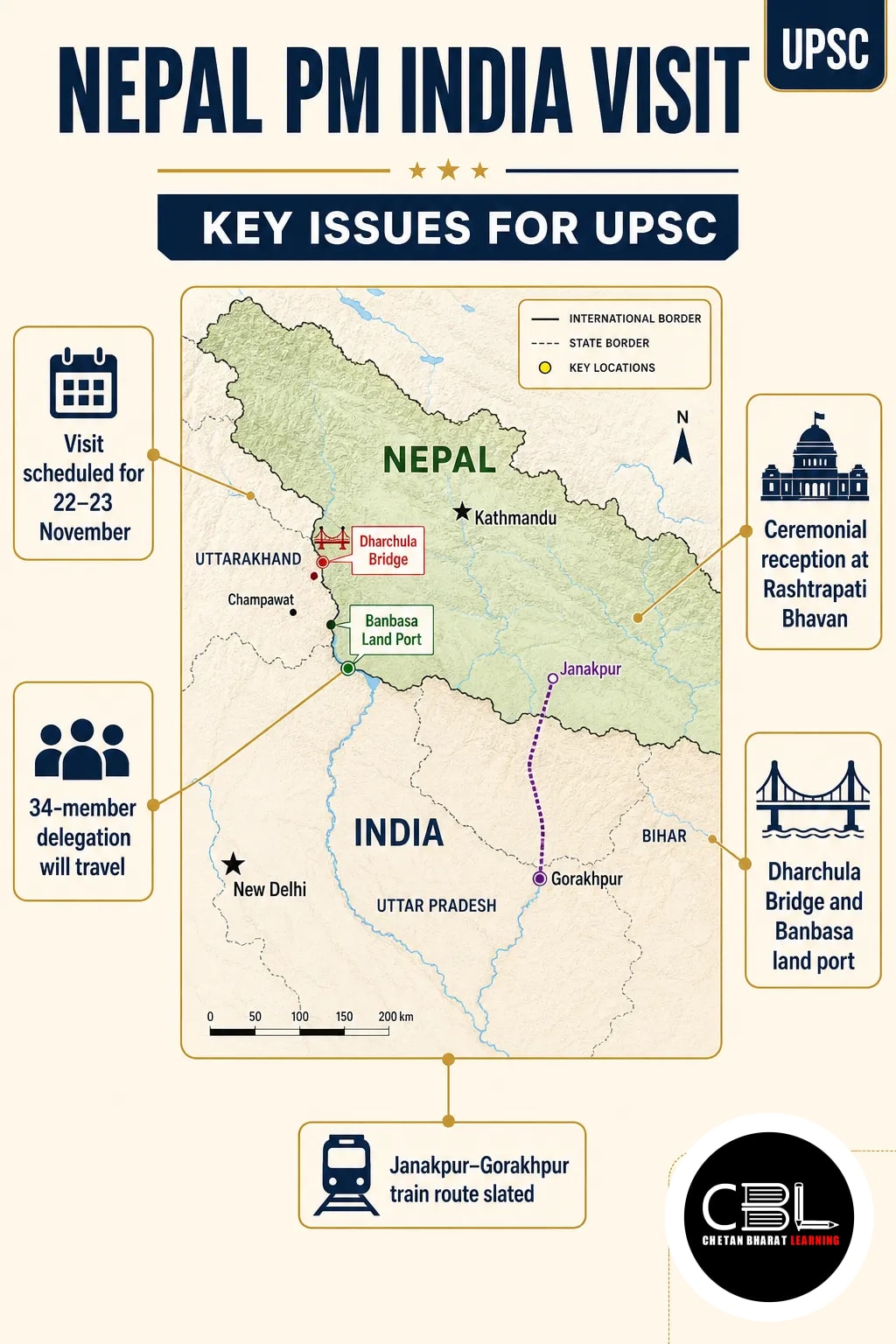
The Nepal PM India visit on 22–23 November 2026 will bring Prime Minister Balendra Shah to New Delhi for his first visit to India since taking office. It places connectivity and energy cooperation at the centre of India’s neighbourhood relations.
Quick answer: The Nepal PM India visit is a state visit scheduled for 22–23 November 2026. Balendra Shah will lead a 34-member delegation and meet Prime Minister Narendra Modi in New Delhi. The two sides expect to exchange cooperation agreements and inaugurate completed projects, including energy projects, although final outcomes await the visit.
What is planned during the visit?
Shah’s state visit combines leader-level talks, ceremonial engagements and a business forum. India’s Ministry of External Affairs announced the visit on 20 November; Nepal’s Foreign Secretary Amrit Bahadur Rai outlined the programme in Kathmandu.
Finance Minister Swarnim Wagle and Foreign Minister Shisir Khanal will join the delegation. Meanwhile, External Affairs Minister S. Jaishankar is scheduled to call on Shah after his arrival on 22 November.
| Engagement | Programme |
|---|---|
| Rashtrapati Bhavan | Ceremonial reception on 23 November |
| Rajghat | Wreath at Mahatma Gandhi’s memorial |
| Hyderabad House | Meeting with Modi and expected signing of agreements |
| Other engagements | Call on President Droupadi Murmu and Nepal–India Business Forum |
After delegation-level talks, the two prime ministers are expected to hold a joint press conference. Shah is scheduled to leave for Kathmandu later on 23 November.
What outcomes are expected?
The two governments expect to exchange several memorandums of understanding and inaugurate completed projects. However, the source does not specify the agreement texts or confirm the final outcomes.
- Energy projects: Rai said the prime ministers would inaugurate projects related to energy; the source does not name them.
- Border infrastructure: Sources identified the Dharchula Bridge and Banbasa land port on the Uttarakhand–Nepal border as slated to open.
- Rail connectivity: Sources also identified a Janakpur–Gorakhpur train route as slated to open. Separately, read CBL’s coverage of the planned Ram Janaki rail service.
These are proposed visit outcomes, not completed announcements as of 21 November. Therefore, aspirants should verify the final agreements and project launches after the talks.
Why does the visit matter for India?
The Nepal PM India visit offers a platform to connect political dialogue with practical cooperation across a shared border. Nepal is landlocked and borders India and China; consequently, dependable transport connections matter for its access to markets.
Trade and movement
Bridges, land ports and rail links can reduce the friction of cross-border movement when infrastructure and procedures work together. For example, a land port needs effective customs processes and last-mile links to deliver its full value. The business forum can also bring commercial concerns into the discussion.
Energy and water resources
Nepal’s Himalayan rivers create opportunities for hydropower cooperation, while India provides a neighbouring market for energy. In addition, water-resource cooperation requires attention to downstream interests, environmental effects and the sharing of benefits. Energy projects can thus support broader economic ties, but their value depends on implementation.
Wider partnership
India’s ministry identified trade, development, energy, water resources and physical and digital connectivity as areas of bilateral progress. It also listed start-ups, technology, innovation and sports as newer areas of engagement. Therefore, the relationship extends beyond any single project or summit.
What challenges need attention?
The central policy challenge is turning announced cooperation into benefits that both countries can measure. The following are implementation considerations, not disputes established by the visit announcement.
- Project delivery: Cross-border infrastructure requires coordination between agencies on both sides; otherwise, a completed link may remain underused.
- Shared rivers: Water and energy projects involve upstream and downstream interests; therefore, environmental and community concerns need attention.
- Economic access: Physical links alone cannot ensure smooth trade; customs procedures and associated services also matter.
- Political trust: Nepal’s domestic political changes make sustained dialogue important; moreover, cooperation must respect each country’s priorities.
Shah took office after the Rastriya Swatantra Party won the election following the September 2025 uprising in Kathmandu. Consequently, his first visit to India as prime minister provides an opportunity for direct engagement with the new leadership.
What should the two countries prioritise next?
India and Nepal should focus on implementation, transparent follow-up and mutually beneficial connectivity. First, they could publish clear responsibilities and timelines for any agreements concluded during the visit. Joint reviews could then distinguish completed infrastructure from fully operational services.
Second, both sides should align border facilities with customs procedures and transport links. Third, energy and water projects should account for environmental impacts and affected communities. Finally, regular political and business dialogue can help identify practical obstacles before they delay cooperation.
Source: The Hindu, 21 November 2026
- Ram Janaki rail service set for 23 November launch (15 Nov 2026)
Asked in UPSC: Previous Year Questions
- UPSC CSE Prelims 2026 (GS Paper I): Which statements correctly describe Maitri Setu, Jhulaghat suspension bridge and Mechi bridge as connections between India and neighbouring countries?
UPSC tests cross-border bridges alongside their locations and neighbouring countries, so revise the map as well as the news.
State PCS General Studies can test Nepal’s neighbouring countries, India–Nepal border infrastructure and the dates of the visit. In addition, candidates should distinguish proposed project openings from confirmed outcomes.
Prelims Practice Corner
Mains Practice Questions
Frequently Asked Questions
When is Nepal’s Prime Minister scheduled to visit India?
On 22–23 November 2026. The state visit will be Balendra Shah’s first India visit since he took office.
How large is the Nepalese delegation?
It has 34 members, according to Nepal’s Foreign Secretary Amrit Bahadur Rai. It will also include Finance Minister Swarnim Wagle and Foreign Minister Shisir Khanal.
Have India and Nepal already signed the expected visit agreements?
No; as of 21 November, the agreements were expected during the visit. Therefore, their final contents and signing require confirmation after the talks.
Related Current Affairs
Preparing for UPSC, PCS or HCS?
Talk to a mentor at Chetan Bharat Learning, Chandigarh. Free guidance on choosing the right exam and building a study plan.
Chat on WhatsAppCall 97793 53345UPSC / IAS / PCS coaching in Chandigarh · Trusted by aspirants across Punjab & Haryana




Leave a Reply
You must be logged in to post a comment.