
UPSC Mapping
- Prelims: Social Issues, Women and Child Protection Laws
- Mains: GS Paper 1 – Society; GS Paper 2 – Social Justice
What is Child Marriage?
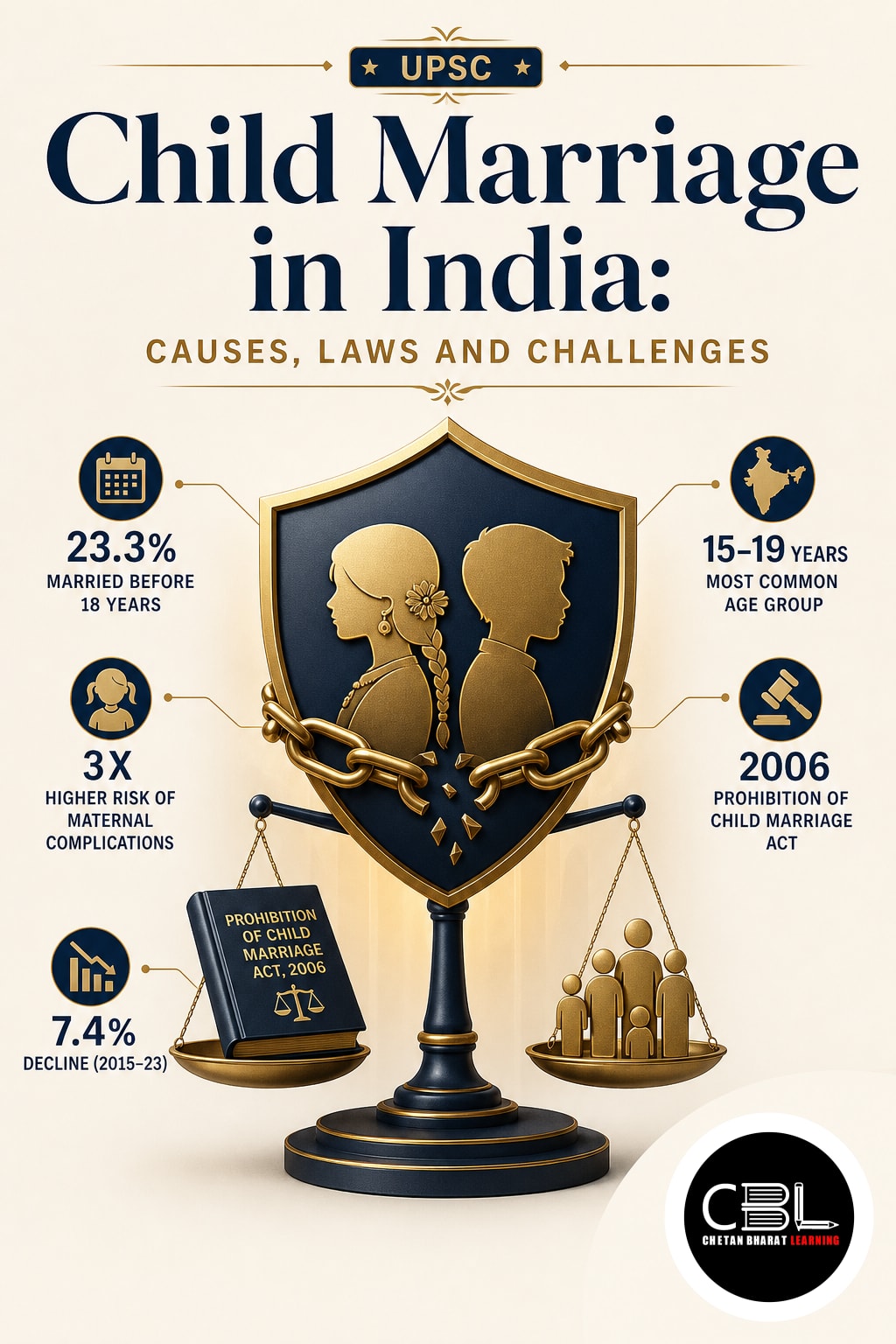
Child marriage refers to a marriage or informal marital union involving a person below the legally prescribed marriageable age. Under India’s Prohibition of Child Marriage Act, 2006, a child is a female below 18 years or a male below 21 years.
It constitutes a serious social and human-rights concern because it can restrict education, bodily autonomy, health and economic independence. Girls face disproportionate consequences from early pregnancy, interrupted schooling and unequal household power relations.
The practice is closely associated with structural poverty, gender inequality and limited access to opportunities rather than being explained by cultural customs alone.
Why in News?
Field investigations in Telangana revealed persistent child marriage despite improved national and State-level indicators. Authorities prevented 1,245 child marriages in 2025–26 and another 825 between April and August 2026, totalling 2,070 interventions. Since 2014–15, 10,710 marriages have been prevented.
Key Data and Trends
The National Family Health Survey measures women aged 20–24 who married before 18:
| Survey | Women Married Before 18 |
|---|---|
| NFHS-3 (2005–06) | 47.4% |
| NFHS-4 (2015–16) | 26.8% |
| NFHS-5 (2019–21) | 23.3% |
| NFHS-6 (2023–24) | 20.1% |
- Telangana-Specific: Prevalence fell from 23.5% to 17.9%; rural 19.6%, urban 12.9%; districts Vikarabad (878), Mahabubnagar (759), Sangareddy (715); 777 out-of-school children identified.
Causes Behind the Persistence of Child Marriage
- Extreme Poverty: Financial insecurity drives early marriage as a coping strategy.
- Household Shocks: Illness or loss of income increases pressure to marry children.
- Patriarchal Norms: Honour, sexuality and gender roles encourage early unions.
- School Dropout: Lack of secondary education access leaves girls vulnerable.
- Intermediaries: Creditors or matchmakers exploit indebted families.
- Adolescent Elopement: Informal unions add legal complexity.
- Weak Post-Rescue Support: No follow-through on education or welfare.
Constitutional and Legal Provisions
| Article or Law | Key Provision |
|---|---|
| Article 14 | Equality before law and equal protection of laws. |
| Article 15(3) | Special provisions for women and children. |
| Article 21 | Right to life and personal liberty. |
| Article 21A | Free and compulsory education for children 6–14. |
| Article 39(f) | Directs state to protect children’s development. |
| PCMA 2006 | Prohibits child marriage; penalties and remedies. |
| POCSO Act 2012 | Protects minors from sexual offences. |
Prohibition of Child Marriage Act, 2006
- Marriage voidable at option of child party; void in specified trafficking or deception cases.
- Adults solemnising or promoting face cognizable, non-bailable offences.
- Court injunctions prevent proposed marriages; Child Marriage Prohibition Officers appointed.
Government Initiatives
- Bal Vivah Mukt Bharat – prevention, awareness and community mobilisation.
- Child Helpline 1098 – protection assistance and referrals.
- Mission Vatsalya – institutional coordination and care.
- Kasturba Gandhi Balika Vidyalayas – education for disadvantaged girls.
- District Child Protection Units – rescue and rehabilitation.
- Anganwadi & ASHA networks – frontline identification of vulnerable cases.
- State Campaigns – e.g., Telangana’s Balya Vivaham–Bathuku Aagam.
Social, Health and Economic Implications
- Adolescent pregnancy risks and maternal complications.
- Interrupted education and restricted opportunities.
- Power imbalances increase domestic violence.
- Child health consequences under poor care conditions.
- Lifetime economic dependency and intergenerational poverty.
Challenges and Gaps
- Underreporting due to informal ceremonies.
- Social pressure overrides legal norms.
- Limited rehabilitation and follow-up support.
- Overburdened protection personnel.
- Persistent economic vulnerability post-intervention.
- Barriers to secondary education access.
Way Forward
- Ensure proportionate legal enforcement and accountability.
- Provide targeted financial and social protection support.
- Expand scholarships, safe transport and re-enrolment.
- Develop individual rehabilitation plans for rescued children.
- Train frontline workers for early identification.
- Mobilise communities to challenge harmful norms.
- Measure long-term outcomes beyond prevented ceremonies.
Prelims Practice Corner
Q1. Under the Prohibition of Child Marriage Act, 2006, the legally prescribed minimum marriageable ages are:
(a) 18 years for both men and women
(b) 21 years for women and 18 years for men
(c) 21 years for both men and women
(d) 18 years for women and 21 years for men
Answer: (d) The law defines a child as a female below 18 or a male below 21 years.
Mains Practice Questions
Q1. Child marriage is not merely a violation of human rights but also a significant impediment to women’s empowerment. Discuss the multidimensional approach required to address this practice effectively. (15 marks)
Answer Structure: Intro – define and highlight prevalence; Body – analyse root causes and interventions; Conclusion – integrated legal, educational and community strategies.
Frequently Asked Questions
- What is the legal age of marriage in India? Under PCMA 2006, minimum age is 18 for women and 21 for men.
- What does NFHS-6 reveal? 20.1% of women aged 20–24 married before 18, down from 23.3% in NFHS-5.
- Why does child marriage persist? Due to poverty, gender norms, limited education, family distress and weak rehabilitation.
Related Current Affairs
Preparing for UPSC, PCS or HCS?
Talk to a mentor at Chetan Bharat Learning, Chandigarh. Free guidance on choosing the right exam and building a study plan.
Chat on WhatsAppCall 97793 53345UPSC / IAS / PCS coaching in Chandigarh · Trusted by aspirants across Punjab & Haryana
Leave a Reply
You must be logged in to post a comment.