
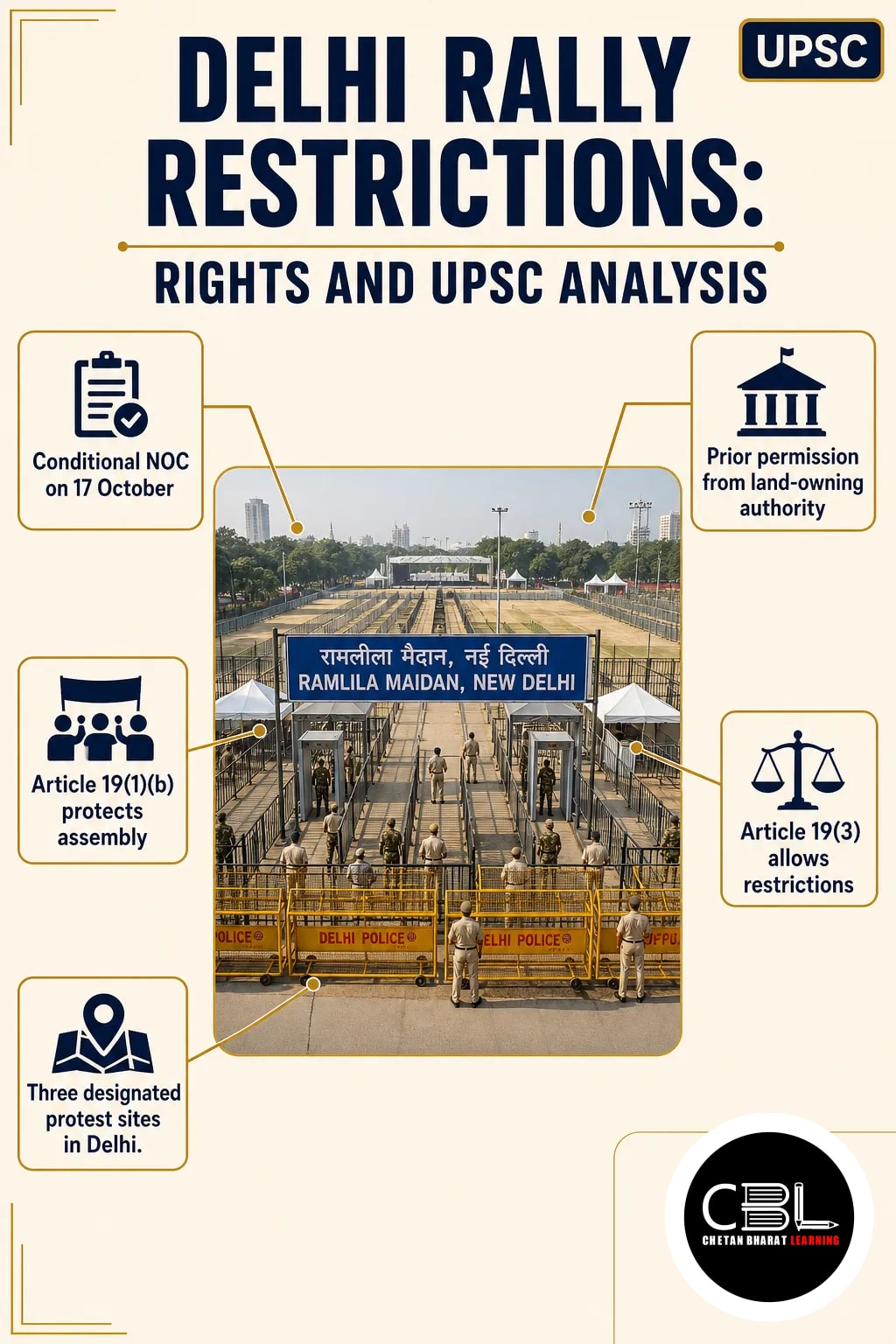

Delhi rally restrictions have brought the right to peaceful assembly into focus before the INDIA bloc’s 1 November protest. The case also illustrates questions examined in Indian polity and governance.
Quick answer: Delhi rally restrictions apply to the Congress-led INDIA bloc’s 1 November 2026 protest at Ramlila Maidan, New Delhi. Delhi Police issued a conditional no-objection certificate on 17 October and required prior permission from the land-owning authority. The rally seeks Chief Election Commissioner Gyanesh Kumar’s resignation over electoral roll revision and alleged irregularities.
What conditions apply to the Delhi rally?
Delhi Police granted conditional approval and required prior permission from the land-owning authority. Its no-objection certificate (NOC) came on 17 October 2026, ahead of the planned 1 November rally.
The permission letter also warns that violations may invite legal action or revocation. However, the supplied report does not specify the remaining conditions; therefore, they cannot be listed as established facts.
According to Deputy Commissioner of Police (Central) Rohit Rajbir Singh, Congress sought permission only for a rally at Ramlila Maidan. Consequently, the police approval should not be treated as permission for a separate march or another venue.
Why is the rally being held?
The Congress-led INDIA bloc plans the rally to demand Chief Election Commissioner (CEC) Gyanesh Kumar’s resignation. The opposition links its demand to the Special Intensive Revision (SIR) of electoral rolls and alleged electoral irregularities; these are allegations, not established findings.
The bloc also planned a ‘public impeachment’ at Congress president Mallikarjun Kharge’s official residence on 30 October. However, that political event is not the constitutional procedure for removing a CEC. For the distinction, read the explanation of the CEC removal rules.
Under Article 324, the Election Commission supervises, directs and controls elections specified in the Constitution. Article 324(5) protects the CEC by providing removal in the same manner and on the same grounds as a Supreme Court judge. For background on electoral rolls, see SIR and voter roll revision.
Which constitutional provisions apply?
The Constitution protects peaceful assembly and expression, while allowing restrictions on specified grounds. Moreover, any restriction must be supported by law and satisfy the applicable constitutional standard.
| Provision | Relevance |
|---|---|
| Article 19(1)(a) | Protects citizens’ freedom of speech and expression. |
| Article 19(1)(b) | Protects citizens’ right to assemble peaceably and without arms. |
| Article 19(2) | Permits reasonable restrictions on speech on listed grounds, including public order. |
| Article 19(3) | Permits reasonable restrictions on assembly in the interests of public order or India’s sovereignty and integrity. |
| Article 14 | Guarantees equality before the law and equal protection of the laws. |
| Articles 32 and 226 | Provide routes to seek constitutional remedies before the Supreme Court and High Courts, respectively. |
Article 19 does not guarantee an unrestricted choice of venue. However, a restriction cannot rest merely on a preference for administrative convenience; its legal basis and reasonableness matter.
Why do designated protest sites matter?
Designated sites help authorities plan public assemblies, but their location also affects protesters’ ability to communicate. Ramlila Maidan is one of three designated protest sites in Delhi after Jantar Mantar was de-notified.
For administrators, a known venue can make coordination of access, safety and emergency response easier. For participants, however, the availability and accessibility of a venue determine whether the opportunity to protest is meaningful.
These considerations frame the Delhi rally restrictions as a governance issue rather than a choice between an absolute right and unrestricted police discretion. The report does not establish whether the conditions in this particular NOC are constitutionally valid; that would require examining their terms and legal basis.
What are the governance concerns?
The central concern is whether regulation protects public order without unnecessarily weakening peaceful assembly. A sound assessment should distinguish the stated objective from the effect of each condition.
- Clarity and legality: Organisers need to know which conditions apply, their legal basis and the consequences of breach.
- Reasonableness: A condition should address an identifiable concern; therefore, a broader restriction needs stronger justification than a targeted one.
- Equal treatment: Authorities should apply comparable standards across groups, while accounting for relevant differences between events.
- Review and remedies: Revocation can affect expression and assembly; consequently, reasons and access to legal remedies are important safeguards.
How can authorities balance rights and public order?
Authorities can balance both objectives through transparent, event-specific decisions and coordination with organisers. First, police and land-owning authorities can communicate their respective requirements and decision timelines clearly.
Second, conditions should respond to demonstrable safety or public-order needs rather than prohibit activity more widely than necessary. In addition, written reasons for refusal or revocation would help affected parties understand and challenge a decision.
Finally, accessible venues and arrangements for emergency services can protect both participation and public safety. These are governance recommendations, not claims about conditions imposed on this rally.
Source: The Hindu, 30 October 2026
- CEC Impeachment Protest: Constitutional Rules for UPSC (29 Oct 2026)
Punjab PCS and Haryana HCS can test Article 19 alongside the administration of public meetings. In addition, candidates should examine how authorities balance peaceful assembly, venue access and public order.
Prelims Practice Corner
Mains Practice Questions
Frequently Asked Questions
Where and when is the INDIA bloc rally planned?
The rally is planned at Ramlila Maidan, New Delhi, on 1 November 2026. Delhi Police issued a conditional NOC on 17 October.
Does the police NOC replace the land-owning authority’s permission?
No, because police also required prior permission from the land-owning authority. In addition, violations of the permission conditions could lead to legal action or revocation.
Which Article protects peaceful assembly?
Article 19(1)(b) protects citizens’ right to assemble peaceably and without arms. However, Article 19(3) permits reasonable restrictions on specified grounds.
Can a public impeachment protest remove the CEC?
No, because a political protest is not the constitutional removal procedure. Article 324(5) protects the CEC through the same removal manner and grounds as a Supreme Court judge.
Related Current Affairs
Preparing for UPSC, PCS or HCS?
Talk to a mentor at Chetan Bharat Learning, Chandigarh. Free guidance on choosing the right exam and building a study plan.
Chat on WhatsAppCall 97793 53345UPSC / IAS / PCS coaching in Chandigarh · Trusted by aspirants across Punjab & Haryana
Leave a Reply
You must be logged in to post a comment.