
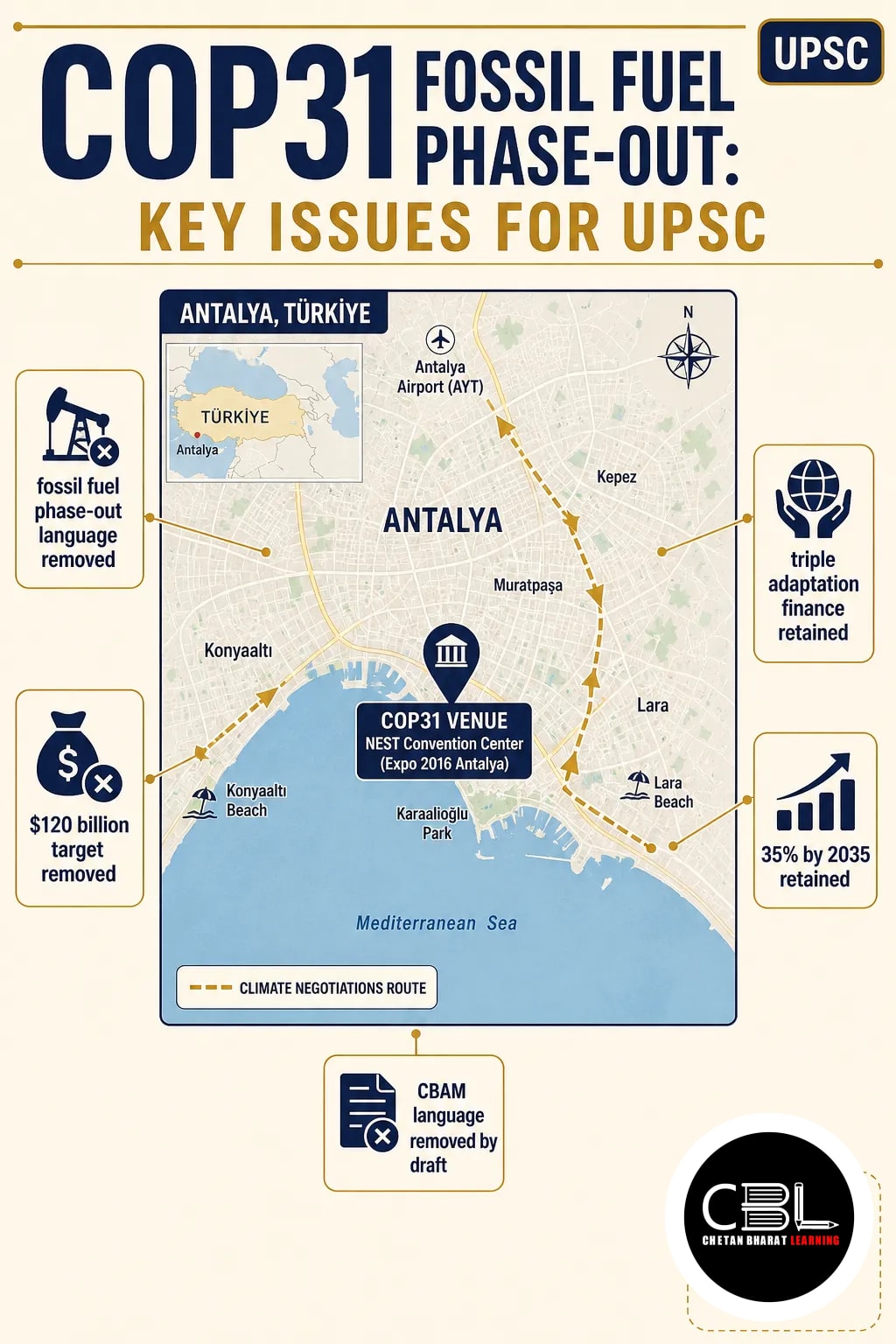
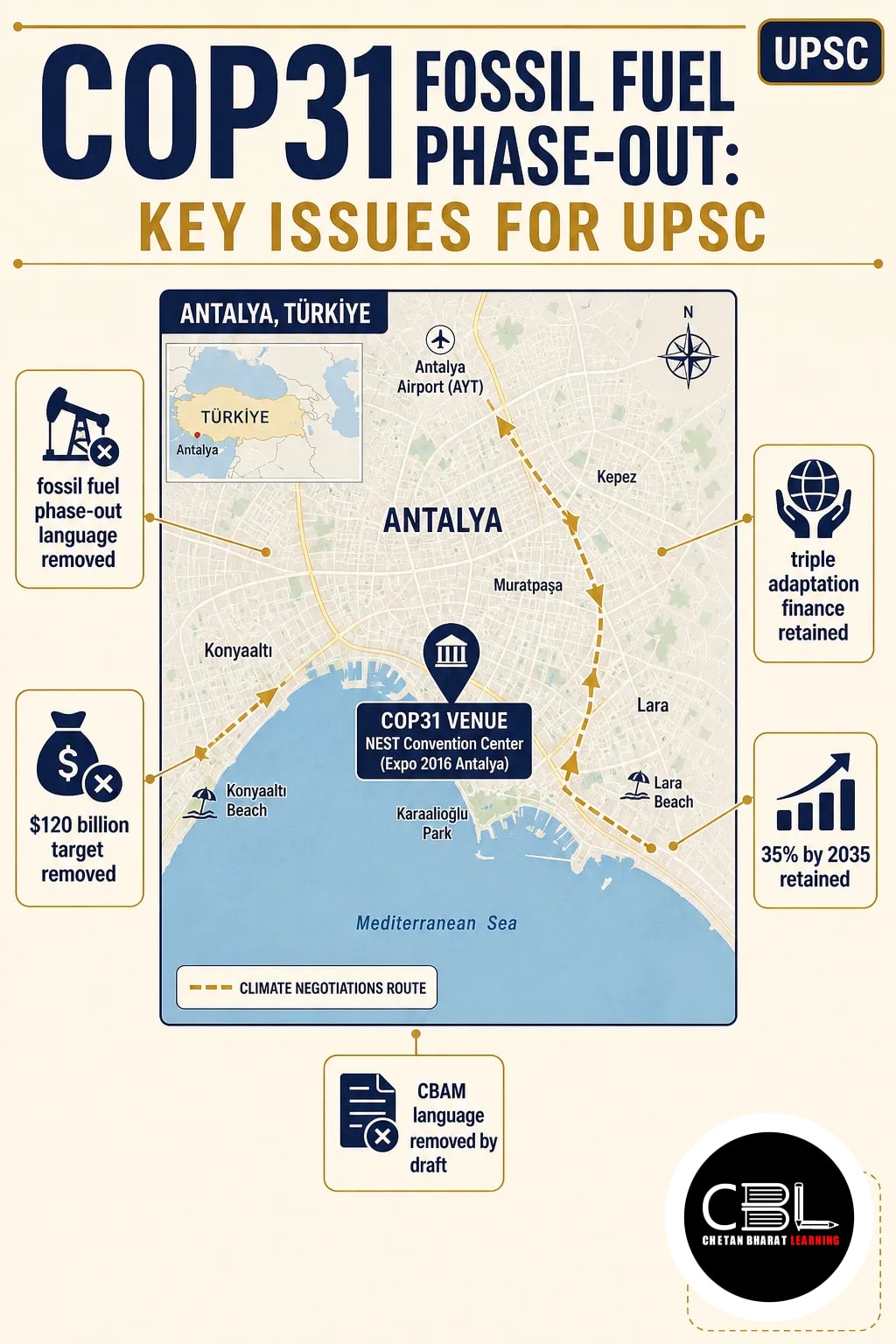
COP31 fossil fuel phase-out language has disappeared from a revised climate conference draft, alongside proposed net-zero dates and a specific adaptation-finance target. The negotiations raise questions about equity and implementation in international climate diplomacy.
Quick answer: At COP31 in Antalya, Türkiye, the 19 November 2026 draft omitted fossil fuel phase-out and net-zero dates. It also dropped a $120 billion adaptation-finance target and language on ending unilateral trade measures by 2027. However, a broad commitment to triple adaptation finance remained. The text was still under negotiation.
What happened at the COP31 negotiations?
The COP31 Presidency shortened its draft cover decision and removed several contested proposals. The 19 November version had 80 paragraphs, compared with 144 in the 16 November version. The conference was officially scheduled to end on 20 November.
A cover text is an overarching political decision that frames a climate conference outcome. It does not settle every agenda item separately. Moreover, its adoption requires consensus among Parties; the Presidency had said earlier drafts did not represent consensus.
The draft therefore should not be treated as a final agreement. For background on implementation challenges, see CBL’s analysis of the COP31 climate delivery gap.
What changed in the revised draft?
The revision removed specific language on fossil fuels, finance and trade, while retaining several energy and adaptation goals. The table distinguishes the draft’s contents from proposals no longer present.
| Issue | Status in 19 November draft |
|---|---|
| Fossil fuels and net zero | References to phase-out and net-zero dates removed |
| Adaptation finance | Specific $120 billion target removed; broad tripling commitment retained |
| Unilateral trade measures | Earlier language on phasing them out by 2027 removed |
| Electricity | 35% share in final energy consumption by 2035 retained |
| Early warning | Universal early warning systems by 2027 retained |
| Carbon capture | Scaling up carbon capture utilisation technologies retained |
The text also links electrification with tripling renewable energy capacity and doubling the rate of energy efficiency improvement by 2030. However, those provisions do not replace an explicit fossil fuel phase-out reference.
Why do the omissions matter?
The omissions affect the clarity of proposed action on emissions, adaptation funding and trade. They also remove demands associated with both developed and developing country blocs.
- Mitigation: Without explicit phase-out language or net-zero dates, the draft gives less specific political direction on fossil fuels and long-term emissions.
- Adaptation: A broad tripling commitment remains; however, the removal of a specific figure makes the proposed scale less clear.
- Trade: The earlier draft addressed unilateral measures such as the Carbon Border Adjustment Mechanism (CBAM). Its removal leaves that developing-country concern outside the revised cover language.
- Negotiating balance: Shorter text may make consensus easier, but it can also leave difficult questions unresolved.
Developing countries had sought a $120 billion adaptation-finance target as a legally binding obligation on developed countries. Separately, climate policy expert Rachel Cleetus called for at least $120 billion annually by 2035. The revised draft contains neither that firm figure nor the earlier demand for binding obligations.
What is the significance for India?
India has stakes in affordable energy, adaptation finance and fair conditions for climate-related trade. The revised language affects each of these negotiating areas.
Energy transition and electrification
The proposed 35% figure concerns electricity’s share of final energy consumption, not the renewable share of electricity generation. Therefore, it also depends on electricity use in sectors such as transport, buildings and industry.
Ajay Mathur, India’s lead negotiator at the Paris climate conference and former Director General of the International Solar Alliance, described the target as ambitious for India. He estimated that India could reach 32–34% by 2035 as renewables expand. This is an estimate, not an adopted national target.
Finance, trade and equity
Adaptation finance helps countries prepare for and respond to climate impacts. However, a general promise without a specified amount leaves the scale of support less certain.
CBAM links a border measure to the carbon content of covered imports. For developing countries, such measures raise questions about competitiveness and whether climate rules account for different capacities. Consequently, the deleted 2027 language matters to the wider debate on equitable trade.
The principle of common but differentiated responsibilities and respective capabilities recognises that countries share climate responsibilities but have different circumstances and capabilities. For India, it provides a framework for assessing the balance between mitigation expectations and support.
What are the main concerns and the way forward?
The central challenge is to connect credible climate ambition with finance, implementation and fairness. A consensus text is useful only if countries can translate it into practical action.
- Clarify finance: Negotiators could specify funding levels, timelines and reporting arrangements, while distinguishing commitments from proposals.
- Match goals with capacity: Countries could link electrification with investment in grids, clean generation and efficient end uses.
- Address trade concerns: Dialogue on carbon-related border measures should consider transparency, development needs and access to transition support.
- Measure outcomes: Clear indicators for adaptation, early warning and energy access can help track implementation.
- Preserve ambition: Parties should explain how energy goals contribute to emissions reductions, rather than treating technology targets alone as a complete transition plan.
Overall, the COP31 fossil fuel phase-out debate illustrates a wider trade-off: precise commitments can strengthen accountability, while unresolved finance and equity questions can make consensus harder. The final decision, not the revised draft alone, will determine the conference outcome.
Source: The Hindu, 20 November 2026
- COP31 Climate Goals: The Delivery Gap for UPSC (13 Nov 2026)
Asked in UPSC: Previous Year Questions
- UPSC CSE Mains 2025 (GS Paper III): Discuss India’s Paris Agreement commitments, their strengthening at COP26, and the 2022 update to its first Nationally Determined Contribution.
UPSC links climate negotiations with India’s commitments and their subsequent updates.
State PCS questions can connect global climate commitments with state-level electricity planning and disaster preparedness. For example, candidates can examine how early warning and adaptation measures depend on coordination across government levels.
Prelims Practice Corner
Mains Practice Questions
Frequently Asked Questions
Did COP31 agree to a fossil fuel phase-out?
The 19 November draft did not contain a fossil fuel phase-out reference. However, it was a negotiating draft, not a final conference decision.
What adaptation-finance target did the revised draft retain?
It retained a broad commitment to triple adaptation finance. However, it removed the specific $120 billion target sought by developing countries.
What does the 35% electricity goal measure?
It measures electricity’s share of final energy consumption by 2035. Therefore, it is different from the share of renewables in electricity generation.
What happened to the CBAM language in the COP31 draft?
The revised draft removed earlier language on phasing out unilateral trade measures such as CBAM by 2027. Consequently, that developing-country concern no longer appeared in the revised cover text.
Related Current Affairs
Preparing for UPSC, PCS or HCS?
Talk to a mentor at Chetan Bharat Learning, Chandigarh. Free guidance on choosing the right exam and building a study plan.
Chat on WhatsAppCall 97793 53345UPSC / IAS / PCS coaching in Chandigarh · Trusted by aspirants across Punjab & Haryana









Leave a Reply
You must be logged in to post a comment.