
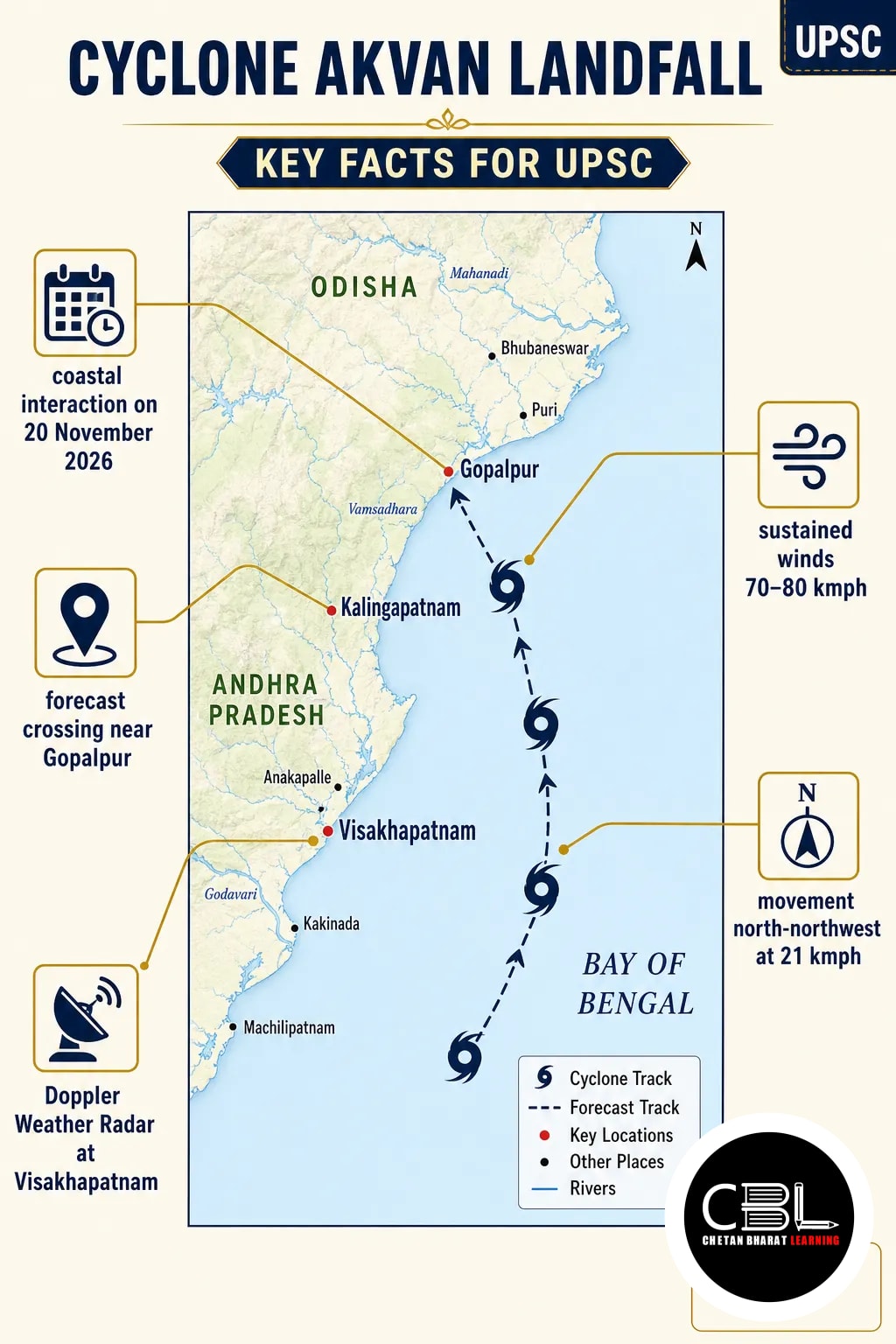
Cyclone Akvan landfall entered a new stage as its cloud mass began interacting with the north Andhra Pradesh–south Odisha coast. Unlike the earlier forecast coverage, the latest update records this coastal interaction; explore more geography and environment updates.
Quick answer: Cyclone Akvan landfall began with coastal interaction on 20 November 2026, according to the India Meteorological Department (IMD). The storm had weakened from a severe cyclonic storm. IMD forecast a crossing near Gopalpur, Odisha, with sustained winds of 70–80 kmph, gusting to 90 kmph.
Where was Akvan located?
Akvan lay over the westcentral Bay of Bengal at 2:30 am Indian Standard Time on 20 November. The following figures describe that position and the forecast, not a confirmed completed crossing.
| Feature | IMD update |
|---|---|
| Coordinates | 17.7°N, 84.9°E |
| Position from Gopalpur | 170 km south |
| Position from Kalingapatnam | 110 km southeast |
| Movement | North-northwest at 21 kmph over the preceding six hours |
| Forecast crossing | Near Gopalpur by the forenoon of 20 November |
What is the latest landfall update?
IMD said satellite imagery showed Akvan’s sheared cloud mass entering the coastal region. However, its bulletin described the crossing near Gopalpur as a forecast; it did not confirm that the crossing had finished.
Earlier, the system weakened from a severe cyclonic storm into a cyclonic storm. IMD forecast maximum sustained winds of 70–80 kmph at crossing, with gusts up to 90 kmph.
How long could the process last?
The Cyclone Akvan landfall process could stretch over seven to eight hours, according to Manorama Mohanty, Director of the Bhubaneswar Meteorological Centre. Meanwhile, coastal Odisha districts had begun receiving heavy rain.
IMD also monitored the system continuously using Doppler Weather Radar at Visakhapatnam and Gopalpur. For the preceding stage, see the Akvan forecast and background.
Why does the update matter for UPSC?
The update connects coastal geography with cyclone tracking and disaster preparedness. For example, aspirants should distinguish the storm’s movement speed from its forecast sustained wind speed.
In addition, the onset of land interaction is not the same as confirmation of a completed crossing. Tropical cyclones draw energy from warm ocean waters; therefore, sea-surface conditions are important to their development.
Source: The Hindu, 20 November 2026
- Cyclone Akvan: IMD Forecast and UPSC Facts (16 Nov 2026)
Asked in UPSC: Previous Year Questions
- UPSC CSE Mains 2024 (GS Paper I): What is sea surface temperature rise? How does it affect the formation of tropical cyclones?
- UPSC CSE Mains 2022 (GS Paper I): Discuss the meaning of IMD’s colour-coded weather warnings for cyclone-prone areas.
- UPSC CSE Prelims 2020 (GS Paper I): Consider statements on the hemispheric occurrence of jet streams, cyclone eyes, and the temperature inside a cyclone’s eye.
UPSC tests cyclone formation, structure and warning systems; therefore, revise these alongside the news.
State PCS General Studies can test cyclone terminology, coastal locations and weather-monitoring institutions. In addition, disaster-management questions may examine how authorities use forecasts for preparedness.
Prelims Practice Corner
Mains Practice Questions
Frequently Asked Questions
Where was Cyclone Akvan expected to cross the coast?
Near Gopalpur in Odisha, according to IMD’s forecast. The bulletin expected a crossing by the forenoon of 20 November 2026.
Had Akvan completed its crossing in the latest update?
No, the update confirmed coastal interaction, not a completed crossing. IMD therefore described the crossing near Gopalpur as a forecast.
How long could the landfall process take?
Seven to eight hours, according to meteorologist Manorama Mohanty. Meanwhile, coastal Odisha districts had begun receiving heavy rain.
Related Current Affairs
Preparing for UPSC, PCS or HCS?
Talk to a mentor at Chetan Bharat Learning, Chandigarh. Free guidance on choosing the right exam and building a study plan.
Chat on WhatsAppCall 97793 53345UPSC / IAS / PCS coaching in Chandigarh · Trusted by aspirants across Punjab & Haryana









Leave a Reply
You must be logged in to post a comment.