
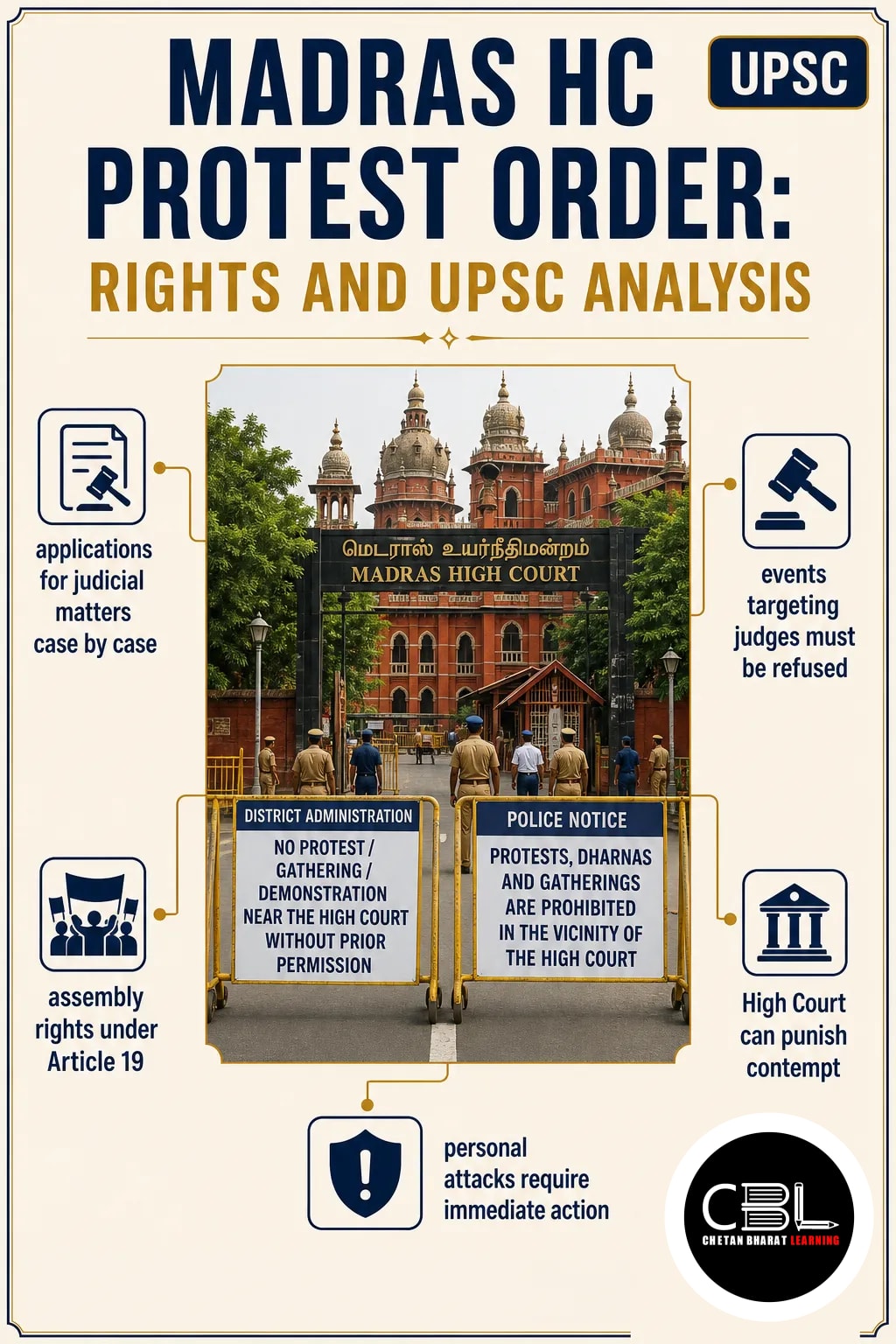
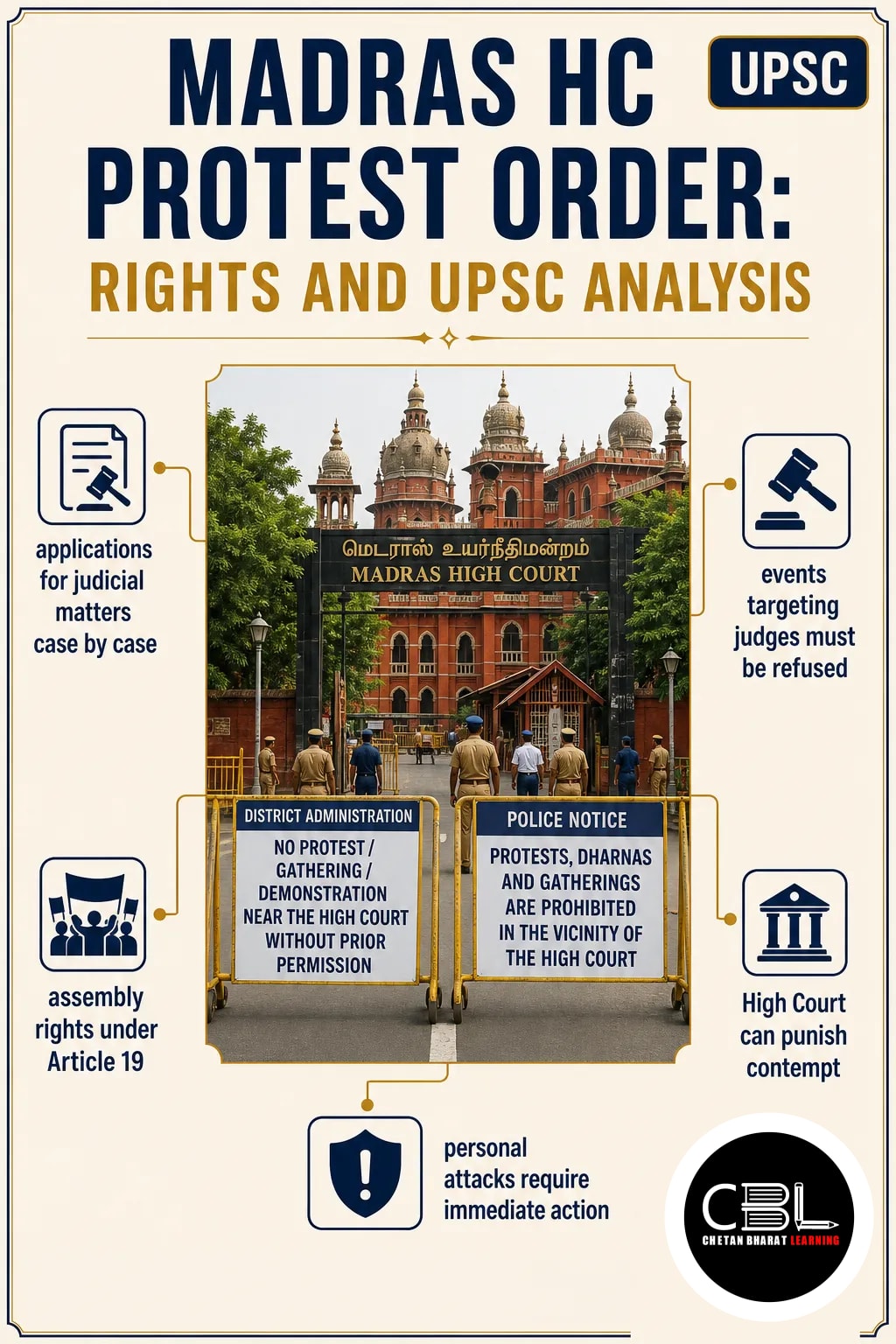
Madras HC protest order directs Tamil Nadu police to scrutinise gatherings concerning judicial matters. This follow-up examines the case-by-case permission test and response to personal attacks, alongside CBL’s earlier report on the order. For wider context, see polity current affairs.
Quick answer: On 30 October 2026, the Madras HC protest order directed Tamil Nadu police not to permit gatherings or marches intended to personally target or intimidate sitting judges. The court acted on a public interest petition alleging personal attacks against Justice G.R. Swaminathan after a reservation ruling.
What did the Court direct?
The court directed officials to assess applications concerning judicial matters individually and refuse events intended to target or intimidate sitting judges. Chief Justice Sushrut Arvind Dharmadhikari and Justice G. Arul Murugan issued the directions while disposing of a public interest litigation (PIL).
- Before an event: Police and district authorities must evaluate applications for meetings, marches and protests on a strict case-to-case basis.
- Legal powers: The bench referred to powers under the Bharatiya Nagarik Suraksha Sanhita (BNSS) and the local Police Act.
- During an event: If a permitted assembly turns into a personal attack on judges, officers must end it immediately and take appropriate legal action.
However, the reported directions should not be read as a blanket ban on discussing judgments. The distinction between criticism and intimidation remains central to their application.
What was the background of the case?
Chennai resident R. Karthikeyan filed the PIL seeking action against activities he alleged scandalised or intimidated the judiciary. He also sought guidelines for permission to hold events related to judicial proceedings.
The petitioner referred to protests by Tamil Nadu Thowheed Jamaath and Tamil Nadu Muslim Munnetra Kazhagam. These followed a ruling by a bench led by Justice G.R. Swaminathan that converted Muslims were not entitled to reservations.
In addition, the petitioner sought preventive and penal measures from the Union Ministry of Home Affairs, the State government and the Director General of Police. His requests covered public events, speeches and social media publications. The source reports the petitioner’s demands; it does not establish that the court accepted every demand.
Which constitutional and legal provisions matter?
The dispute brings free expression and peaceful assembly into conversation with judicial independence and lawful restrictions.
| Provision | What it says |
|---|---|
| Article 19(1)(a) | Protects citizens’ freedom of speech and expression. |
| Article 19(1)(b) | Protects citizens’ right to assemble peacefully and without arms. |
| Articles 19(2) and 19(3) | Permit reasonable restrictions by law on specified grounds; the grounds differ for speech and assembly. |
| Article 215 | Makes every High Court a court of record with power to punish for contempt of itself. |
| Article 226 | Empowers High Courts to issue writs for fundamental rights and other purposes. |
| BNSS and local Police Act | The bench referred to powers under these laws for case-by-case assessment. |
For example, Article 19(2) includes contempt of court and public order among grounds for speech restrictions. Article 19(3), meanwhile, covers public order and the sovereignty and integrity of India for assembly restrictions.
What are the implications for rights and policing?
The Madras HC protest order requires authorities to protect judges from intimidation while assessing each proposed event separately.
Judicial independence and public scrutiny
Judges must decide cases without intimidation. Therefore, preventing targeted threats can support independent adjudication and public confidence in courts.
However, judicial decisions also affect public policy and rights. Citizens may debate their reasoning; criticism of a judgment should not automatically be equated with a personal attack on its author.
Permission and enforcement
A case-by-case test requires officials to examine the proposed event rather than rely solely on its subject. Similarly, a permitted gathering may require a different response if participants subsequently make personal attacks.
Ending an event affects participants who may be protesting peacefully. Therefore, enforcement decisions should identify the conduct prompting intervention and the legal basis for action. For a related rights issue, see CBL’s analysis of rally restrictions.
What concerns and safeguards arise?
The main concern is that broad or inconsistent application could deter legitimate discussion of judicial decisions.
- Unclear boundaries: Officials must distinguish criticism of judicial reasoning from conduct aimed at personally targeting or intimidating a judge.
- Discretion: Different districts may assess similar applications differently; therefore, recorded reasons matter.
- Collective impact: Ending an entire gathering can affect peaceful participants, so officials should assess the circumstances carefully.
- Accountability: A refusal or police action should rest on applicable law and remain open to judicial scrutiny.
As a governance response, authorities could maintain written assessments, communicate permission decisions promptly and train personnel to recognise the distinction between criticism and intimidation. These are analytical safeguards, not additional directions attributed to the court.
Source: The Hindu, 30 October 2026
- Madras High Court Judges: Protest Order for UPSC (30 Oct 2026)
Punjab PCS and Haryana HCS General Studies can test Articles 19 and 215 alongside the role of district authorities in managing assemblies. Also revise the difference between peaceful criticism of judgments and intimidation of judges.
Prelims Practice Corner
Mains Practice Questions
Frequently Asked Questions
What does the Madras HC protest order say?
It directs authorities not to permit gatherings or marches intended to personally target or intimidate sitting judges. Moreover, officials must assess applications concerning judicial matters case by case.
Does the order ban criticism of court judgments?
No, the reported directions do not impose a blanket ban on criticism of judgments. Instead, they address intended personal targeting or intimidation and personal attacks at permitted assemblies.
Which constitutional articles protect speech and assembly?
Articles 19(1)(a) and 19(1)(b) protect citizens’ speech and peaceful assembly, respectively. However, Articles 19(2) and 19(3) allow reasonable restrictions by law on specified grounds.
Who filed the petition before the Madras High Court?
R. Karthikeyan of Chennai filed the public interest litigation. He also sought measures against activities he alleged intimidated or undermined the judiciary.
Related Current Affairs
Preparing for UPSC, PCS or HCS?
Talk to a mentor at Chetan Bharat Learning, Chandigarh. Free guidance on choosing the right exam and building a study plan.
Chat on WhatsAppCall 97793 53345UPSC / IAS / PCS coaching in Chandigarh · Trusted by aspirants across Punjab & Haryana
Leave a Reply
You must be logged in to post a comment.