

UPSC Mapping
| Prelims | Mains |
|---|---|
| GI Tags, Intellectual Property Rights and Agriculture | GS Paper III – Intellectual Property Rights and Agricultural Exports |
Quick Facts
| GI Class | Class 30 (Spices) |
|---|---|
| Region | North Gujarat |
| Trading Hub | Unjha, Mehsana |
| Key Law | Geographical Indications of Goods Act, 1999 |
What is Geographical Indication?
Geographical Indication (GI) is an intellectual property right that identifies goods as originating from a specific geographical region where their quality, reputation or other characteristics are essentially attributable to that place of origin. In India, GI registration is governed by the Geographical Indications of Goods (Registration and Protection) Act, 1999.
A GI tag protects traditional products from misuse, enhances market recognition and supports rural livelihoods by linking products with their geographical identity.
Why is Geographical Indication in News?
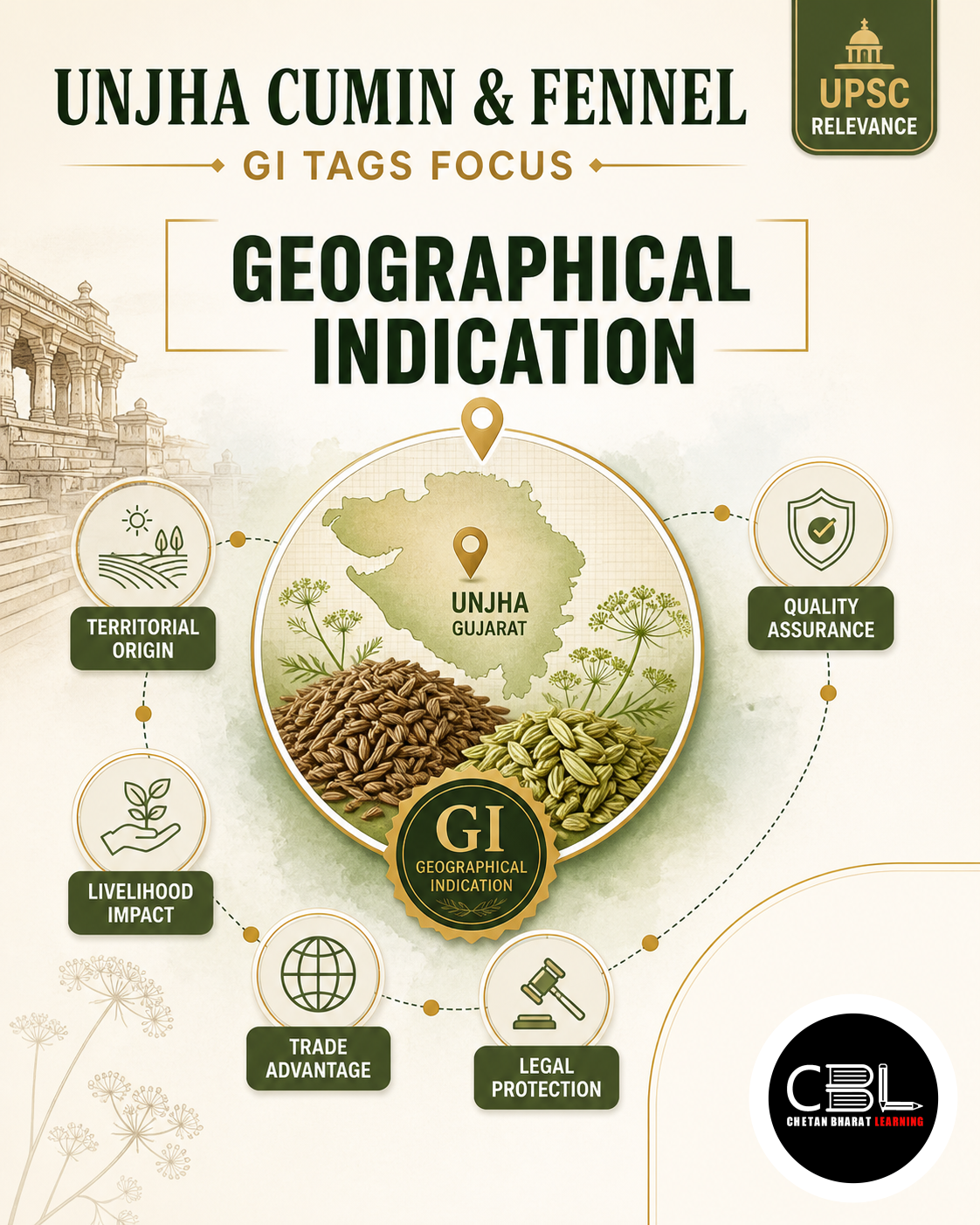
GI status was granted to Unjha Cumin (Jeera) and Unjha Fennel (Saunf) from North Gujarat under Class 30 for spices. This decision has triggered legal objections from farmers in western Rajasthan, who argue that GI protection should recognise genuine cultivation regions instead of trading and processing centres.
Key Features of Unjha Cumin and Unjha Fennel
- Unjha Cumin: Small, greyish-brown split seeds with a strong aroma and high essential oil concentration; thrives in the well-drained sandy-loam soils and dry arid climate of North Gujarat.
- Unjha Fennel: Elongated greenish seeds with a naturally sweet flavour due to high anethole oil content; the annual herb can grow up to six feet in height.
- Premium quality: Both spices enjoy strong domestic and international demand because of their distinctive quality.
- Export importance: Gujarat contributes nearly 80% of India’s seed-spice exports.
Significance of the GI Tag
- Protects authenticity: Prevents misuse of the product name by unauthorised producers.
- Improves market value: Enhances branding and consumer confidence.
- Supports farmers: Creates opportunities for premium pricing and export competitiveness.
- Promotes regional identity: Recognises products linked to unique geographical conditions.
- Boosts rural economy: Encourages value addition and agricultural entrepreneurship.
Legal Conflict
- Cultivation versus trade: Farmers argue that GI protection should be granted to genuine cultivation regions rather than trading and processing hubs.
- Reference to the GI Act: The objection is based on the provisions of the Geographical Indications of Goods Act, 1999.
- Regional claims: The dispute highlights challenges in defining geographical boundaries for agricultural products.
- Producer interests: Competing producer groups seek recognition of their contribution to cultivation.
About Unjha
Unjha, located in the Mehsana district of Gujarat, is recognised as Asia’s largest trading hub for seed spices. The town plays a central role in marketing cumin, fennel and other spices produced across western India. Its well-developed trading ecosystem contributes significantly to India’s spice exports and agricultural value chains.
Way Forward
A transparent scientific assessment of geographical characteristics, cultivation practices and producer participation is essential for strengthening India’s GI ecosystem. Effective enforcement can improve consumer confidence while protecting the interests of genuine producers. Promoting awareness, improving traceability and expanding export branding will enhance the value of GI products in domestic and international markets.
Prelims Practice Corner
- Q1. Geographical Indications in India are governed by: (a) Patents Act, 1970 (b) Copyright Act, 1957 (c) Geographical Indications of Goods Act, 1999 (d) Trade Marks Act, 1999
Answer: (c) Geographical Indications of Goods (Registration and Protection) Act, 1999. - Q2. Unjha is located in which district of Gujarat? (a) Banaskantha (b) Kutch (c) Mehsana (d) Rajkot
Answer: (c) Mehsana. - Q3. Unjha Cumin received GI registration under which class? (a) Class 29 (b) Class 30 (c) Class 31 (d) Class 32
Answer: (b) Class 30. - Q4. The characteristic sweet flavour of Unjha Fennel is mainly due to: (a) Curcumin (b) Piperine (c) Anethole (d) Capsaicin
Answer: (c) Anethole. - Q5. Gujarat contributes approximately what share of India’s seed-spice exports? (a) 40% (b) 60% (c) 80% (d) 95%
Answer: (c) Nearly 80%.
Mains Practice Questions
-
Q1. Discuss the significance of Geographical Indications in promoting agricultural exports, protecting traditional knowledge and improving farmers’ incomes. (10 marks)
Answer Structure
- Intro: Define Geographical Indications.
- Body: Legal framework, economic benefits, export potential, challenges and recent examples.
- Conclusion: Emphasise stronger protection and branding of GI products.
-
Q2. Examine the challenges involved in granting Geographical Indications to agricultural products with overlapping cultivation regions. (15 marks)
Answer Structure
- Intro: Explain the purpose of GI protection.
- Body: Boundary disputes, producer interests, legal issues and policy considerations.
- Conclusion: Highlight evidence-based and inclusive GI governance.
FAQs on Geographical Indication
What is a Geographical Indication?
A Geographical Indication is an intellectual property right identifying products whose quality, reputation or characteristics are linked to a specific geographical origin.
Why are Unjha Cumin and Unjha Fennel important?
They recently received GI protection under Class 30 for spices, recognising their distinctive characteristics associated with North Gujarat.
Why are GI tags important for UPSC?
GI tags are frequently asked in UPSC Prelims under intellectual property rights, agriculture, geography and current affairs.
Related Current Affairs
Preparing for UPSC, PCS or HCS?
Talk to a mentor at Chetan Bharat Learning, Chandigarh. Free guidance on choosing the right exam and building a study plan.
Chat on WhatsAppCall 97793 53345UPSC / IAS / PCS coaching in Chandigarh · Trusted by aspirants across Punjab & Haryana
Leave a Reply
You must be logged in to post a comment.