
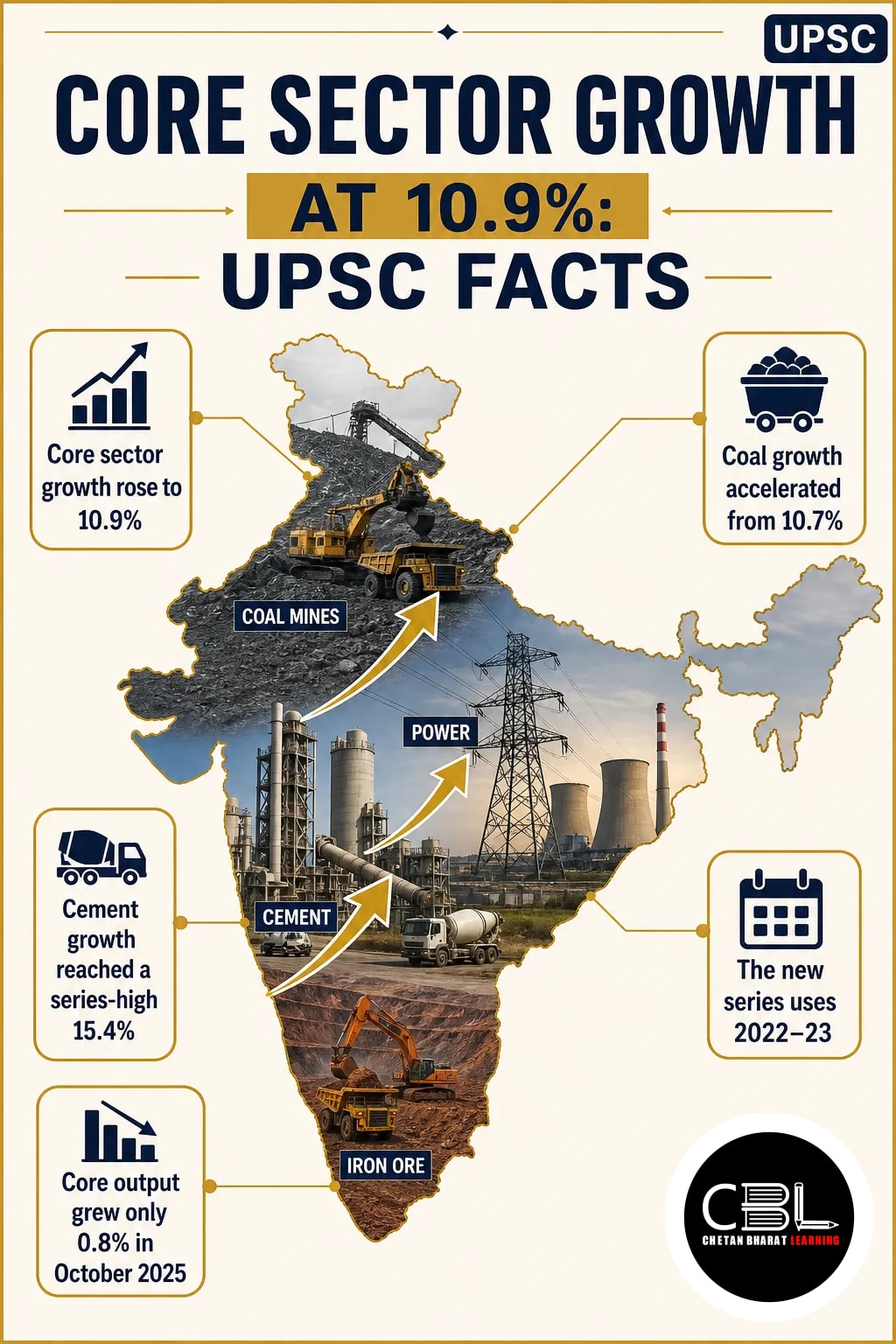
Core sector growth reached a series-high 10.9% in October 2026, according to data released by the Ministry of Commerce and Industry. For more context, explore economy current affairs.
Quick answer: India’s core sector growth rose to 10.9% in October 2026 from 8.2% in September, official data released on 20 November showed. Coal, electricity, cement and iron ore contributed to the rise. However, the weak comparison base of October 2025 also boosted the annual growth rate.
October 2026: sector-wise growth
Iron ore, coal, electricity and cement recorded the strongest growth rates among the sectors listed below. In contrast, crude oil and natural gas output contracted.
| Sector | October 2026 growth |
|---|---|
| Iron ore | 23.4% |
| Coal | 23.05% |
| Electricity | 21.6% |
| Cement | 15.4% |
| Steel | 7.3% |
| Refinery products | 3.4% |
| Crude oil | −4.1% |
| Natural gas | −7.6% |
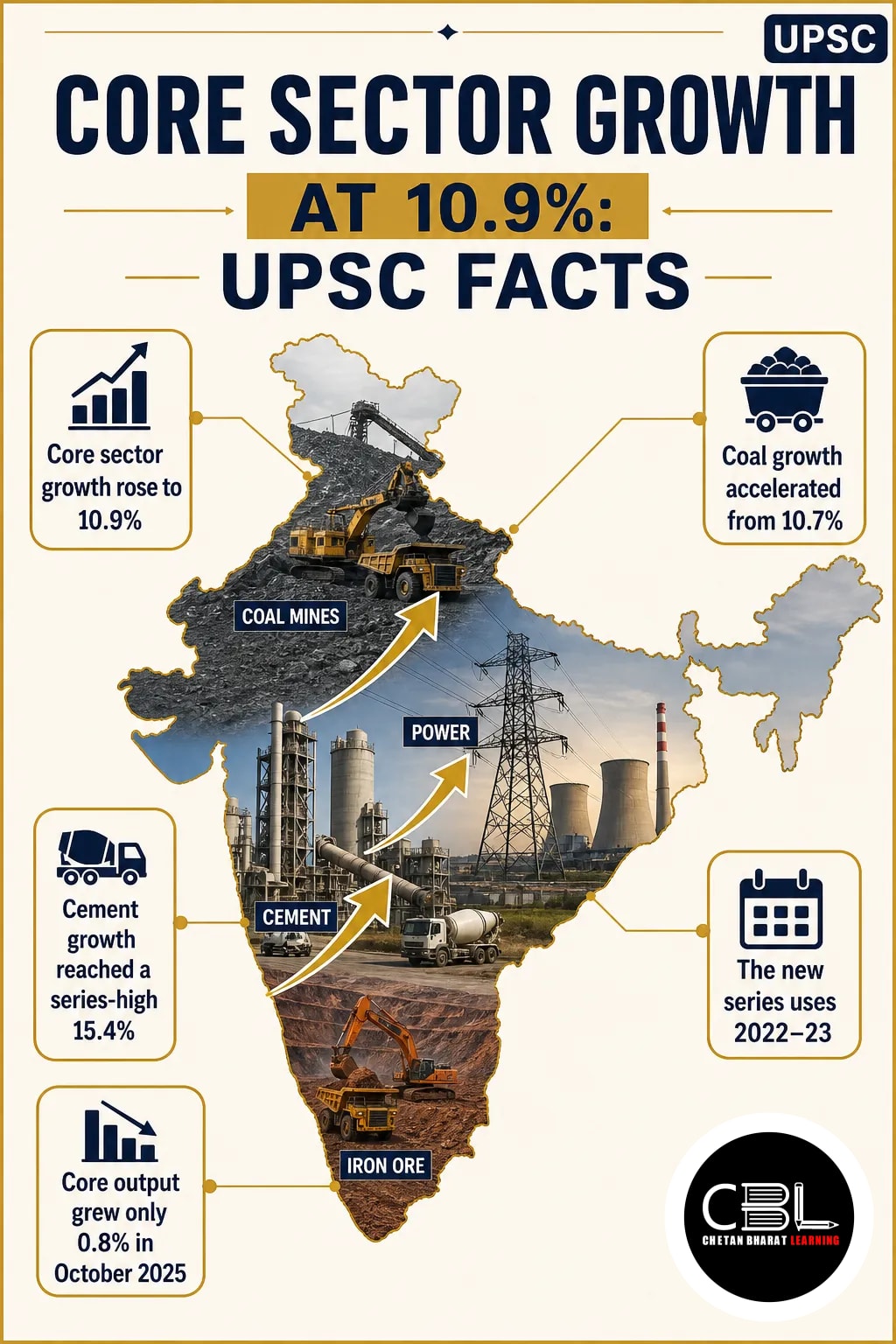
Coal growth accelerated from 10.7% in September. Meanwhile, Coal India reported October production of 67.2 million tonnes, up about 19%. Read also about the coal mine star rating.
Cement growth reached a series-high 15.4%, while steel growth was its fastest in seven months. In contrast, crude oil contracted for the 22nd consecutive month and natural gas for the 28th. For related context, see India’s October crude import bill.
What is the Index of Core Industries?
The Index of Core Industries tracks output in selected industries important to the economy. The Ministry of Commerce and Industry releases its data.
The new series uses 2022–23 as its base year and has data from April 2024 onwards. Therefore, October’s 10.9% is a record within this series, not necessarily across all earlier series.
How did the low-base effect influence the figures?
A low-base effect can raise a growth rate when output in the comparison period was unusually weak. Thus, a high percentage increase does not by itself establish an equally strong underlying improvement.
Core output grew only 0.8% in October 2025. Coal contracted 8.4% and electricity nearly 7% in that month; consequently, their October 2026 rates benefited from a weak comparison base.
By contrast, iron ore and cement had grown 8.7% and 5.2%, respectively, in October 2025. Their 2026 growth therefore came without the same low-base support.
Why does this reading matter?
Core sector growth offers a snapshot of production across key industries, but its headline rate needs context. In particular, a shift in the festive calendar affects year-on-year comparisons.
ICRA chief economist Aditi Nayar suggested examining the October–November average to adjust for festive base effects. Meanwhile, the contractions in crude oil and natural gas show that performance was uneven.
Source: The Hindu, 21 November 2026
- Coal Mine Star Rating: 50 Mines Awarded Five Stars (3 Nov 2026)
Punjab PCS and Haryana HCS General Studies can test the index’s base year, releasing ministry and sector-wise trends. Also revise how a low comparison base affects growth rates.
Prelims Practice Corner
Mains Practice Questions
Frequently Asked Questions
What was core sector growth in October 2026?
It was 10.9%, the highest rate in the new series. In comparison, September growth stood at 8.2%.
Which ministry releases the Index of Core Industries?
The Ministry of Commerce and Industry releases the index data. Its new series uses 2022–23 as the base year.
What is the low-base effect in growth data?
It is the upward influence of a weak comparison-period value on a percentage growth rate. For example, core output grew just 0.8% in October 2025.
Related Current Affairs
Preparing for UPSC, PCS or HCS?
Talk to a mentor at Chetan Bharat Learning, Chandigarh. Free guidance on choosing the right exam and building a study plan.
Chat on WhatsAppCall 97793 53345UPSC / IAS / PCS coaching in Chandigarh · Trusted by aspirants across Punjab & Haryana






Leave a Reply
You must be logged in to post a comment.