
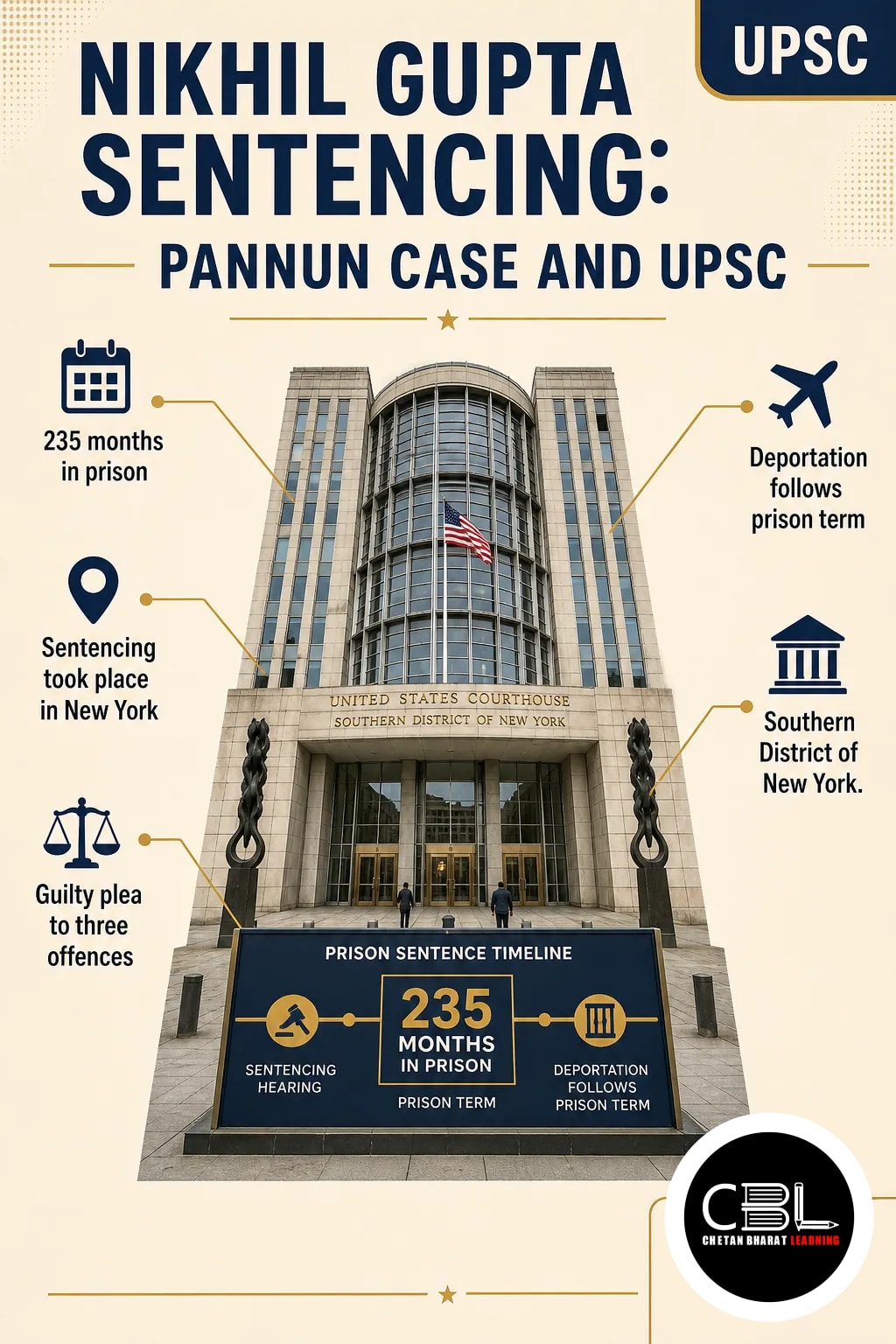
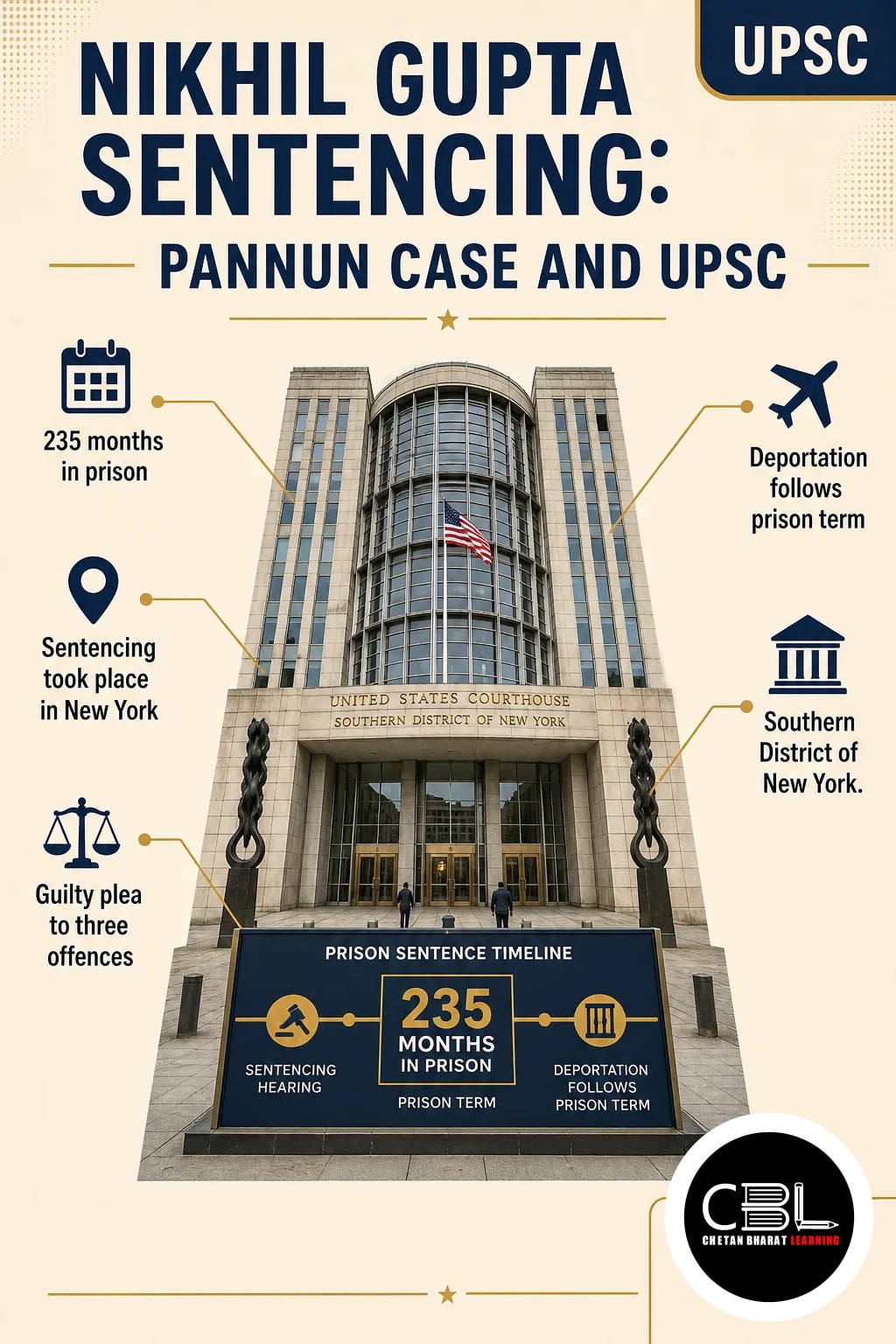
Nikhil Gupta sentencing marks a new stage in the Pannun plot case: a United States court has imposed a prison term following Gupta’s earlier guilty plea. For the wider context, explore CBL’s international relations coverage.
Quick answer: In the Nikhil Gupta sentencing, Judge Victor Marrero imposed 235 months in prison on 20 November 2026 in New York. Gupta had pleaded guilty to three offences linked to a plot to murder Gurpatwant Singh Pannun. The judge said deportation and removal proceedings would follow completion of the prison term.
What did the court decide?
The court sentenced Indian national Nikhil Gupta to 235 months in prison for his role in the plot. Judge Marrero announced the sentence after a hearing lasting almost 80 minutes.
The judge imposed no term of supervised release. Instead, he said Gupta would face deportation and removal proceedings after completing the prison term. That direction concerns a future legal process; it does not itself establish its outcome.
Gupta apologised during a roughly six-minute statement in court. His defence lawyers later expressed disappointment and said they had sought a shorter term.
What is the background of the Pannun case?
The case concerns efforts to murder Khalistani separatist Gurpatwant Singh Pannun in New York. Earlier in 2026, Gupta pleaded guilty to three offences connected with the plot.
| Event | Key fact |
|---|---|
| Guilty plea | Gupta pleaded guilty earlier in 2026 to murder-for-hire, conspiracy to commit murder-for-hire and conspiracy to commit money laundering. |
| Sentencing hearing | On 20 November 2026, Judge Marrero imposed a 235-month prison term in New York. |
| After imprisonment | The judge said deportation and removal proceedings would follow completion of the term. |
Pannun also addressed the hearing. He said the threat had prevented him from carrying on his regular legal practice for over 1,200 days. This was his statement to the court, rather than a separate finding established in the source.
Which legal concepts should aspirants distinguish?
The Nikhil Gupta sentencing illustrates the difference between a guilty plea, punishment and a subsequent immigration process. Indian constitutional provisions below are useful comparisons; they did not govern this United States court’s sentencing decision.
| Concept or provision | What to remember |
|---|---|
| Guilty plea and sentence | A guilty plea concerns the offences; sentencing determines the punishment imposed by the court. |
| Removal proceedings | These are distinct from the prison sentence. The judge said they would follow completion of Gupta’s term. |
| Article 21 of the Indian Constitution | It protects life and personal liberty against deprivation except according to procedure established by law. |
| Article 22 of the Indian Constitution | It provides safeguards concerning arrest and detention, subject to constitutional qualifications. |
Similarly, extradition concerns the surrender of a person by one state to another for prosecution or punishment. It should not be confused with deportation or removal. The supplied account does not establish an extradition history for this case.
Why does the case matter for India?
The case raises questions about criminal accountability and cooperation when an Indian national faces prosecution abroad.
- Territorial jurisdiction: The plot concerned an intended killing in New York; therefore, the proceedings highlight the role of the forum state’s criminal justice system.
- Diplomatic context: India and the United States must manage sensitive legal issues alongside their broader relationship. However, the sentence alone does not establish a change in bilateral policy.
- Protection and accountability: States need to protect people within their territory while ensuring that criminal allegations undergo judicial scrutiny.
- Cooperation across borders: Where evidence or persons are located in different countries, lawful cooperation can assist investigations. Its scope depends on applicable law and the facts of each case.
What are the concerns and the way forward?
The main challenge is to separate established court outcomes from wider claims that require independent evidence.
- Avoid over-attribution: Gupta’s guilty plea and sentence concern his individual criminal case; therefore, they should not automatically be treated as findings about other actors.
- Protect legal process: Authorities should use established legal channels and respect procedural safeguards. In addition, they should distinguish criminal proceedings from immigration proceedings.
- Preserve cooperation: Dialogue and evidence-based cooperation can address criminal justice concerns without assuming outcomes beyond the available record.
For a Mains answer, use the Nikhil Gupta sentencing as a case study rather than as proof of an unreported diplomatic development. Thus, connect the facts to jurisdiction, due process and bilateral cooperation, while clearly marking analytical possibilities as such.
Source: The Hindu, 21 November 2026
Punjab PCS and Haryana HCS may test the case under international relations and current affairs. Also revise the distinction between a criminal sentence and subsequent removal proceedings.
Prelims Practice Corner
Mains Practice Questions
Frequently Asked Questions
What sentence did Nikhil Gupta receive?
He received 235 months in prison. Judge Victor Marrero imposed the term in New York on 20 November 2026.
What offences did Gupta plead guilty to?
He pleaded guilty to murder-for-hire, conspiracy to commit murder-for-hire and conspiracy to commit money laundering. The offences related to efforts to murder Gurpatwant Singh Pannun in New York.
Will Gupta face removal proceedings?
Yes, the judge said deportation and removal proceedings would follow completion of his prison term. However, that statement does not determine the outcome of those proceedings.
Related Current Affairs
Preparing for UPSC, PCS or HCS?
Talk to a mentor at Chetan Bharat Learning, Chandigarh. Free guidance on choosing the right exam and building a study plan.
Chat on WhatsAppCall 97793 53345UPSC / IAS / PCS coaching in Chandigarh · Trusted by aspirants across Punjab & Haryana






Leave a Reply
You must be logged in to post a comment.