
UPSC Mapping
| Prelims | Income Tax, Finance Act 2026, UPI, REITs and InvITs |
|---|---|
| Mains | GS Paper III – Indian Economy, Taxation, Financial Sector and Investment |
Quick Facts
| Status | Passed by Lok Sabha |
|---|---|
| Objective | Economic stability and investment promotion |
| Key Laws | Finance Act 2026; Payment and Settlement Systems Act 2007 |
| Effective Date | 1 April 2026 for specified provisions |
What is Taxation Amendment Bill?
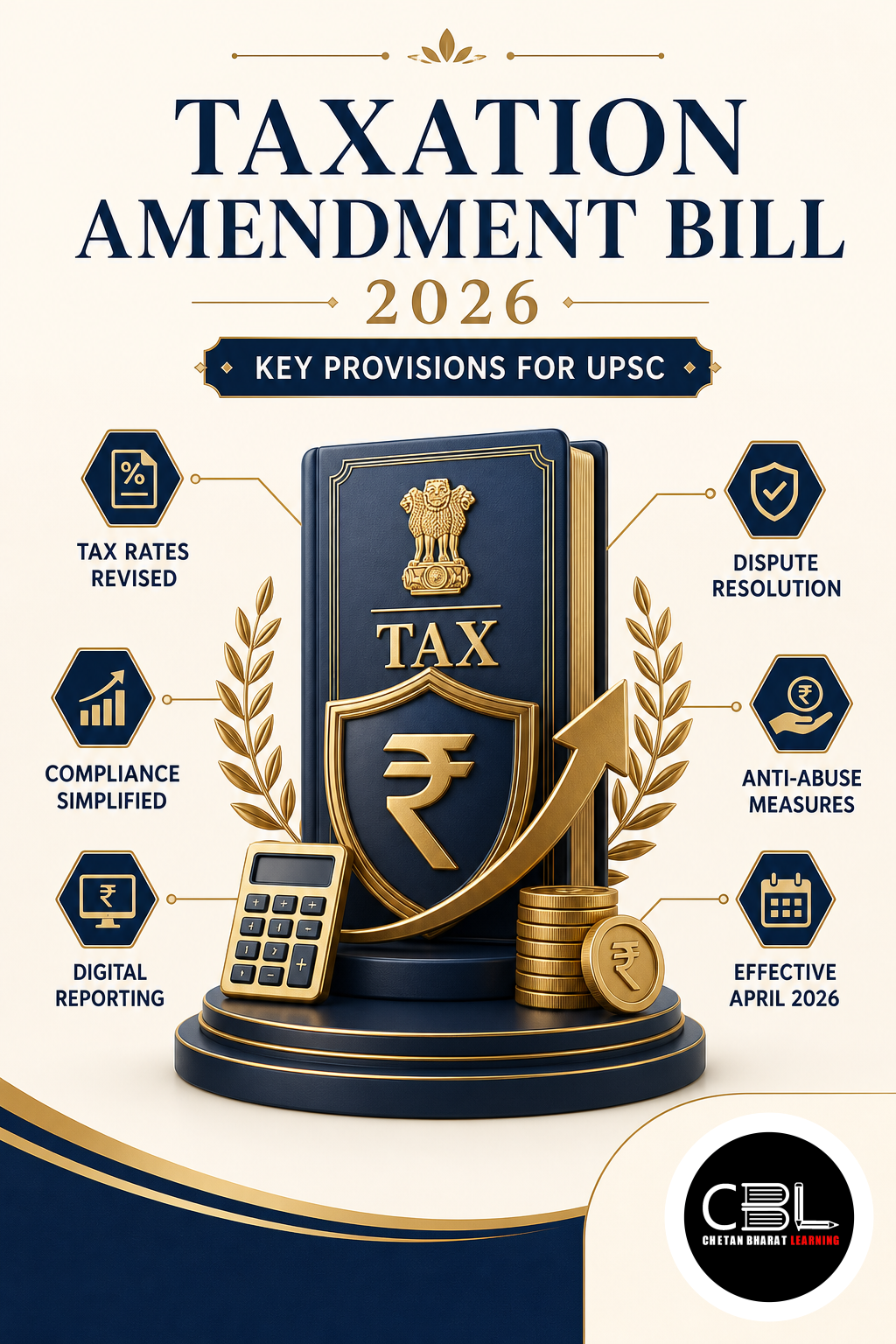
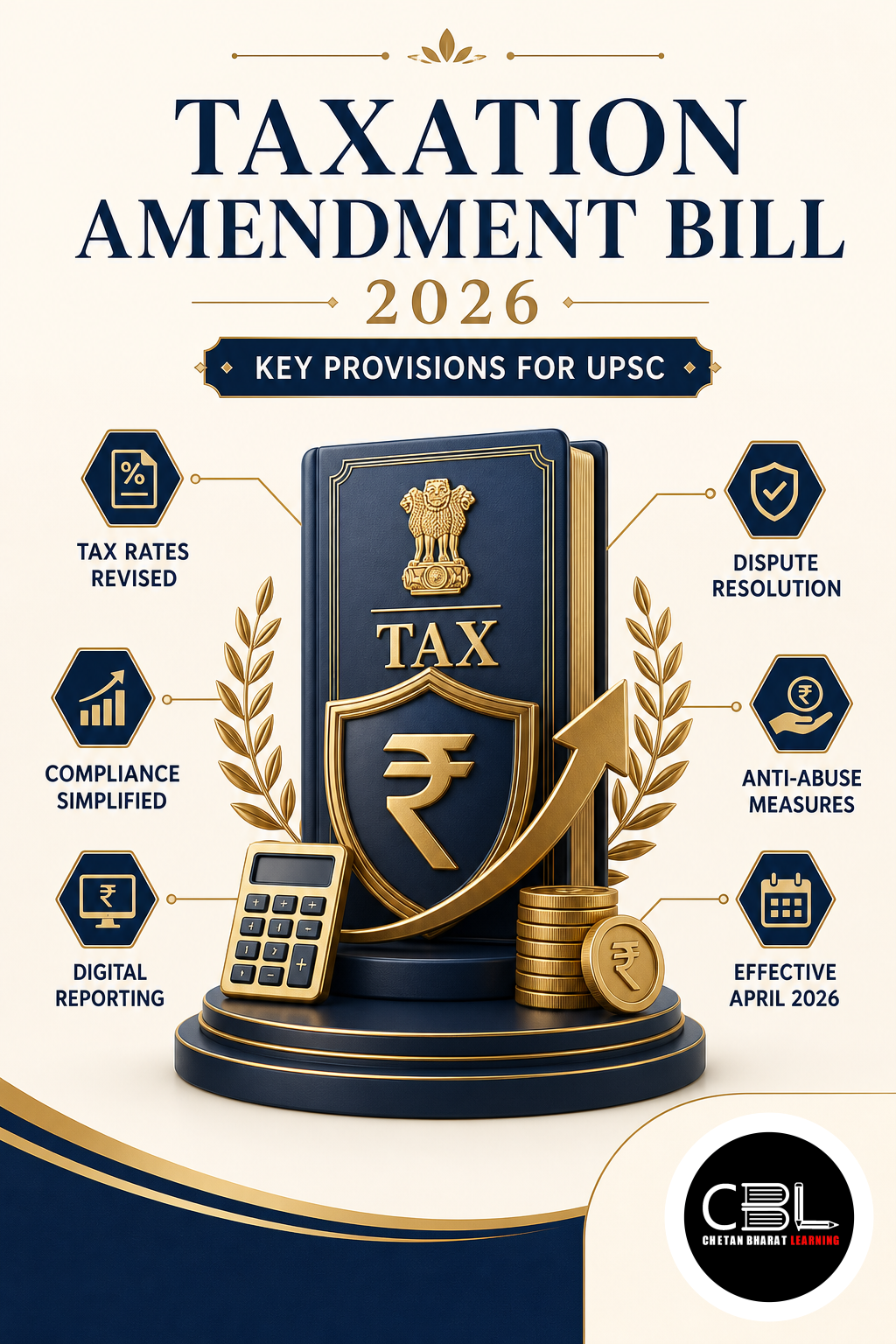
The Taxation Amendment Bill seeks to replace the Income-tax (Amendment) Ordinance, 2026, which was promulgated to mitigate the impact of external economic shocks and support domestic economic stability. The legislation also amends the Finance Act, 2026 and the Payment and Settlement Systems Act, 2007.
The Bill introduces targeted tax measures for foreign investors, investment funds, business trusts, data centres and selected industries. It also changes the legal framework governing charges on UPI and other notified electronic payment modes.
The measure therefore combines tax policy and financial-sector regulation. Its provisions are relevant to investment flows, business competitiveness, digital payments and the wider resilience of the Indian economy.
For UPSC aspirants, the Bill provides an example of how fiscal policy can be used alongside regulatory changes to respond to economic conditions. It also raises questions about revenue effects, investment incentives and the affordability of digital payments.
Why is Taxation Amendment Bill in News?
The Lok Sabha passed the Bill to replace the Income-tax (Amendment) Ordinance, 2026. The supplied material states that the legislation seeks to cushion the economy from external shocks while promoting investment and financial stability.
The Bill is significant because it does not focus on a single tax measure. It covers foreign institutional investment, offshore funds, business trusts, foreign companies operating in selected sectors, data-centre services and digital payment systems.
One major provision concerns Foreign Institutional Investors and the Bank for International Settlements. The Bill provides an income-tax exemption on interest earned from investments in Government securities with effect from 1 April 2026, replacing the earlier tax treatment described in the supplied material.
Another important provision concerns UPI. The Bill amends the Payment and Settlement Systems Act, 2007 to authorise the Government to permit banks and payment service providers to levy charges, including Merchant Discount Rate, on UPI and other notified electronic payment modes.
The development is relevant for UPSC because taxation influences investment decisions, while payment-system regulation affects financial inclusion and the digital economy. Candidates should therefore connect the issue with fiscal policy, capital flows, financial markets and digital payments.
Key Features
- Ordinance replacement: The legislation replaces the Income-tax (Amendment) Ordinance, 2026 and provides statutory backing to the relevant tax measures.
- Government securities: FIIs and the Bank for International Settlements receive income-tax exemption on interest from investments in Government securities from 1 April 2026.
- Foreign companies: Eligible foreign companies dealing in rough diamonds and supplying electronics components through bonded warehouses receive extended tax exemptions.
- Offshore funds: Conditions concerning minimum investors, corpus size, investor concentration and investment limits are relaxed for eligible investment funds.
- Business trusts: Changes are introduced for the concessional tax regime applicable to SPVs under REITs and InvITs, alongside an exemption for specified dividend income received by unit holders.
- Data centres: Tax exemptions for foreign companies procuring services from Indian data centres are expanded by removing notification requirements.
- Digital payments: The Payment and Settlement Systems Act is amended to permit the Government to authorise charges, including MDR, on UPI and other notified electronic payments.
Challenges
- Revenue implications: Tax exemptions may reduce immediate tax collections and require assessment of their wider economic returns.
- UPI costs: Allowing MDR could increase payment costs for merchants, particularly small businesses that depend heavily on digital transactions.
- Regulatory oversight: Relaxed conditions for offshore investment funds require effective monitoring to manage financial and regulatory risks.
- Tax neutrality: Concessions should promote investment without creating excessive distortions between domestic and foreign investors.
- Policy certainty: Long-term incentives require predictable implementation so that businesses can make investment decisions with greater confidence.
Way Forward
The Taxation Amendment Bill seeks to improve India’s investment environment through targeted tax changes while strengthening the legal framework for selected financial activities. Its success will depend on transparent administration, policy stability and effective regulatory oversight.
Tax incentives should be periodically assessed against their economic objectives. Measures designed to attract foreign capital should ideally contribute to productive investment, employment, technology transfer or deeper financial markets rather than merely encouraging short-term flows.
For digital payments, the regulatory framework should balance the sustainability of payment providers with the affordability of transactions. Small merchants and financial inclusion should remain important considerations when charges are permitted or structured.
Investment-fund reforms should be accompanied by robust monitoring. Regulatory authorities need sufficient information and supervisory capacity to identify emerging risks while avoiding unnecessary barriers to legitimate investment.
The taxation system should also maintain predictability. Clear rules, timely guidance and consistent implementation can reduce uncertainty for businesses and improve the credibility of India’s investment environment.
The wider UPSC lesson is that fiscal policy operates through multiple channels. Taxation, investment, financial markets and digital infrastructure are increasingly interconnected within the modern Indian economy.
Prelims Practice Corner
Q1. The Taxation and Other Laws (Amendment) Bill, 2026 replaces which ordinance?
- a. Finance Ordinance, 2026
- b. Income-tax (Amendment) Ordinance, 2026
- c. GST Ordinance, 2026
- d. Customs Ordinance, 2026
Answer: Income-tax (Amendment) Ordinance, 2026
Q2. Which institutions receive income-tax exemption on interest earned from Government securities under the Bill?
- a. RBI and NABARD
- b. FIIs and BIS
- c. SIDBI and EXIM Bank
- d. SEBI and IRDAI
Answer: FIIs and BIS
Q3. The amendment to the Payment and Settlement Systems Act, 2007 relates to:
- a. GST collection
- b. UPI and notified electronic payment modes
- c. Customs duty
- d. Direct Benefit Transfer
Answer: UPI and notified electronic payment modes
Q4. Which investment vehicles are specifically mentioned under the business-trust reforms?
- a. Mutual Funds only
- b. REITs and InvITs
- c. Pension Funds only
- d. Sovereign Wealth Funds only
Answer: REITs and InvITs
Q5. Tax exemption for eligible foreign diamond and electronics companies has been extended until:
- a. 2031
- b. 2035
- c. 2041
- d. 2050
Answer: 2041
Mains Practice Questions
Q1. Examine the significance of the Taxation and Other Laws (Amendment) Bill, 2026 in promoting investment and economic stability. (10 Marks)
Answer Structure:
- Intro: Introduce the Bill as a legislative measure replacing the 2026 Income-tax Ordinance and supporting economic resilience.
- Body: Discuss tax relief for foreign investors, offshore funds, business trusts, data centres and selected industries, along with implications for investment and financial markets.
- Conclusion: Emphasise that predictable taxation and effective regulation are necessary for durable investment-led growth.
Q2. Discuss the implications of permitting Merchant Discount Rate on UPI and other electronic payment modes under the amended Payment and Settlement Systems Act, 2007. (15 Marks)
Answer Structure:
- Intro: Explain the amendment and its significance for India’s digital-payment ecosystem.
- Body: Examine payment-provider sustainability, merchant costs, small-business concerns, competition, financial inclusion and the potential effect on UPI adoption.
- Conclusion: Recommend a calibrated framework that balances payment-system sustainability with affordability and inclusive digitalisation.
FAQs on Taxation Amendment Bill
Why was the Taxation and Other Laws (Amendment) Bill, 2026 introduced?
The Bill replaces the Income-tax (Amendment) Ordinance, 2026 and provides statutory backing to measures intended to mitigate external economic shocks. It also seeks to support investment and domestic economic stability.
Which major laws are amended by the Bill?
The legislation amends the Finance Act, 2026 and the Payment and Settlement Systems Act, 2007, besides replacing the Income-tax (Amendment) Ordinance, 2026.
What is the key UPI-related amendment?
The amendment authorises the Government to permit banks and payment service providers to levy charges, including Merchant Discount Rate, on UPI and other notified electronic payment modes. Its implementation will determine the practical effect on merchants and consumers.
Related Current Affairs
Preparing for UPSC, PCS or HCS?
Talk to a mentor at Chetan Bharat Learning, Chandigarh. Free guidance on choosing the right exam and building a study plan.
Chat on WhatsAppCall 97793 53345UPSC / IAS / PCS coaching in Chandigarh · Trusted by aspirants across Punjab & Haryana
Leave a Reply
You must be logged in to post a comment.