

UPSC Mapping
| Prelims | Industrial parks, DPIIT, NICDC and infrastructure schemes |
|---|---|
| Mains | GS Paper III: Industry and Infrastructure; GS Paper II: Government Policies |
Article
What is the BHAVYA Scheme?
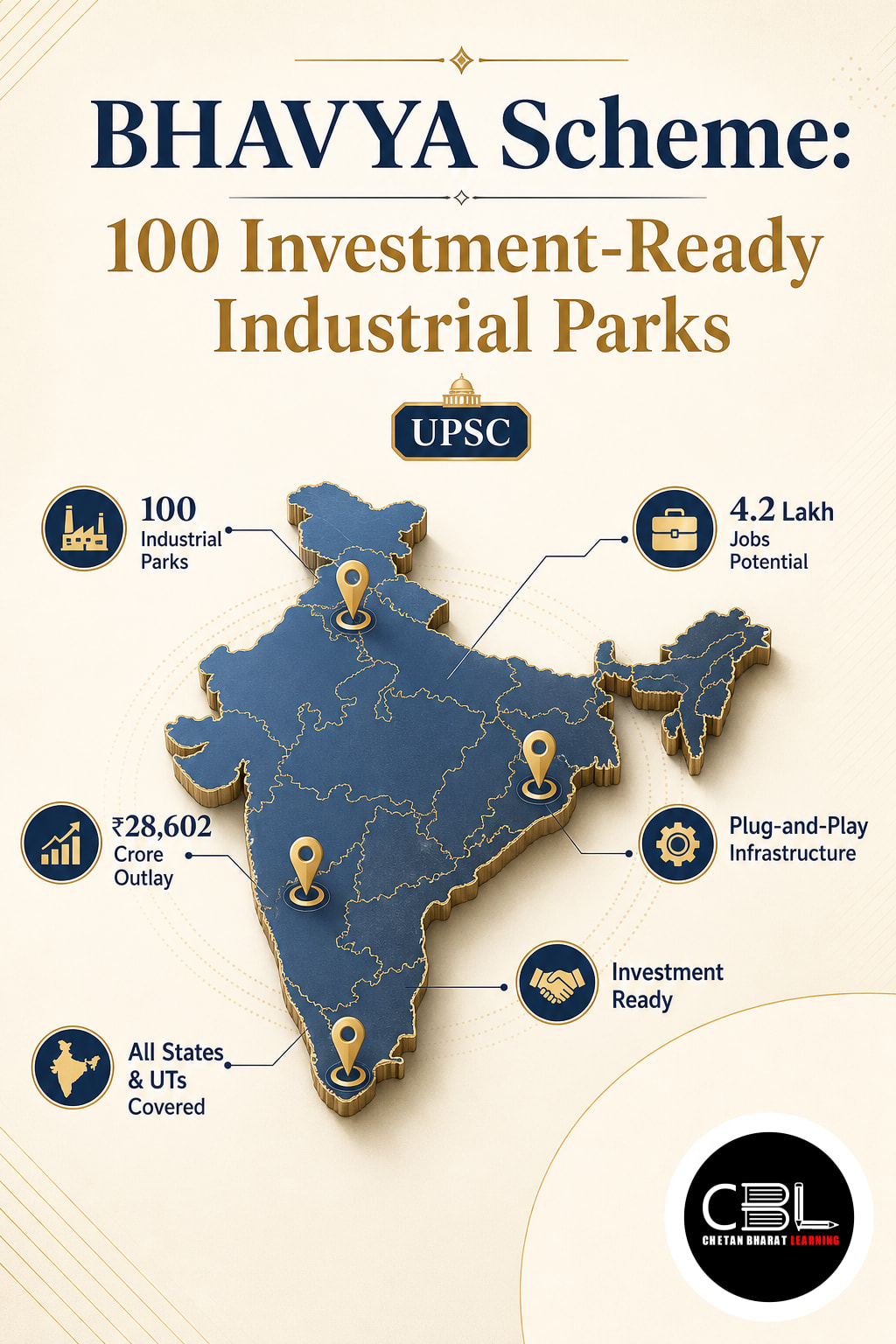
Bharat Audyogik Vikas Yojana is a Central Sector Scheme for developing investment-ready, plug-and-play industrial parks. It aims to strengthen manufacturing capacity, attract investment, support smaller enterprises and generate employment. The Union Cabinet approved the initiative in March 2026, followed by its notification on 10 April 2026.
A plug-and-play industrial park provides developed industrial land, dependable utilities and shared facilities before individual factories begin operations. Enterprises can concentrate on production instead of separately arranging roads, drainage, electricity and basic services. This approach seeks to reduce establishment delays and uncertainty over infrastructure availability.
Trunk infrastructure refers to networks serving several industrial units, such as main roads, water pipelines and power distribution. Shared testing facilities, warehousing and waste treatment can complement these networks. Their availability matters particularly for MSMEs, which often cannot independently finance such facilities.
Why in News?
A PIB backgrounder dated 14 October 2026 highlighted the initiative’s role in creating investment-ready manufacturing ecosystems. It outlined how industrial parks can combine modern infrastructure, reliable services and faster approvals. The programme targets 100 parks with a total outlay of ₹33,660 crore.
The recent discussion places industrial infrastructure within India’s wider effort to strengthen domestic supply chains and manufacturing competitiveness. Read the official October backgrounder for the policy context.
Key Features
- Investment-ready facilities: Developed plots, ready-built factory sheds, built-to-suit units and common services to accelerate manufacturing operations.
- Core infrastructure: Internal roads, power supply, water networks, drainage, common effluent treatment and ICT-enabled administration.
- Conditional financial assistance: Up to ₹1 crore per acre, subject to scheme conditions and provisions for government-led and private projects.
- External connectivity: Up to 25% of funding for road, rail and last-mile logistics connections.
- Worker amenities: Housing, healthcare, skill centres and other social facilities to improve welfare and productivity.
- Utility corridors: Underground networks for maintenance with fewer disruptions.
- Regulatory facilitation: Digital administration and single-window systems for predictable approvals.
Implementation and selection
The Department for Promotion of Industry and Internal Trade, under the Ministry of Commerce and Industry, oversees the programme. The National Industrial Corridor Development Corporation serves as its project management agency. Project-specific special purpose vehicles provide the structure for development and management.
The programme covers six financial years, from 2026–27 to 2031–32. Its first phase envisages competitive selection of up to 50 parks, while later phases work towards the overall target. The framework accommodates greenfield and eligible brownfield parks.
Evolution and economic significance
India’s policy has moved from industrial estates and SEZs towards integrated manufacturing locations. Industrial corridors connect production centres with logistics networks, utilities and urban services. The BHAVYA Scheme extends this emphasis on operational readiness nationwide.
Industrial parks and SEZs differ: parks provide infrastructure, whereas SEZs operate under a specific legal framework. Developing a park does not confer SEZ status automatically.
Shared facilities can lower entry barriers for MSMEs, reduce production interruptions and improve delivery schedules, depending on service quality and demand.
Challenges
- Land readiness: Unclear titles and inadequate consultation can delay projects.
- Demand mismatch: Parks may remain underused without credible investor interest.
- Last-mile gaps: External utility unreliability can negate good internal roads.
- Environmental pressures: Water stress and pollution risks require effective treatment systems.
- Maintenance financing: Sustainable service charges and competent management are essential post-construction.
- MSME affordability: High rents or charges can exclude smaller firms.
- Administrative coordination: Multiple agencies must align land, infrastructure and approvals.
Way Forward
Prioritise demand-led location selection, transparent land arrangements and realistic schedules. Use independent appraisal of investor interest, environmental capacity and connectivity. Phase development to match occupancy growth.
Park managers should set measurable standards for utility reliability, maintenance and investor services. Transparent charges and suitable spaces improve SME access. Include worker accommodation, safe transport and skilling facilities in planning.
Monitor occupied industrial space, functioning enterprises and employment alongside construction. Public reporting clarifies whether assets support productive activity.
Prelims Practice Corner
-
Q1. What is the principal objective of Bharat Audyogik Vikas Yojana?
(a) Developing 100 plug-and-play industrial parks (b) Replacing all SEZs (c) Providing universal farm subsidies (d) Establishing only export-processing ports
Answer: The initiative targets 100 investment-ready industrial parks across India. -
Q2. Which department oversees the initiative?
(a) Department of Revenue (b) Department for Promotion of Industry and Internal Trade (c) Department of Agriculture and Farmers Welfare (d) Department of Telecommunications
Answer: DPIIT under the Ministry of Commerce and Industry. -
Q3. Consider the statements: 1. Trunk infrastructure serves multiple units. 2. A plug-and-play park automatically receives SEZ status. Which is correct?
(a) 1 only (b) 2 only (c) Both 1 and 2 (d) Neither 1 nor 2
Answer: (a) Only trunk infrastructure serves multiple units; SEZ status requires a separate process. -
Q4. Which organisation serves as the project management agency?
(a) RBI (b) National Industrial Corridor Development Corporation (c) SEBI (d) FCI
Answer: (b) NICDC supports implementation and monitoring. -
Q5. What is the scheduled implementation period?
(a) FY 2024–25 to 2026–27 (b) FY 2026–27 to 2031–32 (c) FY 2030–31 to 2040–41 (d) FY 2025–26 only
Answer: (b) The programme spans FY 2026–27 to 2031–32.
Mains Practice Questions
-
Q1. Explain how plug-and-play industrial parks can improve manufacturing competitiveness in India. Discuss the implementation challenges. (15 marks)
Answer Structure
Intro: Define investment-ready industrial ecosystems and introduce the national park-development initiative.
Body: Explain shared utilities, MSME access, logistics and approval facilitation; assess land readiness, investor demand, environmental safeguards and maintenance.
Conclusion: Recommend demand-led development with accountable management and measurable industrial outcomes.
-
Q2. Industrial infrastructure development requires coordination beyond the construction of factory spaces. Discuss with reference to state governance. (10 marks)
Answer Structure
Intro: Present industrial parks as integrated economic and administrative ecosystems.
Body: Examine external connectivity, utility agencies, pollution regulation, worker housing, skilling and coordination through project SPVs.
Conclusion: Emphasise cooperative federalism and long-term service delivery.
Frequently Asked Questions
What does BHAVYA stand for?
BHAVYA stands for Bharat Audyogik Vikas Yojana. It supports the development of investment-ready industrial parks with common infrastructure and services.
Does every industrial park automatically receive ₹1 crore per acre?
No. This figure represents an upper assistance limit for eligible projects, subject to scheme conditions. Funding provisions differ by project and developer category.
How can plug-and-play parks benefit MSMEs?
Shared infrastructure can reduce the need for individual firms to build utilities and common facilities independently. Affordable premises, reliable services and accessible testing facilities help smaller enterprises begin production sooner.
Related Current Affairs
Preparing for UPSC, PCS or HCS?
Talk to a mentor at Chetan Bharat Learning, Chandigarh. Free guidance on choosing the right exam and building a study plan.
Chat on WhatsAppCall 97793 53345UPSC / IAS / PCS coaching in Chandigarh · Trusted by aspirants across Punjab & Haryana
Leave a Reply
You must be logged in to post a comment.