

UPSC Mapping
- Prelims: Defence Technology, Indian Navy and Indigenous Warships
- Mains: GS Paper 3 – Internal Security, Defence Technology and Indigenisation
Article
Quick Facts
| Commissioned | Class | Builder | Indigenous Content |
|---|---|---|---|
| 12 October 2026 | Mahe-class ASW-SWC | Cochin Shipyard Limited | Over 80% |
What is INS Mangrol?
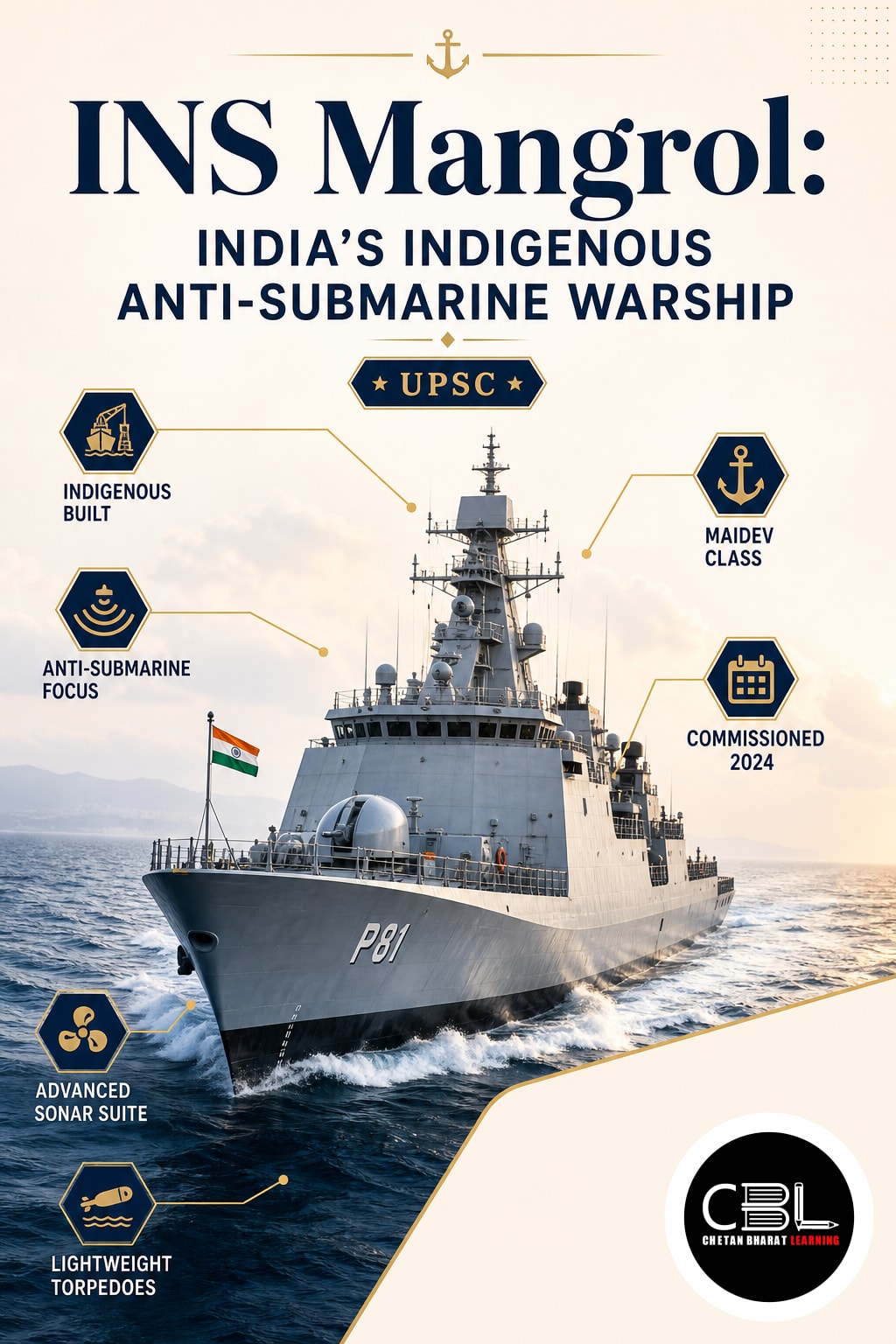
INS Mangrol (P82) is a domestically designed and constructed Anti-Submarine Warfare Shallow Water Craft belonging to the Mahe class. It is specifically developed to detect, track and counter hostile submarines operating in India’s coastal and shallow waters. The vessel is equipped for underwater surveillance, anti-submarine warfare, low-intensity maritime operations and mine warfare-related tasks. Unlike larger destroyers and frigates designed for broader oceanic operations, shallow-water combat craft provide specialised capabilities in congested coastal areas and harbour approaches. The vessel carries forward the name of the former INS Mangrol (M85), an Agray-class minesweeper that remained in Indian Navy service until 7 April 2004.
Origin of the Name
Mangrol is named after the coastal town and fishing harbour of Mangrol in Junagadh district, Gujarat. The naming follows the Indian Navy’s tradition of honouring maritime locations and preserving the legacy of earlier naval vessels.
Why in News?
The Indian Navy formally commissioned its third Mahe-class Anti-Submarine Warfare Shallow Water Craft on 12 October 2026 at the Naval Dockyard in Mumbai.
Vice Admiral Sanjay Vatsayan, Flag Officer Commanding-in-Chief of the Western Naval Command, presided over the commissioning ceremony.
The ship had previously been delivered to the Indian Navy by Cochin Shipyard Limited on 21 August 2026. Commissioning marked its formal entry into active naval service.
According to the Ministry of Defence, the vessel contains more than 80% indigenous components, demonstrating India’s growing strength in warship construction, equipment manufacturing and naval systems integration.
Key Features and Capabilities
- Abhay Hull-Mounted Sonar: Indigenous sonar system for underwater detection and tracking.
- Low-Frequency Towed Array Sonar: Acoustic sensing capability for challenging underwater conditions.
- Anti-Submarine Rocket Launchers: Indigenous rocket-based weapons for attacking underwater threats.
- Lightweight Torpedoes: Torpedo systems to engage hostile submarines.
- Maareech Advanced Torpedo Defence System: Acoustic countermeasures and decoys to protect against incoming torpedoes.
- Waterjet Propulsion: Three diesel-engine-driven waterjets for enhanced manoeuvrability in shallow waters.
- Underwater Surveillance: Advanced sensors for monitoring submarine activity near strategic coastal locations.
- Multi-Mission Capability: Supports low-intensity maritime operations, maritime security and mine warfare.
Why is Waterjet Propulsion Important?
Conventional marine propulsion systems use exposed propellers to generate thrust. Waterjet systems draw water through an intake and expel it at high velocity, providing strong manoeuvring capability ideal for operations in ports, narrow channels and relatively shallow waters. For anti-submarine vessels, manoeuvrability is especially valuable when responding to rapidly changing underwater threats near the coastline.
Major Specifications at a Glance
| Parameter | Details |
|---|---|
| Name | INS Mangrol |
| Pennant Number | P82 |
| Class | Mahe-class ASW-SWC |
| Builder | Cochin Shipyard Limited, Kochi |
| Commissioning Location | Naval Dockyard, Mumbai |
| Commissioning Date | 12 October 2026 |
| Indigenous Content | More than 80% |
| Propulsion | Three diesel engines driving waterjets |
| Primary Role | Shallow-water anti-submarine warfare and underwater surveillance |
Strategic Significance for India
- Coastal Defence: Enhances detection of hostile underwater platforms approaching ports and coastal installations.
- Protection of Strategic Assets: Secures naval bases, commercial harbours and offshore energy infrastructure.
- Countering Submarine Threats: Provides specialised capabilities against submarines in littoral environments.
- Indigenous Defence Manufacturing: Promotes domestic production of sensors, weapons and shipbuilding systems.
- Industrial Development: Supports Indian shipyards, equipment suppliers and MSMEs in defence production.
- Operational Flexibility: Allows larger warships to focus on ocean-going missions.
About the Mahe-Class ASW-SWC Programme
The Mahe-class programme is part of India’s effort to modernise shallow-water anti-submarine capabilities and replace ageing platforms. The Ministry of Defence signed a contract with Cochin Shipyard Limited in April 2019 for eight ASW shallow water craft. INS Arnala and INS Androth preceded INS Mangrol, making it the third vessel of the class to enter service. The programme complements the Navy’s fleet modernisation strategy while expanding domestic shipbuilding and indigenous defence technology.
Challenges in Coastal Anti-Submarine Warfare
- Complex Shallow-Water Acoustics: Underwater noise, seabed reflections and coastal activity complicate detection.
- Congested Maritime Traffic: Commercial vessels and fishing boats make target identification more demanding.
- Technological Adaptation: Modern submarines use quiet propulsion to reduce detectability.
- Maintenance Requirements: Advanced sensors and propulsion equipment require sustained technical support.
- Operational Coordination: Effective ASW depends on coordination among surface vessels, maritime patrol aircraft and helicopters.
Way Forward
- Accelerate Fleet Induction: Timely construction and commissioning of remaining shallow-water warfare vessels.
- Strengthen Indigenous Research: Support domestic innovation in sonar technology, underwater weapons and naval electronics.
- Expand Industry Participation: Encourage partnerships among shipyards, DRDO and MSMEs.
- Improve Operational Integration: Link underwater platforms with maritime aircraft and coastal monitoring networks.
- Enhance Crew Training: Conduct regular ASW exercises and simulated threat scenarios.
- Develop Lifecycle Support: Invest in maintenance, upgrades and domestic spare parts for sustained readiness.
The commissioning of INS Mangrol marks an important milestone in India’s naval modernisation, combining specialised ASW capabilities with domestic shipbuilding expertise. Its induction strengthens coastal security and advances technological self-reliance. Continued investment in underwater surveillance, fleet maintenance and indigenous research is essential for maritime security.
Prelims Practice Corner
Q1. INS Mangrol belongs to which class of Indian naval vessels?
- (a) Kolkata class
- (b) Shivalik class
- (c) Mahe class
- (d) Arihant class
Answer: (c) Mahe class.
Q2. Which organisation constructed INS Mangrol?
- (a) Cochin Shipyard Limited
- (b) Mazagon Dock Shipbuilders Limited
- (c) Garden Reach Shipbuilders and Engineers
- (d) Hindustan Shipyard Limited
Answer: (a) Cochin Shipyard Limited.
Q3. Consider the following statements:
1. INS Mangrol is designed primarily for shallow-water anti-submarine warfare.
2. The ship uses waterjet propulsion.
3. It is a nuclear-powered ballistic missile submarine.
Which statements are correct?
- (a) 1 and 3 only
- (b) 2 and 3 only
- (c) 1, 2 and 3
- (d) 1 and 2 only
Answer: (d) 1 and 2.
Q4. The Maareech system installed on Indian naval vessels is associated with:
- (a) Satellite navigation
- (b) Advanced torpedo defence
- (c) Ballistic missile launch
- (d) Electronic voting technology
Answer: (b) Advanced torpedo defence.
Q5. INS Mangrol is named after a coastal town located in which Indian state?
- (a) Maharashtra
- (b) Kerala
- (c) Gujarat
- (d) Odisha
Answer: (c) Gujarat.
Mains Practice Questions
Q1. Examine the strategic significance of indigenous Anti-Submarine Warfare Shallow Water Craft in strengthening India’s coastal and maritime security. (15 marks)
- Intro: Introduce the October 2026 commissioning of the third Mahe-class ASW-SWC.
- Body: Explain shallow-water submarine threats, sonar detection, specialised weapons, coastal infrastructure protection and naval coordination.
- Conclusion: Emphasise indigenous defence capability and integrated maritime security.
Q2. Indigenous warship construction is essential for India’s defence preparedness and technological self-reliance. Discuss with reference to the Mahe-class programme. (10 marks)
- Intro: Highlight the more than 80% indigenous content in the Mahe-class programme.
- Body: Discuss shipbuilding, sonar and propulsion technology, MSME participation, domestic supply chains and maintenance capabilities.
- Conclusion: Recommend sustained research, procurement and industrial capacity-building.
Frequently Asked Questions
What is INS Mangrol?
INS Mangrol is the Indian Navy’s third Mahe-class Anti-Submarine Warfare Shallow Water Craft. Built by Cochin Shipyard Limited, it was commissioned on 12 October 2026 to strengthen coastal underwater surveillance and anti-submarine capabilities.
What weapons and sensors does INS Mangrol carry?
The vessel includes Abhay hull-mounted sonar, anti-submarine rocket launchers, lightweight torpedoes and the indigenous Maareech torpedo defence system. Its propulsion arrangement uses three diesel engines driving waterjets.
Why is INS Mangrol important for India’s maritime security?
It strengthens India’s capacity to detect and counter submarines in shallow coastal waters while protecting important ports and offshore infrastructure. Its high indigenous content also supports technological self-reliance and domestic defence manufacturing.
Related Current Affairs
Preparing for UPSC, PCS or HCS?
Talk to a mentor at Chetan Bharat Learning, Chandigarh. Free guidance on choosing the right exam and building a study plan.
Chat on WhatsAppCall 97793 53345UPSC / IAS / PCS coaching in Chandigarh · Trusted by aspirants across Punjab & Haryana
Leave a Reply
You must be logged in to post a comment.