
UPSC Mapping
| Prelims | International Organisations |
|---|---|
| Mains | GS Paper 2 |
Article
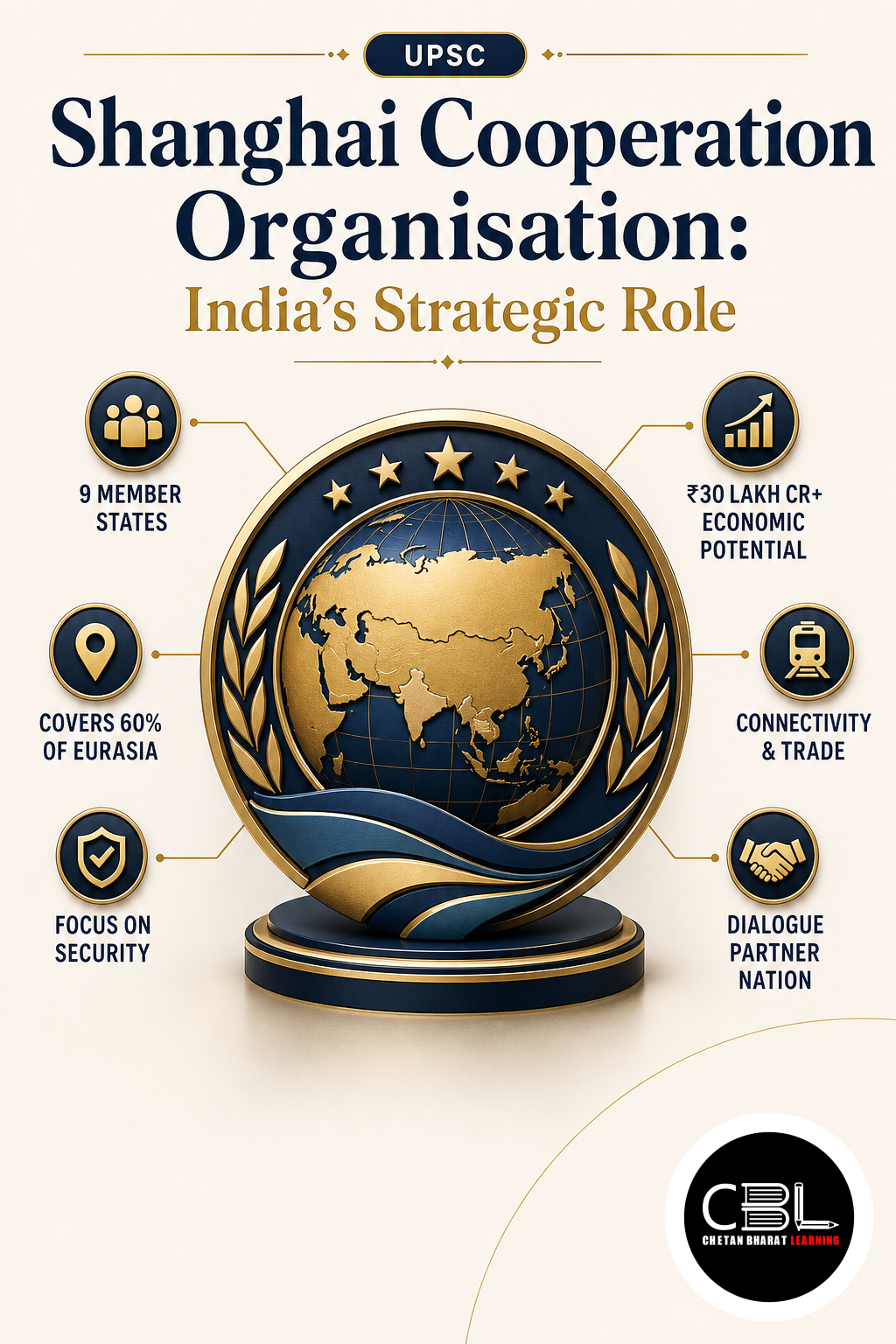
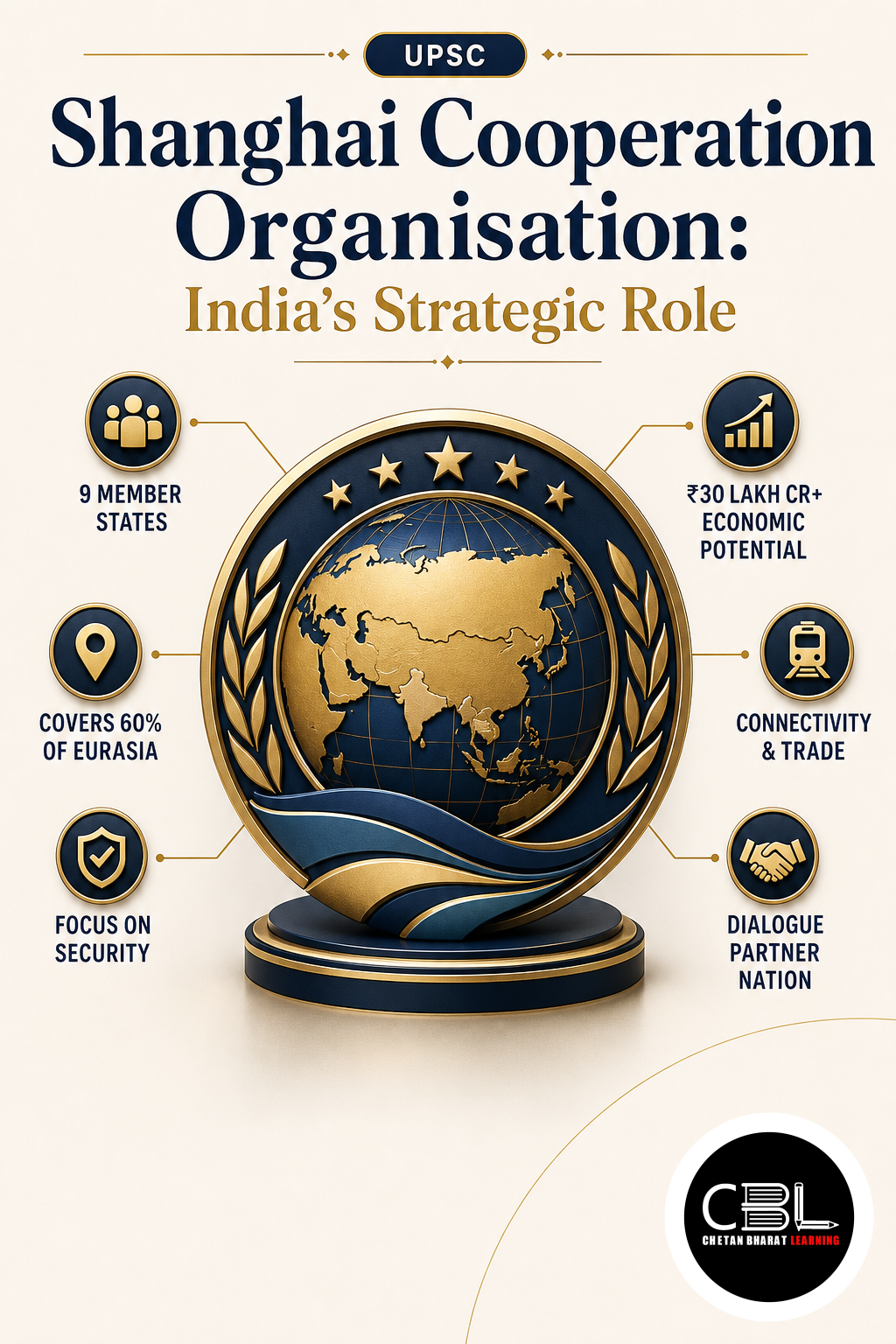
Shanghai Cooperation Organisation remains central to India’s Eurasian diplomacy, especially after the latest summit discussions. The grouping gives India a rare platform to engage China, Russia, Iran, Pakistan and Central Asian republics together. For regular updates on such multilateral developments, follow our daily current affairs archive. The organisation matters for regional security, connectivity, counter-terrorism and India’s wider continental strategy. Its relevance has grown as global politics becomes more fragmented and competitive.
Quick Facts
| Established | 2001 |
|---|---|
| Origin | Shanghai Five |
| India Joined | 2017 |
| Secretariat | Beijing |
What is Shanghai Cooperation Organisation?
The Shanghai Cooperation Organisation is a Eurasian multilateral forum created in 2001 by China, Russia, Kazakhstan, Kyrgyzstan, Tajikistan and Uzbekistan. It evolved from the earlier Shanghai Five, which focused on confidence-building and border stability after the Soviet collapse. The organisation later expanded to include India and Pakistan in 2017, followed by further enlargement.
The grouping does not operate like a military alliance with collective defence obligations. It functions through political dialogue, security cooperation, economic discussions and institutional mechanisms. Its Regional Anti-Terrorist Structure gives members a dedicated forum for cooperation against terrorism, separatism and extremism.
For India, the platform provides structured access to Central Asia despite limited direct land connectivity. It also allows New Delhi to engage Russia and Iran alongside China and Pakistan in a formal setting. This makes the organisation useful even when bilateral relations remain difficult.
The body also offers a space to discuss Afghanistan, West Asia, energy security and regional connectivity. These themes directly affect India’s continental security and long-term strategic autonomy. The grouping’s value lies less in binding decisions and more in sustained diplomatic engagement.
Why is Shanghai Cooperation Organisation in News?
The latest summit brought renewed attention to the Shanghai Cooperation Organisation because members discussed terrorism, Afghanistan, West Asian instability and regional connectivity. India used the platform to reiterate its zero-tolerance approach towards terrorism. The Ministry of External Affairs has consistently highlighted India’s commitment to secure and inclusive regional cooperation through MEA statements.
The summit also drew attention because Pakistan assumed the chairmanship for the next cycle. This creates a diplomatic challenge for India, given continuing bilateral tensions and security concerns. Yet, the institutional format offers a limited channel for engagement without treating bilateral disputes as the central agenda.
Connectivity remained another major issue because India supports regional linkages that respect sovereignty and territorial integrity. This position matters because India has opposed the China-Pakistan Economic Corridor due to its passage through Pakistan-occupied territory. India’s approach separates genuine connectivity from projects that undermine territorial claims.
The organisation also discussed wider geopolitical issues, including West Asia and financial cooperation. These debates reflect how Eurasian platforms now address both traditional security and economic governance. For aspirants, this makes the forum relevant for GS Paper 2 and security-linked dimensions of GS Paper 3.
Key Features
- Eurasian membership: The forum brings together major powers and Central Asian states within one institutional framework.
- Security focus: It prioritises cooperation against terrorism, separatism and extremism through dedicated institutional channels.
- No collective defence: The body promotes dialogue and coordination but does not function like a military alliance.
- Connectivity agenda: Members discuss trade corridors, transport links and economic integration across the Eurasian landmass.
- Consensus culture: Decisions require careful balancing because members hold divergent positions on major geopolitical disputes.
These features make the Shanghai Cooperation Organisation a flexible but limited institution. It provides regular contact among rivals, but it rarely produces strong collective action. Its working style suits a region marked by suspicion, overlapping interests and strategic competition.
Challenges
- India-China tensions: Border disputes and strategic rivalry limit trust between two important members.
- India-Pakistan hostility: Terrorism concerns and bilateral crises reduce the space for cooperative outcomes.
- Divergent foreign policies: Members differ sharply on Ukraine, West Asia, sanctions and relations with the West.
- Connectivity disputes: India rejects projects that violate sovereignty, especially those linked to Pakistan-occupied territory.
- Consensus constraints: The unanimity-based approach can dilute declarations and slow practical decision-making.
These challenges do not make the platform irrelevant, but they reduce its operational depth. India must use the forum carefully, combining engagement with clear red lines. For connected analysis, read our explainer on India-Central Asia relations.
The China factor remains especially important for Indian diplomacy within the forum. Beijing has greater economic influence in Central Asia through infrastructure and trade linkages. India must therefore offer credible alternatives through capacity-building, digital public infrastructure and energy cooperation.
Way Forward
India should continue using the Shanghai Cooperation Organisation to strengthen counter-terrorism cooperation and raise concerns over cross-border terrorism. It should push for clear language against terror financing, radicalisation and safe havens. The official SCO Secretariat mechanisms can support regular consultations among security agencies.
New Delhi also needs a positive economic agenda for Central Asia. This should include digital payments, pharmaceuticals, renewable energy, education, disaster management and resilient supply chains. Such cooperation can build trust without forcing India to accept connectivity projects that compromise sovereignty.
India should coordinate its SCO engagement with other regional initiatives, including the International North-South Transport Corridor and Chabahar Port. These routes can improve access to Afghanistan, Iran and Central Asia while bypassing Pakistan. Better logistics will make India’s continental policy more practical.
The forum also gives India space to maintain strategic balance between competing global blocs. India can engage Russia and Iran without weakening its partnerships with the United States, Europe, Japan and ASEAN. This calibrated diplomacy supports India’s broader policy of strategic autonomy.
Future engagement must combine realism with persistence. The organisation cannot resolve every dispute among members, but it can reduce miscommunication and keep dialogue open. In a divided global order, even limited multilateral contact has value for stability.
Prelims Practice Corner
-
Q1. The Shanghai Cooperation Organisation was formally established in which year?
(a) 1996 (b) 2001 (c) 2014 (d) 2017
Answer: (b) The organisation was formally established in 2001 after evolving from the Shanghai Five.
-
Q2. India became a full member of the SCO in which year?
(a) 2005 (b) 2010 (c) 2017 (d) 2020
Answer: (c) India and Pakistan became full members of the organisation in 2017.
-
Q3. Which of the following best describes the SCO’s security focus?
(a) Nuclear disarmament only (b) Maritime piracy only (c) Terrorism, separatism and extremism (d) Space security only
Answer: (c) The organisation focuses strongly on combating terrorism, separatism and extremism.
-
Q4. Why has India not endorsed the Belt and Road Initiative within the SCO framework?
(a) It opposes all foreign infrastructure projects (b) It objects to sovereignty concerns linked to CPEC (c) It has no interest in Central Asia (d) It rejects all trade corridors
Answer: (b) India opposes CPEC because it passes through Pakistan-occupied territory, raising sovereignty concerns.
-
Q5. Which city hosts the SCO Secretariat?
(a) Moscow (b) Beijing (c) Astana (d) Tashkent
Answer: (b) The SCO Secretariat is located in Beijing.
Mains Practice Questions
-
Q1. Examine the significance of the Shanghai Cooperation Organisation for India’s Eurasian strategy. Also discuss the key limitations India faces within the grouping. (250 words)
Answer Structure:
- Intro: Define the organisation as a Eurasian multilateral forum linking India with Central Asia, Russia, China, Iran and Pakistan.
- Body: Cover counter-terrorism, Afghanistan, Central Asian connectivity, energy security and diplomatic engagement. Add limitations such as India-China tensions, India-Pakistan rivalry, BRI concerns and consensus-based functioning.
- Conclusion: Conclude that India should use the forum for selective engagement while protecting sovereignty and strategic autonomy.
-
Q2. India’s position on connectivity within Eurasian forums reflects both opportunity and caution. Discuss with reference to sovereignty and regional integration. (150 words)
Answer Structure:
- Intro: Frame connectivity as essential for India’s access to Central Asia and wider Eurasia.
- Body: Discuss INSTC, Chabahar, trade potential, energy links and India’s objection to CPEC due to sovereignty concerns.
- Conclusion: End with the need for transparent, inclusive and sovereignty-respecting connectivity projects.
FAQs on Shanghai Cooperation Organisation
- When was the organisation established?
- It was formally established on 15 June 2001. It developed from the Shanghai Five mechanism involving China, Russia and three Central Asian republics.
- Why is the forum important for India?
- It gives India a platform to engage Central Asia, Russia, China, Iran and Pakistan together. It also supports India’s interests in counter-terrorism, Afghanistan, energy security and regional connectivity.
- Does the organisation have a collective defence mechanism?
- No, it is not a collective defence alliance. It mainly works through political dialogue, security coordination, economic consultation and institutional engagement.
Related Current Affairs
Preparing for UPSC, PCS or HCS?
Talk to a mentor at Chetan Bharat Learning, Chandigarh. Free guidance on choosing the right exam and building a study plan.
Chat on WhatsAppCall 97793 53345UPSC / IAS / PCS coaching in Chandigarh · Trusted by aspirants across Punjab & Haryana
Leave a Reply
You must be logged in to post a comment.