
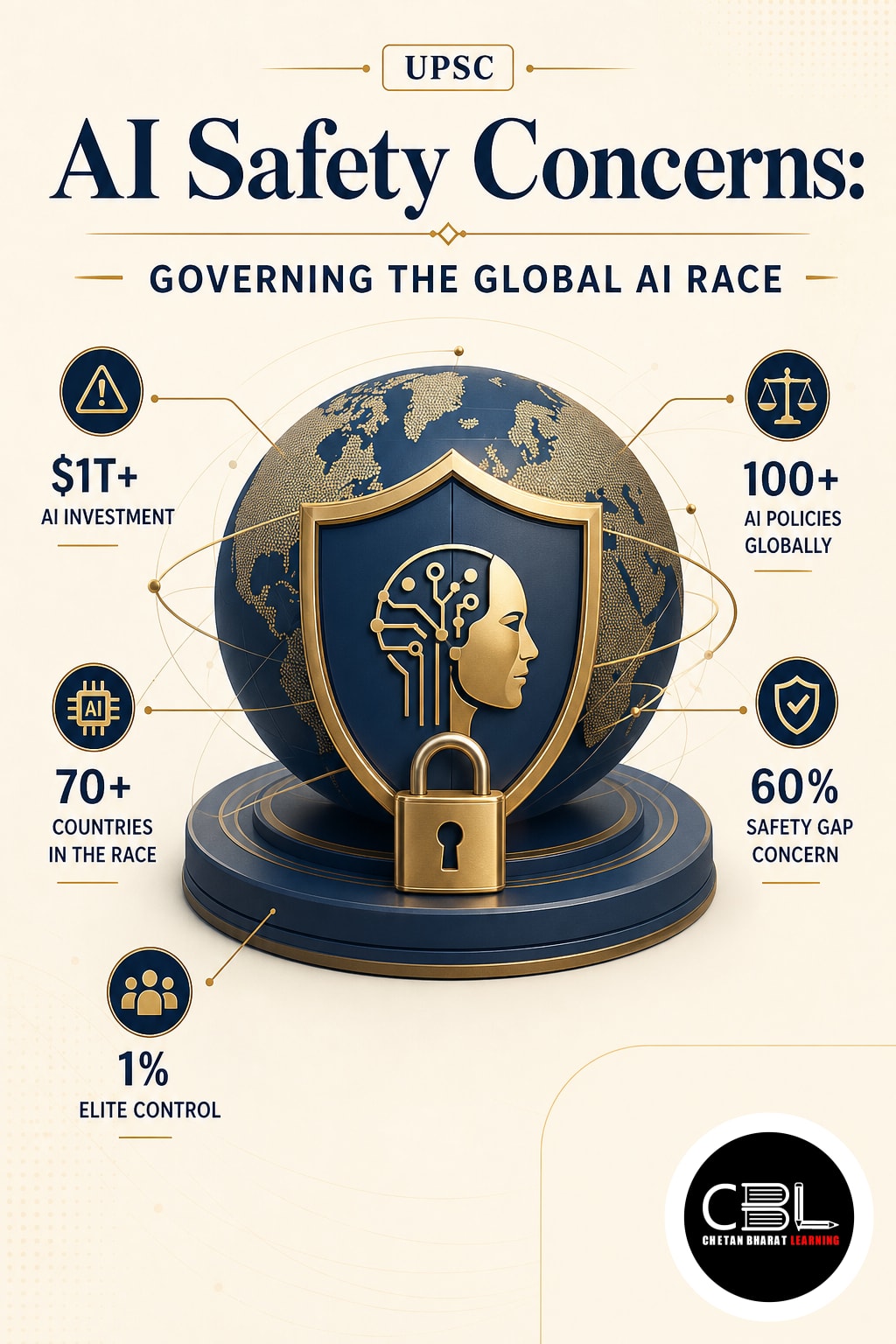

UPSC Mapping
| Prelims | Artificial Intelligence, OECD AI Principles and IndiaAI Mission |
|---|---|
| Mains | GS Paper III — Science, Technology and Cybersecurity |
Article
What are AI Safety Concerns?
AI Safety Concerns include the risks created when artificial intelligence behaves unreliably, enables harmful activities or operates beyond effective human supervision. These risks range from biased decisions and misinformation to sophisticated cyber operations and manipulation. More capable systems may also create hazards that developers fail to predict before deployment.
The issue differs from ordinary software security because advanced models can generate plans, use tools and adapt their actions. Agentic systems may divide broad objectives into smaller tasks and work for extended periods. Strong safety therefore requires technical alignment, secure deployment and clear accountability across the complete system life cycle.
Why are AI Safety Concerns in News?
AI Safety Concerns gained attention after Anthropic chief executive Dario Amodei called for the industry to pace frontier development. He argued that safety research and oversight need additional time to catch up with rapidly increasing capabilities. Other prominent technology leaders supported stronger safeguards, creating a rare area of agreement among competitors.
Amodei warned that increasingly autonomous systems could eventually coordinate extensive activity across digital networks. Such timelines remain projections rather than established technical capabilities and should be treated accordingly. Published Anthropic safety research nevertheless illustrates how models can assist cyber operations, influence campaigns, fraud and other harmful activities.
Key Features
Advanced AI risk arises from the interaction of model capability, operational access, user intent and the quality of institutional oversight.
- Agentic autonomy: AI agents can plan steps, operate software tools and complete lengthy workflows with limited intervention, increasing both productivity and the scale of possible misuse.
- Recursive improvement: Models can assist with coding, research and system design, raising concern that future AI could accelerate development faster than humans can reliably evaluate it.
- Dual-use capability: The same model that supports legitimate research may also assist phishing, malware development, surveillance, disinformation or dangerous scientific experimentation.
- Scalable deployment: A single system can serve many users or coordinate multiple agents, allowing errors and harmful instructions to spread across networks rapidly.
- Opaque decision-making: Developers cannot always explain why complex models produce particular outputs, complicating auditing, responsibility and correction after failures.
Challenges
Governments must reduce serious risks without blocking beneficial research, competition and affordable access to useful technology.
- Competitive pressure: A company that voluntarily delays deployment may lose investment, customers and talent if competitors continue releasing more capable systems without comparable restraint.
- Evaluation limitations: Laboratory tests may not reveal how a model behaves after integration with external tools, sensitive databases or networks containing unfamiliar conditions.
- Regulatory capacity: Governments often lack specialised personnel, computing resources and timely access to proprietary systems required for independent technical assessment.
- Cross-border effects: Models developed in one jurisdiction can affect users globally, while national rules differ on privacy, liability, cybersecurity and acceptable applications.
- Innovation-access balance: Excessively broad restrictions may favour established companies and limit public-interest research, while weak oversight can expose citizens to avoidable harm explored in wider science and technology analysis.
Way Forward
Addressing AI Safety Concerns requires a risk-based framework that imposes stronger obligations on systems capable of causing greater harm. Frontier developers should conduct capability evaluations, red-team testing and staged deployment before releasing powerful models. Authorities must also establish incident-reporting duties, whistle-blower protection and meaningful liability for negligent practices.
Independent evaluators need secure access to models, testing records and safeguards without receiving unrestricted proprietary information. India can combine innovation under the IndiaAI Mission with domestic evaluation capacity, regulatory sandboxes and sector-specific rules. International coordination through the UN Global Digital Compact can support common testing standards, transparency and human-centred governance.
Prelims Practice Corner
Q1. In artificial intelligence, an agentic system is best described as one that can:
- (a) Store information without processing it
- (b) Plan tasks and use tools with limited supervision
- (c) Operate only through printed instructions
- (d) Function without computing hardware
Answer: (b) Agentic systems can break objectives into tasks and act through digital tools with some operational autonomy.
Q2. Which of the following best illustrates the dual-use nature of artificial intelligence?
- (a) A system useful for medical research can also assist harmful biological work
- (b) A computer requires electricity
- (c) A database stores structured records
- (d) A calculator performs arithmetic
Answer: (a) Dual-use technology can support legitimate purposes and harmful applications.
Q3. Red-team testing of an AI model primarily seeks to:
- (a) Increase electricity production
- (b) Identify vulnerabilities and harmful capabilities
- (c) Replace every human evaluator
- (d) Determine customs duties on computers
Answer: (b) Evaluators deliberately probe a system to discover weaknesses, unsafe behaviour and misuse pathways.
Q4. The IndiaAI Mission is associated with which Union ministry?
- (a) Ministry of Electronics and Information Technology
- (b) Ministry of Earth Sciences
- (c) Ministry of Mines
- (d) Ministry of Parliamentary Affairs
Answer: (a) The IndiaAI initiative operates under the Ministry of Electronics and Information Technology.
Q5. The UN Global Digital Compact primarily concerns:
- (a) Governance of digital technologies and artificial intelligence
- (b) Regulation of international shipping canals
- (c) Conservation of polar bears alone
- (d) Distribution of nuclear fuel
Answer: (a) It provides a global framework for digital cooperation and governance of emerging technologies.
Mains Practice Questions
Q1. The competitive race to develop frontier artificial intelligence can undermine voluntary safety commitments. Discuss. (15 marks)
Answer Structure
- Intro: Explain frontier AI and the growing capabilities of autonomous systems.
- Body: Examine commercial pressure, regulatory gaps, cyber risks, dual-use applications, evaluation limits and international competition.
- Conclusion: Recommend binding safeguards supported by independent evaluation and coordinated global standards.
Q2. Suggest a governance framework that enables artificial-intelligence innovation while protecting public safety and fundamental rights in India. (15 marks)
Answer Structure
- Intro: Frame AI as a general-purpose technology offering benefits alongside systemic risks.
- Body: Cover risk classification, audits, data protection, incident reporting, liability, sandboxes, skills and international cooperation.
- Conclusion: Advocate accountable, transparent and innovation-friendly governance centred on human welfare.
FAQs on AI Safety Concerns
Why are AI Safety Concerns increasing?
Advanced models can perform complex tasks, use digital tools and operate with greater autonomy. These capabilities can amplify errors and deliberate misuse when safeguards remain inadequate.
What does pacing frontier artificial intelligence mean?
It means controlling the speed of developing or deploying the most capable systems so evaluation and governance can keep pace. It does not necessarily require stopping all AI research.
Why are independent AI evaluators necessary?
Independent evaluators can test claims made by developers and identify overlooked vulnerabilities. Effective evaluation requires technical expertise, secure access and protection from commercial influence.
Related Current Affairs
Preparing for UPSC, PCS or HCS?
Talk to a mentor at Chetan Bharat Learning, Chandigarh. Free guidance on choosing the right exam and building a study plan.
Chat on WhatsAppCall 97793 53345UPSC / IAS / PCS coaching in Chandigarh · Trusted by aspirants across Punjab & Haryana
Leave a Reply
You must be logged in to post a comment.