
UPSC Mapping
- Prelims: Crop Residue Management, Air Pollution, CAQM and Agricultural Policies
- Mains: GS Paper 3 – Environment, Agriculture, Pollution and Sustainable Development
What is Stubble Burning?
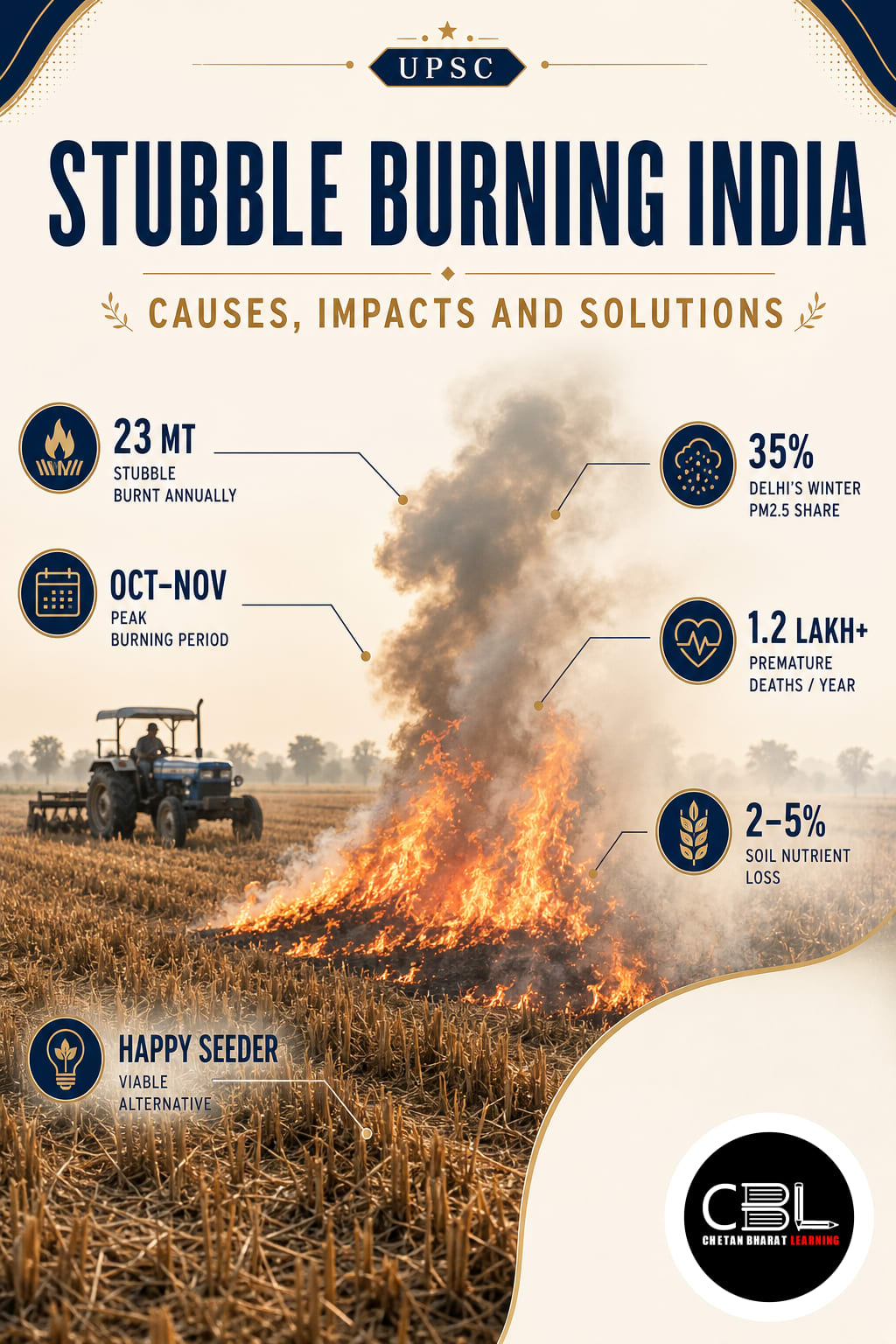
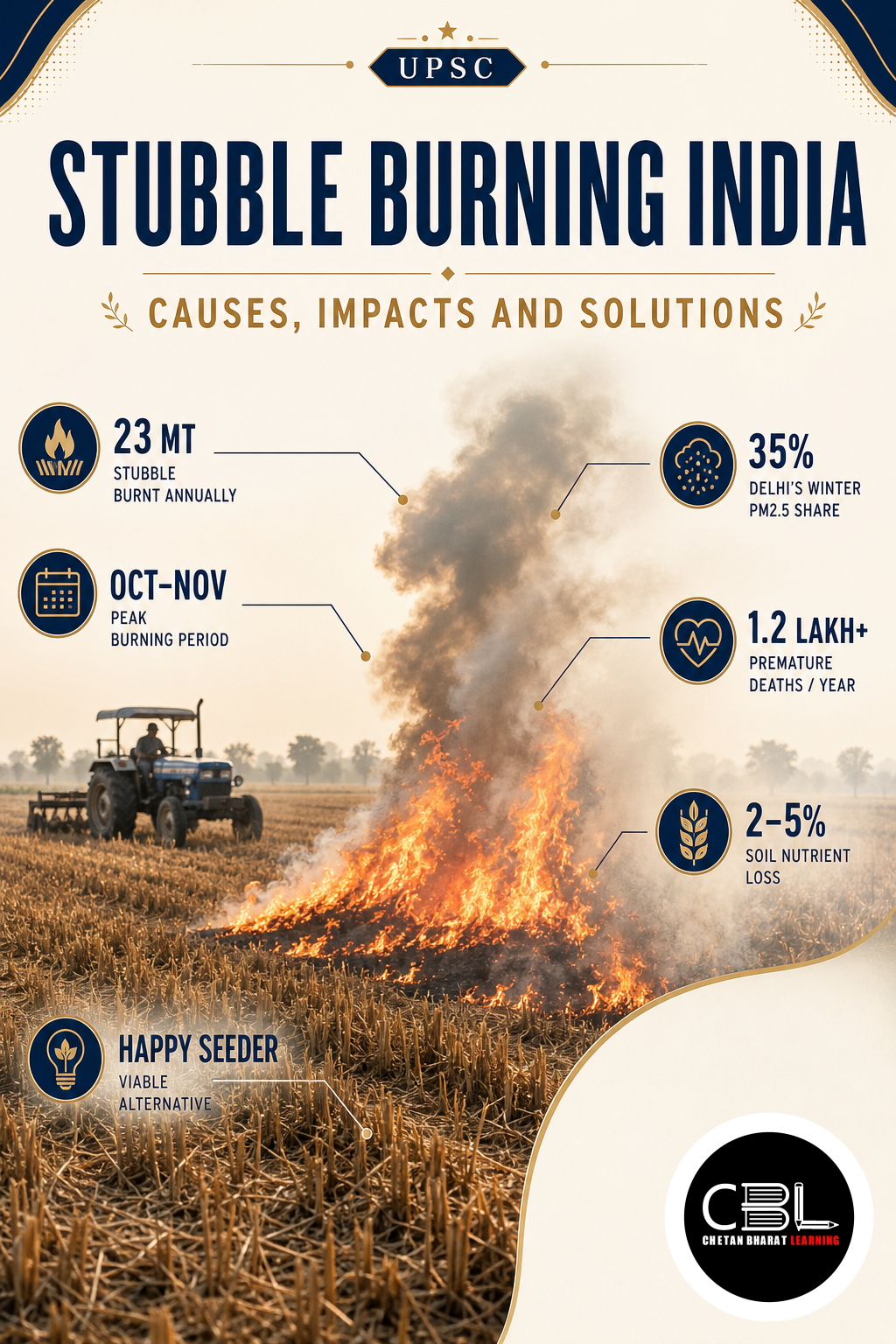
Stubble burning refers to the deliberate burning of agricultural residues left after harvesting crops. In northwestern India, the practice primarily involves paddy straw remaining in fields after mechanised rice harvesting.
Combine harvesters remove grain efficiently but leave substantial straw and rooted stalks behind. Farmers sometimes burn these residues to prepare their fields rapidly for the subsequent wheat crop.
The practice is particularly prevalent during October and November, when the interval between paddy harvesting and wheat sowing is limited.
Why in News?
North India’s seasonal air pollution has revived concerns over agricultural fires in Punjab and Haryana. Despite significant reductions in officially recorded fire events, the underlying economic and agricultural pressures have not disappeared.
Official data show that Punjab recorded 5,114 farm fire incidents in 2025, representing a 90% reduction from the 2022 baseline. Haryana recorded 662 incidents, representing an 81% reduction over the same comparison period.
During September 15–October 13 2026, Punjab registered 174 satellite-detected farm fire events compared with 134 during the corresponding period of 2025, illustrating renewed seasonal concerns.
Agricultural and Environmental Data
| Indicator | Key Finding |
|---|---|
| Annual Paddy Straw Generation | Punjab and Haryana together generate approximately 29 million tonnes of paddy straw annually. |
| Punjab Farm Fires, 2025 | 5,114 incidents, down 90% from 2022. |
| Haryana Farm Fires, 2025 | 662 incidents, down 81% from 2022. |
| Punjab Fires, Sep 15–Oct 13, 2026 | 174 recorded events against 134 in the comparable 2025 period. |
| Monitoring Period | September 15 to November 30 under the standard seasonal reporting protocol. |
| Major Groundwater Challenge | Long-term groundwater depletion associated with intensive irrigation and paddy cultivation. |
The distinction between satellite-detected fire counts and actual burned area is important. Lower fire counts may indicate improvement, but accurate assessment requires multiple observation methods and field verification.
Why Does Stubble Burning Continue?
Compressed Harvesting and Sowing Window
Punjab’s Preservation of Sub-Soil Water Act, 2009 regulates paddy transplantation to conserve groundwater. By delaying transplantation until monsoon onset, harvesting shifts to late October, leaving farmers only 10–15 days to clear fields before wheat sowing.
Long-duration paddy varieties further compress the turnaround period. Burning offers immediate field clearance at relatively low direct cost.
Economic Incentives and Procurement Policies
Reliable Minimum Support Price procurement encourages continued paddy and wheat cultivation over alternative crops. Subsidised agricultural electricity reduces private cost of intensive irrigation, sustaining high-residue cropping patterns.
Mechanisation and Labour Constraints
Combine harvesters leave dense straw deposits that require specialised machinery (e.g., Happy Seeders, Super Seeders) for collection, mulching or incorporation. High rental costs and peak-season shortages limit smallholder access.
Satellite Monitoring Limitations
Satellite detection systems identify active fires during overpass windows. Short-duration fires outside observation periods may be missed, requiring complementary ground patrols and burned-area mapping.
Key Causes of Persistent Stubble Burning
- Short Agricultural Turnaround: Delayed paddy transplantation and long-duration cultivars leave limited time before wheat sowing.
- High Residue Generation: Mechanised harvesting produces large quantities of straw needing rapid management.
- Skewed Procurement Incentives: Assured paddy and wheat procurement discourages diversification to less water-intensive crops.
- Costly Machinery: Seasonal demand, rental rates and equipment requirements restrict smallholder access.
- Insufficient Straw Markets: Weak collection networks and limited buyers depress residue value.
- Labour Shortages: Manual removal is expensive and impractical within short windows.
- Monitoring Gaps: Satellite-window limitations complicate comprehensive surveillance.
- Policy Coordination Failures: Groundwater conservation, procurement, mechanisation and environmental regulation often pursue conflicting objectives.
Environmental and Public Health Impacts
Air Quality Deterioration
Paddy straw combustion releases PM2.5, PM10, CO, NOx and other pollutants. Winter temperature inversions and low winds exacerbate pollution in Delhi-NCR.
Loss of Soil Fertility
Burning destroys organic residues and nutrient content (nitrogen, sulphur), increasing dependence on external fertilisers and undermining long-term soil productivity.
Damage to Soil Microorganisms
High surface temperatures harm beneficial microbes, reducing biological activity, moisture retention and soil structure.
Public Health Consequences
Fine particulate exposure aggravates respiratory and cardiovascular conditions, particularly among children, older adults and those with pre-existing illnesses.
Government Initiatives and Regulatory Measures
- CAQM Action Plans: Annual strategies to reduce stubble burning in affected states.
- Satellite Surveillance: ISRO protocols and ICAR-IARI CREAMS Laboratory for fire detection.
- Flying Squads: CPCB deployed 31 squads across Punjab and Haryana in 2025 for monitoring and enforcement.
- Residue Management Machinery: Subsidies and Custom Hiring Centres for Happy Seeders, Super Seeders and related equipment.
- In-Situ Management: Mulching, soil incorporation and biological decomposition of residues.
- Ex-Situ Management: Collection for biomass fuel, compressed biogas, bioethanol and industrial uses.
- Crop Diversification: State incentives for alternatives to water-intensive paddy cultivation.
- Administrative Enforcement: Monitoring violations and applying environmental compensation or legal action.
In-Situ vs Ex-Situ Crop Residue Management
| Parameter | In-Situ Management | Ex-Situ Management |
|---|---|---|
| Meaning | Managing residue within the field | Removing residue for external use |
| Examples | Happy Seeder, Super Seeder, mulching, decomposition | Baling, biomass pellets, compressed biogas, bioethanol |
| Main Advantage | Improves soil cover and recycles nutrients | Creates industrial resource and farmer revenue |
| Major Limitation | Requires suitable equipment and timely operations | Needs collection, transport and reliable buyers |
Challenges in Existing Policy
- Penalty-Driven Enforcement: Fines alone cannot resolve machinery shortages or market failures.
- Monitoring Discrepancies: Falling fire counts do not necessarily reflect total area burned.
- Smallholder Exclusion: Limited capital hinders machine access during peak demand.
- Insufficient Collection Infrastructure: Dependable transport, storage and buyer agreements are lacking.
- Persistent Paddy Incentives: Assured procurement and irrigation subsidies sustain high-residue cropping.
- Institutional Coordination: Fragmented implementation across agricultural, energy and environmental agencies.
Way Forward
- Integrated Multi-Satellite Monitoring: Combine polar and geostationary observations with ground verification.
- Assured Markets for Alternative Crops: Expand procurement and support for maize, pulses and oilseeds.
- Financial Support for Residue Collection: Predictable purchase arrangements reflecting farmers’ handling costs.
- Short-Duration Paddy Varieties: Promote early-maturing cultivars to extend sowing windows.
- Affordable Shared Machinery: Expand Custom Hiring Centres, tractor pools and booking systems for smallholders.
- Straw-Based Bioenergy Markets: Strengthen supply chains for biogas, bioethanol and biomass pellets.
- Integrated Agricultural Policy: Align groundwater conservation, procurement, energy pricing and pollution control.
- Collaborative Enforcement: Combine legal action with financial support, extension services and transparent monitoring.
Prelims Practice Corner
Q1. Which of the following is an example of in-situ crop residue management?
- (a) Burning straw after harvesting
- (b) Transporting straw to a bioethanol plant
- (c) Using a Happy Seeder to sow wheat through retained residue
- (d) Exporting paddy straw for industrial use
Answer: (c) Happy Seeder technology allows wheat sowing while retaining residue within the field.
Q2. The Punjab Preservation of Sub-Soil Water Act, 2009 primarily aims to:
- (a) Restrict all wheat cultivation
- (b) Reduce groundwater extraction by regulating paddy sowing and transplantation
- (c) Ban mechanised agricultural harvesting
- (d) Replace paddy procurement with cotton procurement
Answer: (b) The law regulates paddy transplantation dates to reduce excessive groundwater use.
Q3. Which statements are correct?
1. Burning releases particulate matter and carbon monoxide.
2. It causes nutrient losses and damages soil microorganisms.
3. It always improves soil organic carbon content.
- (a) 1 and 2 only
- (b) 2 and 3 only
- (c) 1 and 3 only
- (d) 1, 2 and 3
Answer: (a) Statements 1 and 2 are correct. Burning destroys organic residues and degrades soil health.
Q4. Which organisation coordinates air-quality management measures for NCR and adjoining areas?
- (a) National Biodiversity Authority
- (b) Central Ground Water Board
- (c) National Disaster Management Authority
- (d) Commission for Air Quality Management
Answer: (d) CAQM directs agencies to implement crop residue management strategies.
Q5. What is the limitation of satellite-based active fire monitoring?
- (a) Satellites cannot observe agricultural landscapes.
- (b) It measures only groundwater pollution.
- (c) Short-duration fires outside observation windows may escape detection.
- (d) Fire counts always equal total burned area.
Answer: (c) Detection depends on satellite overpass timing, requiring complementary assessments.
Mains Practice Questions
Q1. Stubble burning is not merely a seasonal pollution problem but a symptom of structural weaknesses in India’s agricultural system. Examine the causes and suggest reforms beyond penal enforcement. (15 marks)
Intro: Recurring paddy fires across Punjab and Haryana fuel seasonal air pollution.
Body: Analyse harvesting schedules, groundwater laws, MSP incentives, machinery costs, environmental consequences and enforcement gaps.
Conclusion: Recommend integrated incentives, affordable machinery, crop diversification and viable straw markets.
Q2. Discuss the environmental and economic consequences of crop residue burning in northwestern India. Evaluate the effectiveness of in-situ and ex-situ management strategies. (10 marks)
Intro: Define residue burning and its prevalence during the paddy-wheat transition.
Body: Examine air pollution, soil fertility loss, public health impacts, Happy Seeder, mulching, bioenergy applications and implementation challenges.
Conclusion: Emphasise economically accessible management and sustainable agricultural transformation.
Frequently Asked Questions
Why does stubble burning continue in Punjab and Haryana?
Farmers face short intervals between paddy harvesting and wheat sowing, expensive residue-management equipment and limited straw markets. Assured procurement and irrigation subsidies discourage diversification.
What is the difference between in-situ and ex-situ crop residue management?
In-situ management retains or incorporates residue within the field (e.g., mulching, Happy Seeder). Ex-situ management collects and transports straw for biogas, biomass fuel or bioethanol.
Why is satellite monitoring alone insufficient to measure stubble burning?
Active fire detection depends on satellite overpass timing and sensor capabilities. Fires outside observation windows may be missed, so burned-area mapping and ground verification are needed.
Related Current Affairs
Preparing for UPSC, PCS or HCS?
Talk to a mentor at Chetan Bharat Learning, Chandigarh. Free guidance on choosing the right exam and building a study plan.
Chat on WhatsAppCall 97793 53345UPSC / IAS / PCS coaching in Chandigarh · Trusted by aspirants across Punjab & Haryana
Leave a Reply
You must be logged in to post a comment.