
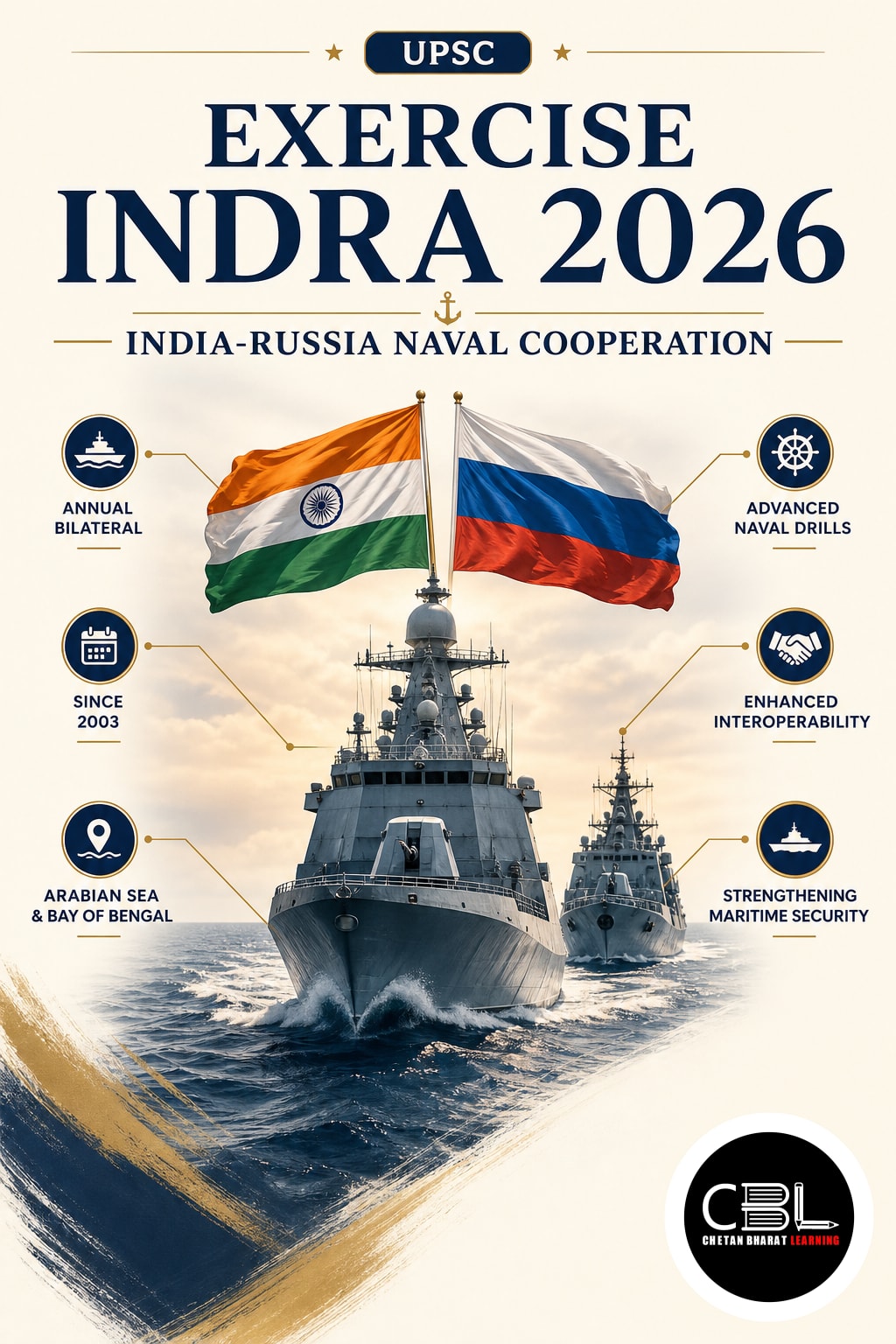

UPSC Mapping
- Prelims: Joint Military Exercises, Defence and Maritime Geography
- Mains: GS Paper 3 – Security; GS Paper 2 – International Relations
Article
Exercise INDRA 2026, the bilateral maritime exercise between India and Russia, commenced on 13 October 2026 at Vladivostok in the Russian Far East. Indian Naval Ship INS Sahyadri arrived at the port on 10 October to participate in the exercise, scheduled until 18 October. The engagement focuses on strengthening maritime cooperation, operational interoperability and professional understanding between the two navies. It also reinforces India’s MAHASAGAR vision and the longstanding India-Russia defence partnership.
Quick Facts
| Feature | Details |
|---|---|
| Exercise Dates | 13–18 October 2026 |
| Host Country | Russia |
| Host Port | Vladivostok |
| Indian Warship | INS Sahyadri |
What is Exercise INDRA 2026?
It is a bilateral naval exercise involving the Indian Navy and the Russian Federation Navy. The exercise strengthens operational coordination, improves interoperability and provides opportunities for exchanging maritime expertise.
The 2026 edition is being hosted by Russia at Vladivostok, with maritime activities in adjacent waters. It combines professional engagements in harbour with coordinated naval operations at sea.
INDRA naval exercises began in 2003 and have become a regular component of India-Russia defence cooperation. The exercise represents an important institutional mechanism for maintaining professional ties between the two navies.
Why in News?
INS Sahyadri arrived at Vladivostok on 10 October 2026 for the India-Russia maritime exercise scheduled between 13 and 18 October. The Ministry of Defence confirmed the deployment through a Press Information Bureau release on 11 October 2026.
The Ministry stated that the exercise would strengthen mutual understanding, operational coordination and interoperability. It would also include professional exchanges and social interactions between naval personnel.
The deployment builds upon the momentum generated at the 23rd India-Russia Annual Summit, held on 4–5 December 2025. It also supports India’s expanding maritime engagement with the Russian Far East.
Key Features of the Naval Exercise
- Harbour Phase: Conducted at Vladivostok, featuring professional discussions, coordination meetings and interactions among naval personnel.
- Sea Phase: Includes coordinated maritime activities designed to improve cooperation and tactical understanding at sea.
- Operational Interoperability: Helps the navies coordinate communication, procedures and operational responses during joint engagements.
- Professional Knowledge Exchange: Enables personnel to share maritime expertise, operational experiences and best practices.
- Social and Cultural Engagement: Encourages personal interaction and professional camaraderie between Indian and Russian naval crews.
- Defence Diplomacy: Reinforces military-to-military relations and strategic communication through regular operational cooperation.
About INS Sahyadri
INS Sahyadri is an indigenously built guided-missile stealth frigate belonging to the Indian Navy’s Shivalik class. It is designed for multidimensional maritime operations and forms part of India’s modern surface combatant fleet.
The vessel was commissioned into the Indian Navy in July 2012. Its participation demonstrates the Navy’s ability to undertake long-distance deployments and professional engagement beyond the Indian Ocean region.
Important Facts about INS Sahyadri
| Feature | Details |
|---|---|
| Ship Name | INS Sahyadri |
| Class | Shivalik class |
| Type | Guided-missile stealth frigate |
| Commissioned | July 2012 |
| Built By | Mazagon Dock Limited, Mumbai |
| Primary Role | Multi-role surface warfare and maritime security operations |
Strategic Importance of Vladivostok
Vladivostok is a major Russian port city in the Far East and an important base for Russia’s Pacific Fleet. It is located near the Sea of Japan, which connects to the wider Pacific Ocean through regional straits.
The port provides Russia with an important maritime gateway for commercial and strategic engagement in East Asia. Hosting Indian naval personnel there strengthens professional connections beyond India’s immediate maritime neighbourhood.
For mapping questions, candidates should remember that Vladivostok lies in Primorsky Krai, on Russia’s Pacific-facing eastern coastline.
Significance for India
1. Strengthening India-Russia Defence Relations
India and Russia maintain a longstanding Special and Privileged Strategic Partnership. Defence cooperation remains a significant component of this relationship.
Regular naval interactions help sustain trust, communication and professional familiarity between the armed forces. They complement institutional mechanisms such as the India-Russia Inter-Governmental Commission on Military and Military Technical Cooperation.
2. Supporting the MAHASAGAR Vision
MAHASAGAR stands for Mutual and Holistic Advancement for Security and Growth Across Regions. It represents India’s emphasis on maritime security, regional cooperation and collective development.
The deployment supports wider naval engagement across regions while demonstrating India’s commitment to collaborative maritime security.
3. Enhancing Operational Readiness
Exercises with foreign navies expose personnel to different operational practices and communication systems. This experience can improve readiness for coordinated maritime activities.
Such engagements also provide opportunities to develop confidence in operating across varied maritime environments.
4. Advancing Maritime Diplomacy
Naval deployments serve both operational and diplomatic purposes. They demonstrate commitment to bilateral cooperation without necessarily implying a formal military alliance.
India’s participation illustrates its policy of maintaining defence relationships with multiple international partners while preserving strategic autonomy.
India-Russia Defence Cooperation: Other Exercises
| Exercise | Nature |
|---|---|
| INDRA Navy | Bilateral naval cooperation between India and Russia |
| INDRA | India-Russia exercise series with military-service-specific editions |
| Avia Indra | Bilateral air force exercise |
Concerns and Challenges
- Geopolitical Uncertainty: India-Russia defence engagement takes place amid competing geopolitical interests and international tensions.
- Operational Differences: Distinct equipment, communication procedures and naval doctrines can create coordination challenges.
- Long-Distance Logistics: Deployment to distant maritime regions requires reliable replenishment, maintenance and operational planning.
- Technology Compatibility: Effective interoperability depends on secure communications and compatible operational protocols.
- Strategic Balancing: India must manage multiple defence partnerships while safeguarding its independent foreign-policy choices.
Way Forward
- Institutionalise Maritime Dialogue: Maintain regular naval consultations, professional exchanges and operational planning meetings.
- Strengthen Interoperability: Improve communication procedures and coordinated maritime operating practices through realistic exercises.
- Expand Training Cooperation: Encourage specialist exchanges covering seamanship, maritime awareness and naval operational planning.
- Support Indigenous Capabilities: Combine international engagement with continued investment in domestically built warships and naval technologies.
- Preserve Strategic Autonomy: Pursue partnerships according to India’s security interests while maintaining balanced international engagement.
Prelims Practice Corner
Q1. Exercise INDRA 2026 is a bilateral maritime exercise between which countries?
(a) India and France
(b) India and Russia
(c) India and Japan
(d) India and Australia
Answer: (b) India and Russia.
Q2. Which Indian naval vessel participated in INDRA 2026?
(a) INS Vikrant
(b) INS Kolkata
(c) INS Sahyadri
(d) INS Chennai
Answer: (c) INS Sahyadri.
Q3. Which statements are correct?
1. INDRA 2026 is hosted by Russia.
2. Vladivostok is located in the Russian Far East.
3. The exercise is conducted exclusively by the Indian and Russian Air Forces.
(a) 1 and 2 only
(b) 2 and 3 only
(c) 1 and 3 only
(d) 1, 2 and 3
Answer: (a) 1 and 2 only.
Q4. What is the correct expansion of MAHASAGAR?
(a) Maritime Alliance for Holistic Security and Regional Growth
(b) Mutual Advancement for Humanitarian Assistance and Global Security
(c) Maritime and Holistic Advancement for Security Across Regions
(d) Mutual and Holistic Advancement for Security and Growth Across Regions
Answer: (d).
Q5. INS Sahyadri belongs to which class of Indian Navy warships?
(a) Kolkata class
(b) Shivalik class
(c) Visakhapatnam class
(d) Nilgiri class
Answer: (b) Shivalik class.
Mains Practice Questions
Q1. Bilateral naval exercises are important instruments of maritime diplomacy and strategic cooperation. Discuss with reference to Exercise INDRA 2026 and India’s defence partnership with Russia. (15 marks)
Answer Structure:
Intro: Introduce the India-Russia bilateral maritime exercise at Vladivostok.
Body: Discuss interoperability, operational readiness, defence diplomacy, strategic relations and maritime security.
Conclusion: Emphasise sustained professional cooperation alongside India’s strategic autonomy.
Q2. Examine the significance of India’s MAHASAGAR vision in strengthening regional maritime security and defence cooperation in the Indo-Pacific region. (10 marks)
Answer Structure:
Intro: Define MAHASAGAR and its cooperative security objectives.
Body: Explain naval diplomacy, maritime partnerships, interoperability, regional security challenges and cooperative development.
Conclusion: Highlight collaborative maritime security supported by capable naval forces and balanced international engagement.
Frequently Asked Questions
What is Exercise INDRA 2026?
Exercise INDRA 2026 is a bilateral maritime exercise between the Indian Navy and the Russian Federation Navy. It is taking place from 13 to 18 October 2026 at Vladivostok and adjacent maritime areas.
Which Indian warship is participating in INDRA 2026?
INS Sahyadri, an indigenously built Shivalik-class guided-missile stealth frigate, arrived at Vladivostok on 10 October 2026 for the exercise.
Why is the India-Russia naval exercise strategically important?
It improves maritime interoperability, reinforces bilateral defence relations and supports India’s wider maritime engagement under the MAHASAGAR vision. The exercise also promotes professional exchanges and operational cooperation between the two navies.
Related Current Affairs
Preparing for UPSC, PCS or HCS?
Talk to a mentor at Chetan Bharat Learning, Chandigarh. Free guidance on choosing the right exam and building a study plan.
Chat on WhatsAppCall 97793 53345UPSC / IAS / PCS coaching in Chandigarh · Trusted by aspirants across Punjab & Haryana
Leave a Reply
You must be logged in to post a comment.