
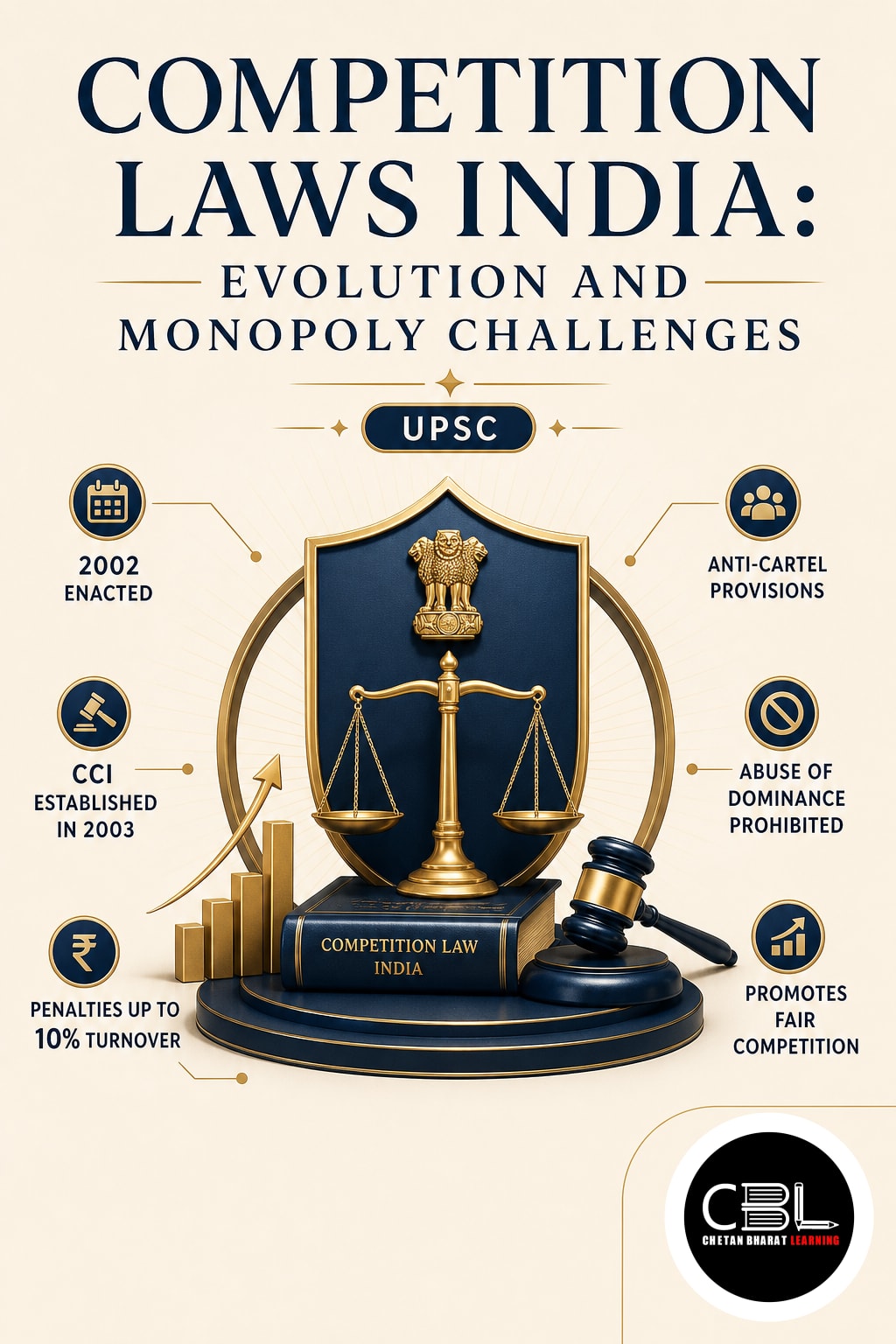

Important for
- Prelims: Economy, Competition Commission and Economic Reforms
- Mains: GS Paper 3 – Economy; GS Paper 2 – Governance
Competition Laws India have returned to public debate following Elon Musk’s allegations that influential business interests are obstructing Starlink’s entry into the Indian satellite internet market. Union Communications Minister Jyotiraditya Scindia rejected the claims, maintaining that India follows a non-discriminatory licensing framework. The controversy raises important questions about monopolies, market dominance, regulatory transparency and fair competition. India’s approach has evolved from colonial trade monopolies and post-Independence industrial controls to a competition framework focused on preventing anti-competitive conduct.
What is a Monopoly?
A monopoly is a market structure in which a single seller supplies a product or service without close substitutes. Significant barriers to entry may enable the firm to influence prices and output.
A monopoly differs from an oligopoly, where a few major firms dominate a market. In competition law, regulators also distinguish market dominance from the unlawful abuse of that dominance.
The Competition Act, 2002 does not prohibit a firm merely for being large or dominant. Section 4 prohibits the abuse of a dominant position through specified anti-competitive practices.
Monopoly vs Dominance vs Abuse of Dominance
| Concept | Meaning |
|---|---|
| Monopoly | A market structure with one supplier and no close substitutes. |
| Dominant Position | Market strength allowing an enterprise to operate independently of competitive forces or influence the relevant market. |
| Abuse of Dominance | Conduct such as unfair pricing, denial of market access or exclusionary practices that violates Section 4. |
| Cartel | Coordination among competing enterprises to manipulate prices, output, markets or bids. |
Why in News?
In October 2026, Elon Musk alleged that influential Indian business interests were obstructing Starlink’s commercial launch. The dispute attracted attention because satellite broadband could expand connectivity in underserved regions.
Union Communications Minister Jyotiraditya Scindia rejected allegations of discriminatory treatment. He stated that Starlink, Jio Satellite Communications and Eutelsat OneWeb had received satellite communication licences but still had to satisfy regulatory requirements before commercial operations.
These requirements include security compliance and satellite spectrum allocation. Regulatory authorisation therefore should not be confused with permission to commence commercial services.
The allegations have not, by themselves, established unlawful monopolistic conduct. Determining abuse requires examination of the relevant market, evidence of exclusionary behaviour and applicable competition law.
Evolution of Competition Regulation in India
1. Colonial Period: Trade Monopolies
- East India Company: Royal charters granted exclusive trading privileges, allowing the Company to control important commercial activities.
- Salt and Opium: Colonial authorities used state-controlled trading and fiscal arrangements to raise revenue.
- Managing Agencies: Powerful business groups controlled significant sections of banking, shipping, jute and industrial commerce.
Colonial monopolies primarily protected administrative revenue and privileged trading interests, rather than competitive market outcomes.
2. Post-Independence Controls: 1947–1991
After Independence, India adopted planned economic development and extensive industrial regulation. Policymakers aimed to prevent excessive private concentration while expanding strategic public-sector industries.
- Article 39(c): Directs State policy against concentration of wealth and means of production to the common detriment.
- Industries Act, 1951: Established industrial licensing and government regulation of specified industries.
- Industrial Policy Resolution, 1956: Expanded the public sector’s role in core and strategic industries.
- Monopolies Inquiry Commission: Examined economic concentration and restrictive business practices during the 1960s.
- MRTP Act, 1969: Addressed monopolistic and restrictive trade practices within the earlier industrial policy framework.
3. Liberalisation After 1991
The 1991 economic reforms dismantled much of the industrial licensing framework. Greater private participation, foreign investment and deregulation intensified competition across several sectors.
The emphasis gradually shifted from controlling the size of business enterprises to regulating conduct that undermined market competition.
4. Competition Act, 2002 and Modern Regulation
The Competition Act, 2002 replaced the MRTP framework and established the Competition Commission of India. Its principal objectives include preventing anti-competitive practices, promoting competition and protecting consumer interests.
The Act also regulates mergers, acquisitions and combinations that may substantially reduce market competition.
Major Laws and Institutions
| Law or Institution | Significance |
|---|---|
| MRTP Act, 1969 | Earlier framework addressing monopolistic and restrictive trade practices. |
| Competition Act, 2002 | Principal legislation against anti-competitive agreements and abuse of dominance. |
| Competition Commission of India | Statutory regulator investigating prohibited practices and reviewing combinations. |
| NCLAT | Appellate tribunal for specified CCI orders and decisions. |
| Competition Amendment Act, 2023 | Introduced reforms relating to merger review, penalties, settlements and commitments. |
Key Provisions of the Competition Act
- Section 3: Prohibits anti-competitive agreements, including certain cartels and bid-rigging arrangements.
- Section 4: Prohibits abuse of a dominant position in a relevant market.
- Sections 5 and 6: Govern combinations and merger notification requirements.
- Section 19: Provides for inquiries into specified anti-competitive conduct.
- Section 27: Authorises the CCI to issue appropriate orders and impose penalties where violations are established.
Competition Amendment Act, 2023
The 2023 amendment modernised competition regulation to address complex mergers and changing business practices, including transactions in digital markets.
- Deal Value Threshold: Introduced notification requirements for qualifying transactions exceeding ₹2,000 crore where the target has substantial business operations in India.
- Faster Merger Review: Reduced the overall combination review timeline from 210 to 150 days.
- Settlement Mechanism: Enables eligible enterprises to seek settlement of specified competition investigations.
- Commitment Mechanism: Allows proposed corrective commitments in eligible cases at the prescribed stage of proceedings.
- Global Turnover-Based Penalties: Expanded the statutory penalty framework to consider global turnover from all products and services.
- Greater Enforcement Flexibility: Introduced additional mechanisms to improve regulatory efficiency and compliance.
Emerging Monopoly and Competition Challenges
- Digital Platform Network Effects: Large user networks may make it difficult for smaller competitors to attract customers and developers.
- Data Concentration: Extensive access to user data and digital infrastructure can create competitive advantages that are difficult to replicate.
- Predatory Pricing: Below-cost pricing by a dominant enterprise may constitute unlawful conduct where the statutory requirements are satisfied.
- High Infrastructure Costs: Telecommunications, energy and transport require substantial capital investment, potentially limiting new entry.
- Cross-Sector Conglomerates: Large business groups may operate across interconnected markets, creating complex questions about competition and vertical integration.
- Regulatory Overlap: Sectoral regulators and the CCI may examine different aspects of the same business conduct, requiring coordinated jurisdiction.
- Algorithmic Conduct: Pricing algorithms and automated platforms can present new challenges concerning coordination, exclusion and market transparency.
Starlink-Jio Dispute: Key Regulatory Questions
The Starlink controversy raises three separate questions: whether companies satisfy lawful entry requirements, whether regulators apply those requirements fairly, and whether any enterprise has engaged in prohibited anti-competitive conduct.
Satellite broadband operators require applicable licensing, security compliance and spectrum authorisation. These conditions can serve legitimate public-interest purposes, but their implementation should remain transparent and proportionate.
Market concentration alone cannot establish a legal violation. Any competition assessment must define the relevant market and examine actual evidence of exclusionary practices.
Challenges in Competition Enforcement
- Complex Market Definition: Digital services and bundled products can make relevant-market boundaries difficult to establish.
- Fast Technological Change: Technology may evolve faster than traditional investigation and litigation procedures.
- Information Asymmetry: Regulators may struggle to access proprietary pricing algorithms, technical systems and platform data.
- Regulatory Coordination: Overlapping telecom, data, consumer and competition rules can create uncertainty.
- Cross-Border Business Models: Multinational digital enterprises may operate through complex corporate and data structures.
- Consumer Welfare Assessment: Low prices may benefit consumers immediately while potentially obscuring longer-term exclusionary risks.
Way Forward
- Strengthen Digital Competition Regulation: Develop proportionate ex-ante obligations for designated large digital enterprises where justified by evidence.
- Improve Licensing Transparency: Publish objective entry requirements, review timelines and consistent regulatory procedures.
- Ensure Infrastructure Access: Promote fair and non-discriminatory access to essential facilities where legally and technically appropriate.
- Enhance CCI Capabilities: Expand expertise in algorithms, digital markets, telecommunications and forensic data analysis.
- Coordinate Regulators: Strengthen cooperation between the CCI, TRAI and other specialised authorities.
- Protect Innovation and Consumers: Balance efficient large-scale investment with market contestability, consumer choice and new enterprise entry.
India’s competition framework has evolved from controlling industrial concentration to regulating business conduct in increasingly complex markets. The Competition Act and its 2023 amendments represent important steps towards modern economic oversight.
The satellite internet controversy demonstrates the need to distinguish legitimate security regulation from possible anti-competitive barriers. Strong institutions must protect fair competition without presuming that commercial success or market dominance is inherently unlawful.
Prelims Practice Corner
Q1. Which legislation established India’s modern competition regulatory framework?
(a) MRTP Act, 1969
(b) Companies Act, 1956
(c) Competition Act, 2002
(d) Industries Act, 1951
Answer
Answer: (c) The Competition Act, 2002 established the framework administered by the Competition Commission of India.
Q2. Consider the following statements:
1. Section 3 addresses anti-competitive agreements.
2. Section 4 prohibits the abuse of dominant position.
3. Every enterprise holding a dominant position is automatically guilty of violating competition law.
Which statements are correct?
(a) 1 and 2 only
(b) 2 and 3 only
(c) 1 and 3 only
(d) 1, 2 and 3
Answer
Answer: (a) Dominance itself is not prohibited. The law prohibits specified abuses of that dominance.
Q3. What deal-value threshold was introduced under the Competition Amendment Act, 2023, subject to substantial business operations in India?
(a) ₹500 crore
(b) ₹1,000 crore
(c) ₹5,000 crore
(d) ₹2,000 crore
Answer
Answer: (d) Qualifying transactions exceeding ₹2,000 crore can trigger combination notification requirements.
Q4. Which constitutional provision directs State policy against concentration of wealth and means of production to the common detriment?
(a) Article 19(1)(g)
(b) Article 39(c)
(c) Article 32
(d) Article 51A
Answer
Answer: (b) Article 39(c) forms part of the Directive Principles of State Policy.
Q5. Which institution is the designated appellate tribunal for specified decisions of the Competition Commission of India?
(a) National Green Tribunal
(b) Central Administrative Tribunal
(c) National Company Law Appellate Tribunal
(d) Securities Appellate Tribunal
Answer
Answer: (c) The NCLAT hears appeals against specified CCI decisions.
Mains Practice Questions
Q1. Trace the evolution of competition regulation in India from colonial monopolies to the Competition Act, 2002. Examine the challenges posed by digital platforms and infrastructure-intensive markets. (15 marks)
Answer Structure:
Intro: Define monopolies and distinguish market dominance from abuse of dominance.
Body: Explain colonial trade controls, post-Independence licensing, MRTP, liberalisation, the CCI and digital competition challenges.
Conclusion: Recommend modern competition regulation that protects innovation and fair market access.
Q2. The emergence of satellite internet and digital platforms creates new challenges for competition regulators. Discuss with reference to the Starlink-Jio debate and India’s current competition framework. (10 marks)
Answer Structure:
Intro: Introduce the dispute over satellite broadband licensing and commercial entry.
Body: Discuss security requirements, regulatory fairness, market contestability, dominance assessments and CCI-TRAI coordination.
Conclusion: Emphasise transparent rules, impartial enforcement and consumer choice.
Frequently Asked Questions
What is the difference between monopoly and abuse of dominance?
A monopoly is a market structure dominated by one seller. Abuse of dominance refers to prohibited conduct by an enterprise with significant market power, such as exclusionary practices or unfair pricing. Indian competition law does not prohibit dominance by itself.
What are the major provisions of the Competition Act, 2002?
Section 3 addresses anti-competitive agreements, Section 4 prohibits abuse of dominance, and Sections 5 and 6 regulate qualifying mergers and acquisitions. The CCI enforces these provisions.
Why is the Starlink-Jio dispute relevant to competition law?
The dispute raises questions about regulatory transparency, market entry and competition in satellite broadband. Government officials reject allegations of discriminatory treatment, while operators continue to face regulatory requirements. Establishing abuse of dominance would require evidence beyond the allegations themselves.
Related Current Affairs
Preparing for UPSC, PCS or HCS?
Talk to a mentor at Chetan Bharat Learning, Chandigarh. Free guidance on choosing the right exam and building a study plan.
Chat on WhatsAppCall 97793 53345UPSC / IAS / PCS coaching in Chandigarh · Trusted by aspirants across Punjab & Haryana
Leave a Reply
You must be logged in to post a comment.