
CEC impeachment 2026 entered a new phase on 31 October, when the INDIA bloc held a mock public hearing against Chief Election Commissioner Gyanesh Kumar. For the removal rules, see CBL’s earlier analysis of the constitutional process and its polity current affairs coverage.
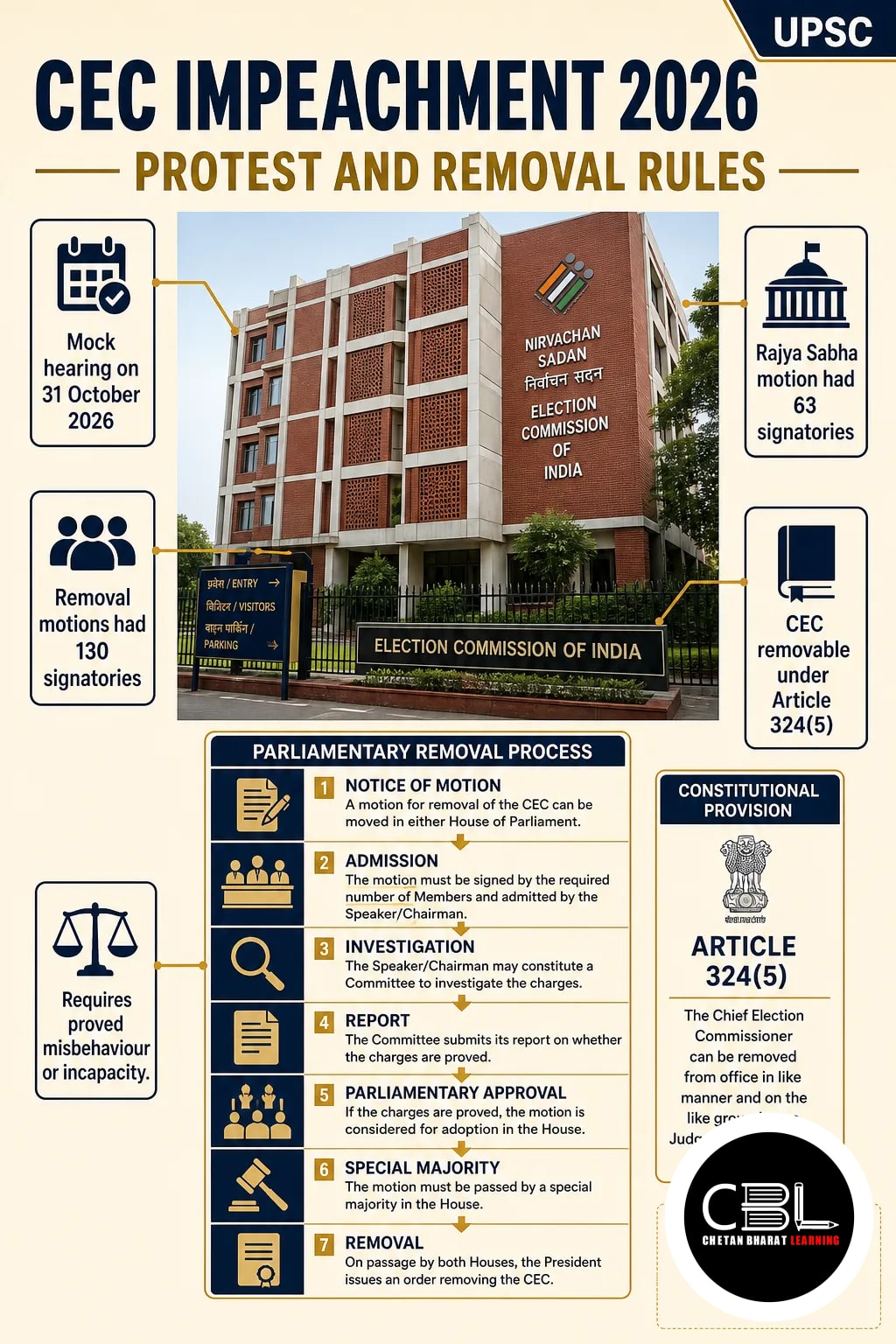
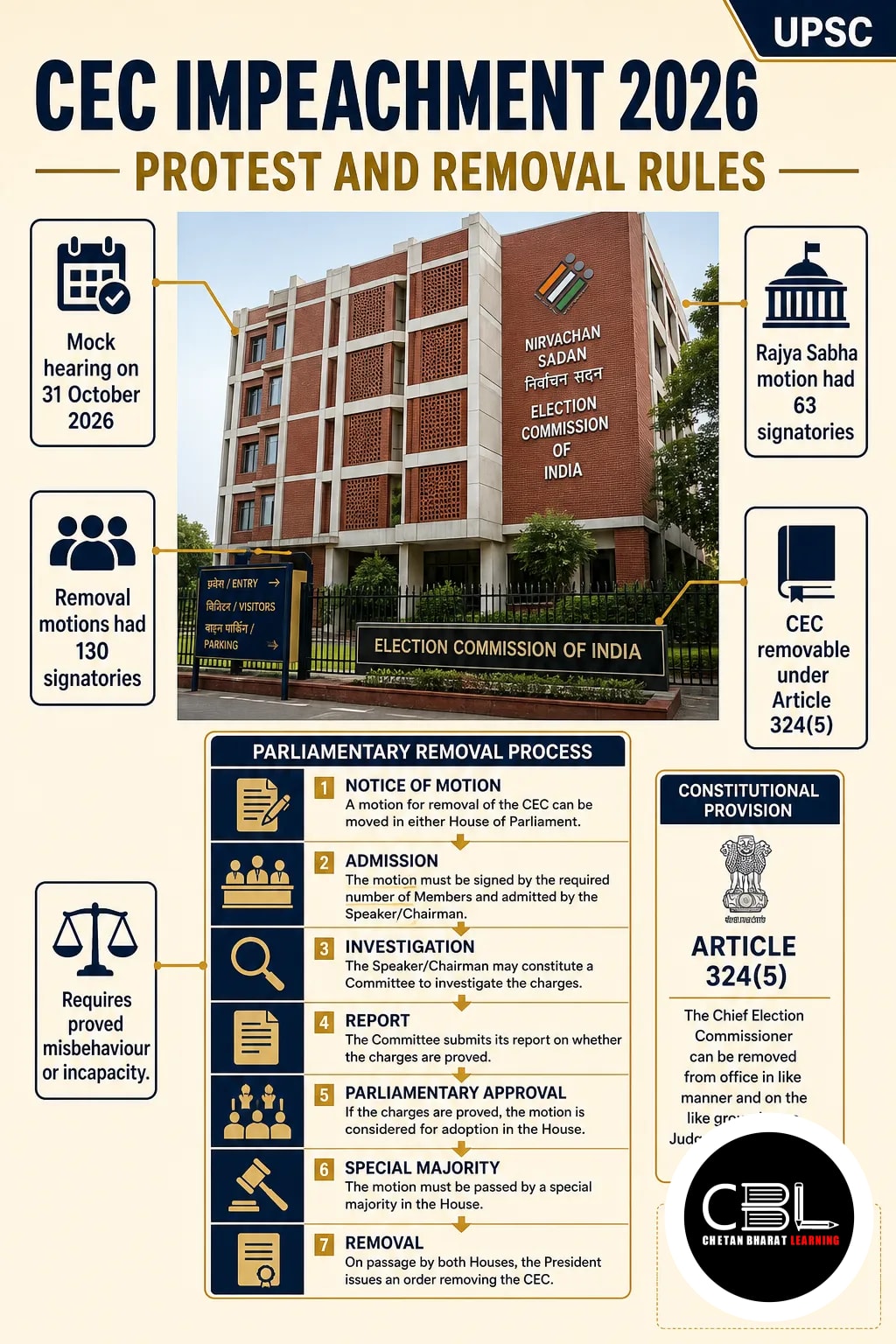
Quick answer: In the CEC impeachment 2026 dispute, opposition leaders staged a mock hearing over alleged voter-roll irregularities. Earlier, Parliament’s presiding officers rejected removal motions signed by 130 Lok Sabha and 63 Rajya Sabha members. The public event cannot remove the Chief Election Commissioner; only the constitutional process can do so.
What happened at the public hearing?
The opposition staged a symbolic hearing against the Chief Election Commissioner (CEC) over alleged irregularities in electoral-roll revision. Former Lok Sabha Speaker Meira Kumar presided over the mock proceedings. Trinamool Congress leader Saugata Roy and Samajwadi Party leader Awadhesh Prasad served as deputy chairs.
Congress president Mallikarjun Kharge listed six charges, including allegations of facilitating vote theft and deleting 13.2 crore voter names. He also alleged that Form 6 had changed without parliamentary oversight. Rahul Gandhi claimed that the 2024 Lok Sabha elections were illegal; these are political allegations, not findings established by the mock hearing.
The dispute concerns the Election Commission of India (ECI) and its Special Intensive Revision (SIR) of electoral rolls. Meanwhile, opposition parties planned a rally at Delhi’s Ramlila Maidan seeking Kumar’s resignation on 1 November. For background, read CBL’s coverage of electoral-roll revision and judicial review.
Why were the parliamentary motions rejected?
The Lok Sabha Speaker and Rajya Sabha Chairman rejected the opposition’s removal motions in April without assigning reasons, according to the source. The motions, submitted on 12 March, alleged partisan and discriminatory conduct during SIR and obstruction of investigation into electoral fraud.
The Lok Sabha notice had 130 signatories and the Rajya Sabha notice had 63. Both exceeded the respective signature thresholds. However, meeting a threshold does not automatically secure admission: the relevant presiding officer decides whether to admit the notice.
The source also says that the two Election Commissioners raised concerns about SIR-related processes. Consequently, the episode raises questions about how electoral-roll decisions are scrutinised within the Commission as well as in public.
What does the Constitution require for removal?
The CEC can be removed only in the same manner and on the same grounds as a Supreme Court judge. This protection under Article 324(5) sets a high threshold to insulate the office from political pressure.
| Provision | Rule |
|---|---|
| Article 324(5) | Protects the CEC through the Supreme Court judge removal standard; other Election Commissioners require the CEC’s recommendation for removal. |
| Article 124(4) | Specifies proved misbehaviour or incapacity and the parliamentary majorities for removing a Supreme Court judge. |
| 2023 Act, Section 11 | Restates the constitutional removal protection for the CEC. |
How does the formal process work?
A removal notice requires at least 100 Lok Sabha members or 50 Rajya Sabha members. The Speaker or Chairman respectively may admit or refuse it. If admitted, an inquiry committee examines the allegations and evidence.
Removal requires proved misbehaviour or incapacity, not merely a political accusation. Each House must then support an address by a majority of its total membership and at least two-thirds of members present and voting, in the same session. The President issues the removal order after those requirements are met.
Therefore, a mock hearing has no constitutional effect on tenure. Equally, rejection of a notice is not an inquiry finding that resolves the underlying allegations.
How are Election Commissioners appointed?
The President appoints the CEC and Election Commissioners on the recommendation of a three-member selection committee. The committee comprises the Prime Minister, the Leader of the Opposition in the Lok Sabha and a Union Cabinet minister.
Under the 2023 law, appointees must have held secretary-level government positions and possess the specified integrity and electoral-management experience. Their term is six years or until age 65, whichever comes first. Moreover, the CEC receives service and monetary benefits equivalent to those of a Supreme Court judge.
Why does the dispute matter for electoral governance?
The controversy exposes the tension between institutional independence and meaningful accountability for electoral administration. A difficult removal process protects the CEC from arbitrary dismissal; however, that protection does not eliminate the need to examine credible complaints.
- Voter inclusion: Roll revisions require careful scrutiny because erroneous exclusions can prevent eligible citizens from voting.
- Evidence and trust: Published explanations and accessible records can help citizens assess allegations without treating either side’s claims as established facts.
- Institutional accountability: Reasoned decisions and effective complaint mechanisms can support scrutiny while preserving the Commission’s independence.
- Procedural balance: Parliament’s removal power addresses serious misconduct or incapacity; it is not a substitute for routine correction of individual roll errors.
A practical response would distinguish individual corrections from institutional allegations. For instance, clear notices, accessible appeals and timely disposal of voter complaints could address roll errors. Separately, evidence-based scrutiny of systemic allegations can strengthen public confidence without prejudging the outcome; see the discussion of voter-roll appeals and legal issues.
Source: Indian Express Explained, 31 October 2026
- CEC Impeachment Process: Rules and UPSC Analysis (31 Oct 2026)
- CEC Impeachment Protest: Constitutional Rules for UPSC (29 Oct 2026)
- Electoral Roll Revision and Supreme Court Review (28 Oct 2026)
Asked in UPSC: Previous Year Questions
- UPSC CSE Mains 2026 (GS Paper II): Discuss the Election Commission’s position while revising electoral rolls. Can it also examine voters’ citizenship?
- UPSC CSE Mains 2018 (GS Paper II): In light of the electronic voting machine controversy, what challenges does the Election Commission face in ensuring trustworthy elections?
UPSC links the Commission’s powers with electoral integrity; therefore, revise both constitutional safeguards and administrative processes.
State PCS General Studies can test the ECI’s constitutional position and voter-roll administration. Also distinguish the ECI from State Election Commissions, which supervise elections to local bodies under Articles 243K and 243ZA.
Prelims Practice Corner
Mains Practice Questions
Frequently Asked Questions
Can a public impeachment remove the CEC?
No, because a mock public hearing has no constitutional power to remove the CEC. Formal removal requires the prescribed parliamentary process and a presidential order.
What are the grounds for removing the CEC?
Proved misbehaviour or incapacity are the grounds. Article 324(5) applies the same grounds and manner as for a Supreme Court judge.
What majority is needed in Parliament to remove the CEC?
Each House needs a majority of its total membership and two-thirds of members present and voting. Moreover, both Houses must pass the address in the same session.
Related Current Affairs
Preparing for UPSC, PCS or HCS?
Talk to a mentor at Chetan Bharat Learning, Chandigarh. Free guidance on choosing the right exam and building a study plan.
Chat on WhatsAppCall 97793 53345UPSC / IAS / PCS coaching in Chandigarh · Trusted by aspirants across Punjab & Haryana

 Ananya RanaIAS · AIR 60
 Aditya SharmaIAS · AIR 70
 Ria Kaur SethiIPS · AIR 89
 Aman AloonIRS · AIR 295
 Sumer Singh VirkIRS · AIR 335
 Shivani PanchalIAS

Leave a Reply
You must be logged in to post a comment.