

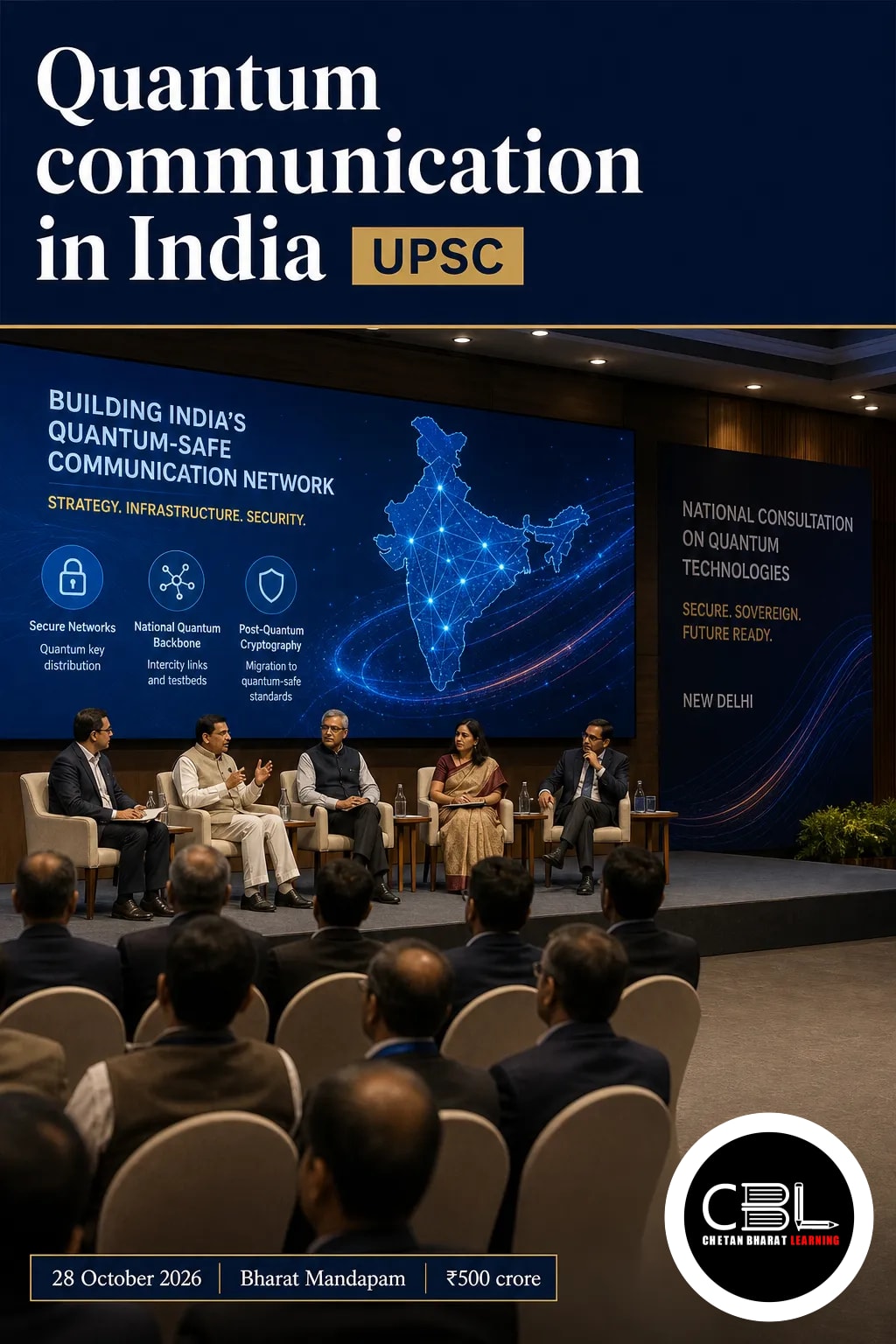
Quantum communication in India featured in a Department of Telecommunications session on secure networks at ESTIC 2026. For background, read CBL’s analysis of India’s Quantum Mission.
Quick answer: Quantum communication in India was a focus of the telecom department’s session on 28 October 2026 at Bharat Mandapam, New Delhi. A vision document identified a national quantum-secure communication network as a priority. The department also cited support for over 130 telecom projects worth approximately ₹500 crore.
What is quantum communication?
Quantum communication uses quantum states to transmit information or establish cryptographic keys. For example, quantum key distribution uses quantum properties to help detect interception during key exchange.
Quantum key distribution primarily establishes a shared key; it does not itself transmit the encrypted message. In contrast, post-quantum cryptography uses mathematical algorithms designed to resist attacks by quantum computers.
Why was quantum communication in the news?
The Department of Telecommunications (DoT), under the Ministry of Communications, led the session at the Emerging Science, Technology and Innovation Conclave (ESTIC) 2026. Telecom Secretary Amit Agrawal chaired the discussion with industry and academic experts.
The accompanying vision document identified a national quantum-secure communication network as a priority, rather than announcing its completed deployment. Moreover, it called for stronger links between research, testbeds, industry and commercial deployment.
What were the key facts and priorities?
The session linked Quantum communication in India with indigenous telecom development and network security.
| Area | Key fact |
|---|---|
| Telecom base | Agrawal cited 1.2 billion mobile network connections and fifth-generation (5G) services in almost every district. |
| Telecom research | The Telecommunication Technology Development Fund has supported over 130 projects worth approximately ₹500 crore. |
| Testing and standards | The Technology Development and Investment Promotion Scheme has a budget above ₹200 crore and has been renewed until 2031. |
| Vision priorities | Indigenous sixth-generation (6G) technologies, quantum-secure communication, zero trust, cyber resilience and skills. |
| Demonstrations | The Centre for Development of Telematics and Bharat Sanchar Nigam Limited jointly displayed quantum communication and mission-critical service solutions. |
The investment promotion scheme helps startups and micro, small and medium enterprises engage with global standardisation. In addition, it supports testing their solutions on live networks.
How can intelligent and secure networks be used?
Intelligent networks can combine automation with stronger communication security. At the session, N. G. Subramaniam of Tejas Networks discussed artificial intelligence (AI), quantum-safe technology and blockchain as complementary tools.
- Healthcare: High-bandwidth, low-latency links could support AI-based medical imaging beyond major urban centres, with quantum-safe security.
- Radio access: Indigenous chips, radio units and base-station solutions can support network development; AI can also help optimise networks.
- Cybersecurity: The vision document prioritised zero trust, an approach that requires verification rather than assuming access is trustworthy.
What challenges and next steps matter?
The vision document emphasised moving research towards practical deployment. However, a stated priority is not the same as a functioning national network.
- Testing and adoption: Testbeds and live-network trials can help connect research with commercial use.
- Standards and skills: Participation in standardisation and workforce development can support adoption; both require sustained attention.
- Security design: Quantum-safe tools need to complement wider cyber-resilience measures rather than replace them.
Source: Press Information Bureau, 28 October 2026
- Quantum Mission: India’s Tech Leap Analysis (7 Sep 2026)
- Digital India Act: Replacing the IT Act for a Safer Internet (10 Sep 2026)
Punjab PCS and Haryana HCS General Studies can test quantum communication, cybersecurity and telecom institutions. Questions may also connect secure networks to digital public services.
Prelims Practice Corner
Mains Practice Questions
Frequently Asked Questions
What is quantum key distribution?
Quantum key distribution uses quantum states to establish a cryptographic key. It can also help communicating parties detect interception during key exchange.
Is post-quantum cryptography the same as quantum communication?
No. Post-quantum cryptography uses mathematical algorithms designed to resist quantum-computer attacks, whereas quantum communication uses quantum states.
What did the ESTIC 2026 vision document say about quantum networks?
It identified a national quantum-secure communication network as a priority. It also emphasised links between research, testbeds, industry and commercial deployment.
How many projects has the telecom development fund supported?
It has supported more than 130 projects worth approximately ₹500 crore. The telecom secretary cited these figures at the session on 28 October 2026.
Related Current Affairs
Preparing for UPSC, PCS or HCS?
Talk to a mentor at Chetan Bharat Learning, Chandigarh. Free guidance on choosing the right exam and building a study plan.
Chat on WhatsAppCall 97793 53345UPSC / IAS / PCS coaching in Chandigarh · Trusted by aspirants across Punjab & Haryana
Leave a Reply
You must be logged in to post a comment.