

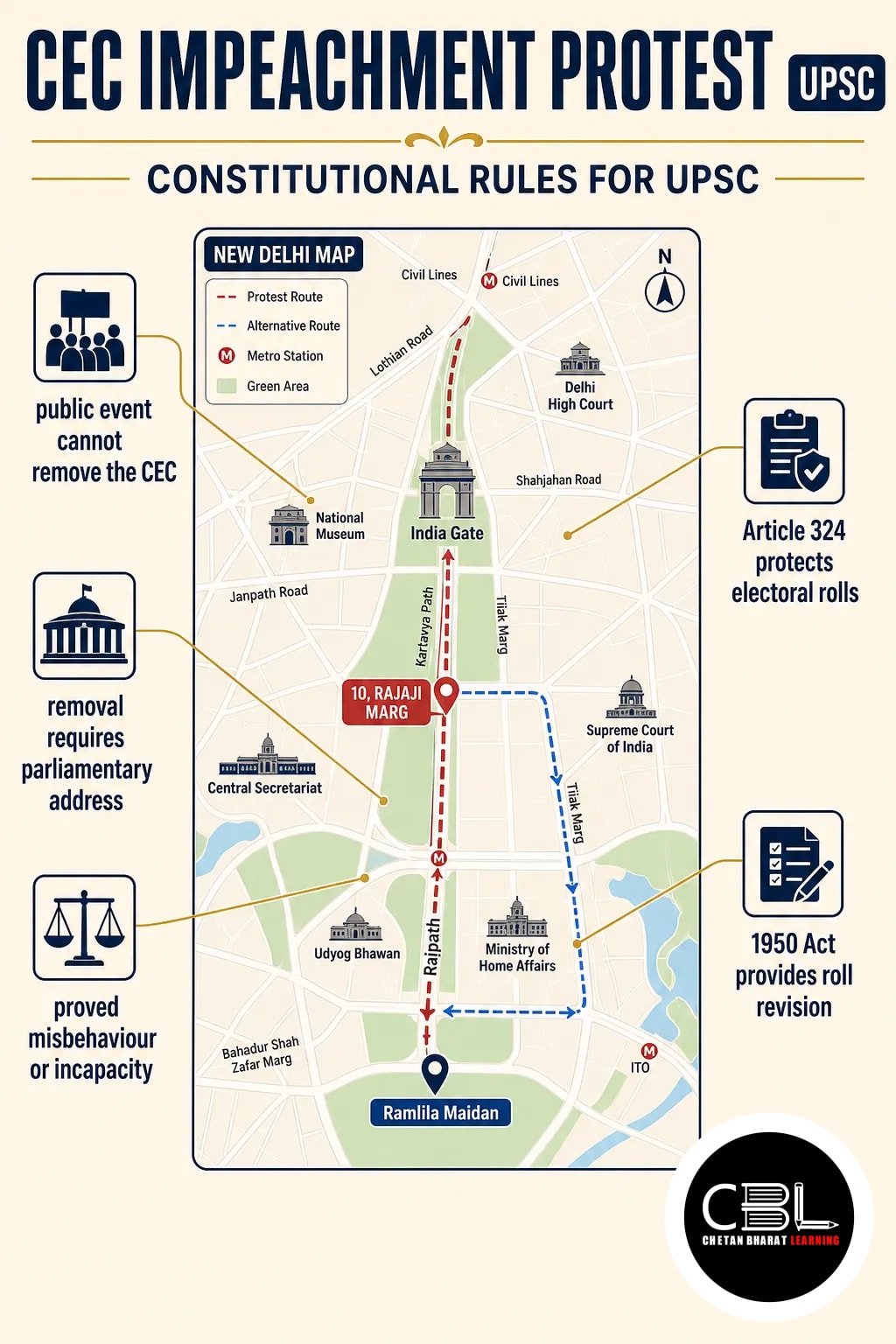
The CEC impeachment protest planned for 30 October 2026 has raised questions about electoral rolls and constitutional safeguards. The event is a political protest, not a formal removal proceeding; follow more current affairs for UPSC.
Quick answer: The CEC impeachment protest is an opposition event planned in New Delhi on 30 October 2026 against Chief Election Commissioner Gyanesh Kumar. The Indian National Developmental Inclusive Alliance alleges electoral manipulation through the Special Intensive Revision of rolls. However, the event cannot remove the CEC; the Constitution prescribes a separate parliamentary process.
What do the constitutional rules say?
The Constitution protects the Chief Election Commissioner (CEC) through a removal process equivalent to that for a Supreme Court judge. Therefore, a public event or a political motion outside Parliament has no power to remove the officeholder.
Under Articles 324(5) and 124(4), removal requires a presidential order after an address by each House of Parliament. Each House must support the address in the same session by a majority of its total membership and by at least two-thirds of members present and voting. The grounds are proved misbehaviour or incapacity.
The phrase ‘public impeachment’ describes the organisers’ event, not a constitutional procedure. Moreover, a political allegation alone does not establish either constitutional ground for removal.
Why is the protest planned?
The Indian National Developmental Inclusive Alliance (INDIA) plans the event over alleged manipulation linked to the Special Intensive Revision (SIR) of electoral rolls. These are allegations by the opposition; the source does not establish them as findings of fact.
According to The Hindu’s sources, former Lok Sabha Speaker Meira Kumar is expected to preside. Congress president Mallikarjun Kharge is likely to move the motion, while Lok Sabha Leader of Opposition Rahul Gandhi is expected to speak last.
Representatives of civil society, student organisations and people left out of electoral rolls are expected to attend. The event is also intended as a curtain-raiser for the bloc’s 1 November Chalo Dilli rally at Ramlila Maidan.
Organisers are likely to avoid posters of the Prime Minister, Home Minister and CEC, as well as symbolic treasury benches. However, the source says there is no official word on the programme’s precise format.
Which constitutional and legal provisions apply?
Article 324 establishes the Election Commission’s electoral responsibilities and safeguards, while electoral roll legislation provides administrative procedures.
| Article or Act | What it provides |
|---|---|
| Article 324 | Vests superintendence, direction and control of electoral rolls and specified elections in the Election Commission. |
| Article 324(5) | Protects the CEC’s removal and service conditions; other Election Commissioners require the CEC’s recommendation for removal. |
| Article 124(4) | Sets out the parliamentary address and grounds for removing a Supreme Court judge, which also govern CEC removal. |
| Article 326 | Provides for adult suffrage in Lok Sabha and State Legislative Assembly elections, subject to constitutional and legal disqualifications. |
| Representation of the People Act, 1950 | Provides for electoral roll preparation, revision, correction and inclusion, subject to statutory conditions. |
The CEC’s service conditions cannot be varied to the holder’s disadvantage after appointment. In addition, an Election Commissioner or Regional Commissioner cannot be removed except on the CEC’s recommendation; this is distinct from the CEC’s own removal safeguard.
What are the implications for electoral governance?
The dispute brings together electoral inclusion, institutional independence and public confidence in the Election Commission of India (ECI).
- Accurate rolls: Revision can help maintain accurate records; however, eligible voters need a fair opportunity to remain enrolled.
- Institutional independence: A demanding removal threshold protects the CEC from arbitrary dismissal. At the same time, it does not prevent scrutiny of administrative decisions.
- Public accountability: Political parties and citizens can question electoral administration; therefore, clear explanations of revision procedures matter.
- Access to remedies: Roll-related correction and inclusion procedures under the 1950 Act matter because errors can affect an eligible person’s ability to vote.
What are the concerns and the way forward?
The central challenge is to assess electoral-roll complaints without confusing political protest with constitutional removal.
- Claims and evidence: Allegations require examination against records and applicable rules; therefore, the protest itself should not be treated as proof.
- Notice and access: Authorities should communicate revision requirements clearly and facilitate claims and objections, so eligible voters can seek corrections.
- Transparent decisions: Officials should explain decisions on disputed entries; consequently, affected voters can better understand available remedies.
- Institutional restraint: Political debate should distinguish criticism of officeholders from the constitutional process that protects the institution.
For Mains, the CEC impeachment protest illustrates a balance: independent election administration needs protection, but credible procedures and accessible remedies also support public trust.
Source: The Hindu, 29 October 2026
Asked in UPSC: Previous Year Questions
- UPSC CSE Mains 2026 (GS Paper II): Discuss the Election Commission’s position in electoral roll revision. Can it also examine voters’ citizenship?
- UPSC CSE Mains 2022 (GS Paper II): Discuss the Election Commission’s role in light of the evolution of the Model Code of Conduct.
- UPSC CSE Mains 2018 (GS Paper II): In light of the electronic voting machine controversy, what challenges does the Election Commission face in ensuring trustworthy elections?
UPSC connects the Commission’s powers with electoral procedures and public confidence; therefore, revise both institutional safeguards and administration.
Punjab PCS and Haryana HCS may test Article 324, electoral rolls and the CEC’s removal safeguards in General Studies. In addition, distinguish the ECI from State Election Commissions, which conduct local body elections.
Prelims Practice Corner
Mains Practice Questions
Frequently Asked Questions
Can the public impeachment event remove the CEC?
No, because it is a political event rather than a constitutional removal proceeding. The Constitution requires a separate parliamentary address and presidential order.
On what grounds can the CEC be removed?
Proved misbehaviour or incapacity are the grounds. In addition, each House must support an address with the required majorities in the same session.
Why is the opposition protesting against the CEC?
The opposition alleges electoral manipulation through the Special Intensive Revision of rolls. However, the source does not establish the allegation as a finding of fact.
Which law provides for electoral roll revision?
The Representation of the People Act, 1950 provides for electoral roll revision. It also contains provisions for correction and inclusion, subject to statutory conditions.
Related Current Affairs
Preparing for UPSC, PCS or HCS?
Talk to a mentor at Chetan Bharat Learning, Chandigarh. Free guidance on choosing the right exam and building a study plan.
Chat on WhatsAppCall 97793 53345UPSC / IAS / PCS coaching in Chandigarh · Trusted by aspirants across Punjab & Haryana
Leave a Reply
You must be logged in to post a comment.