
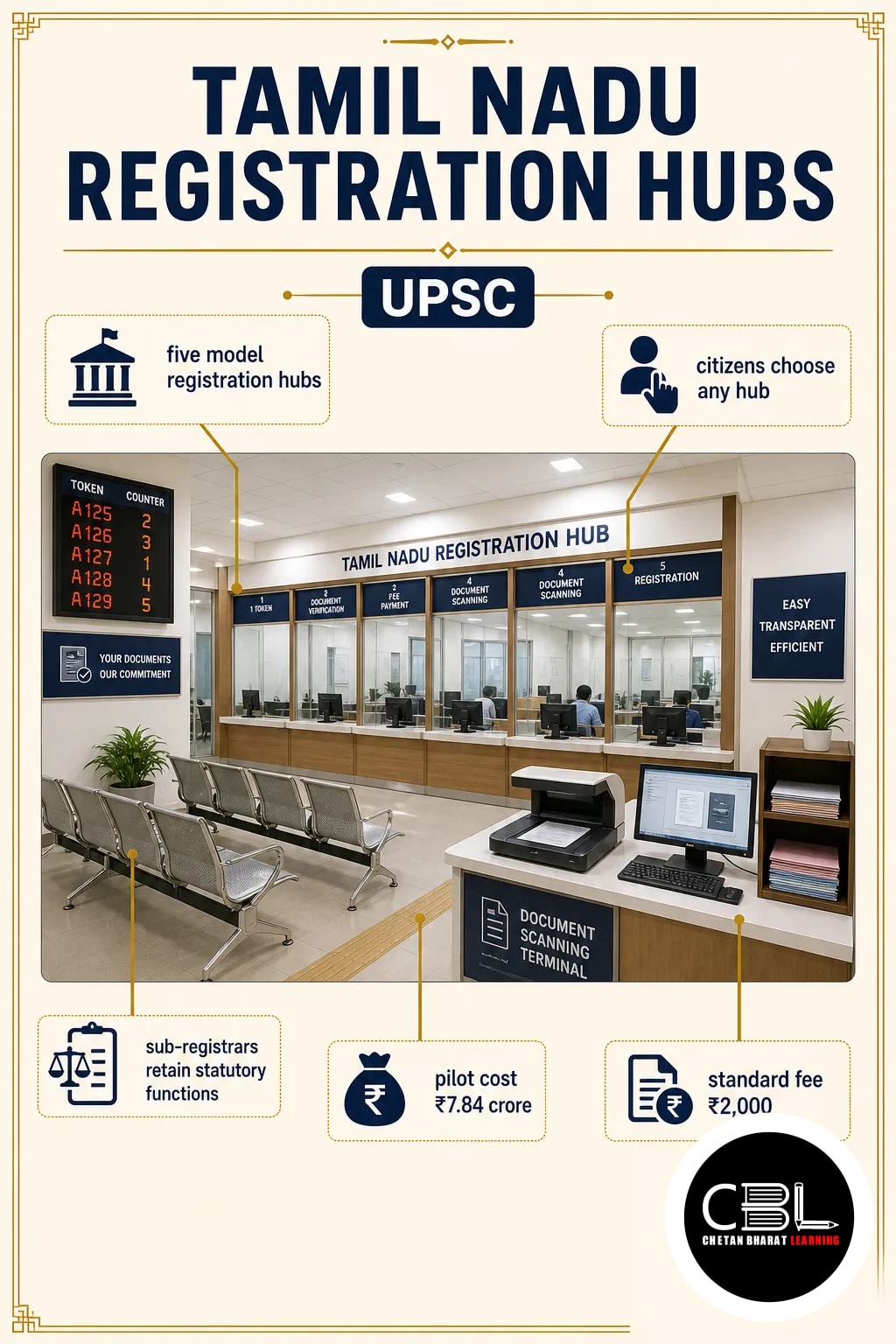
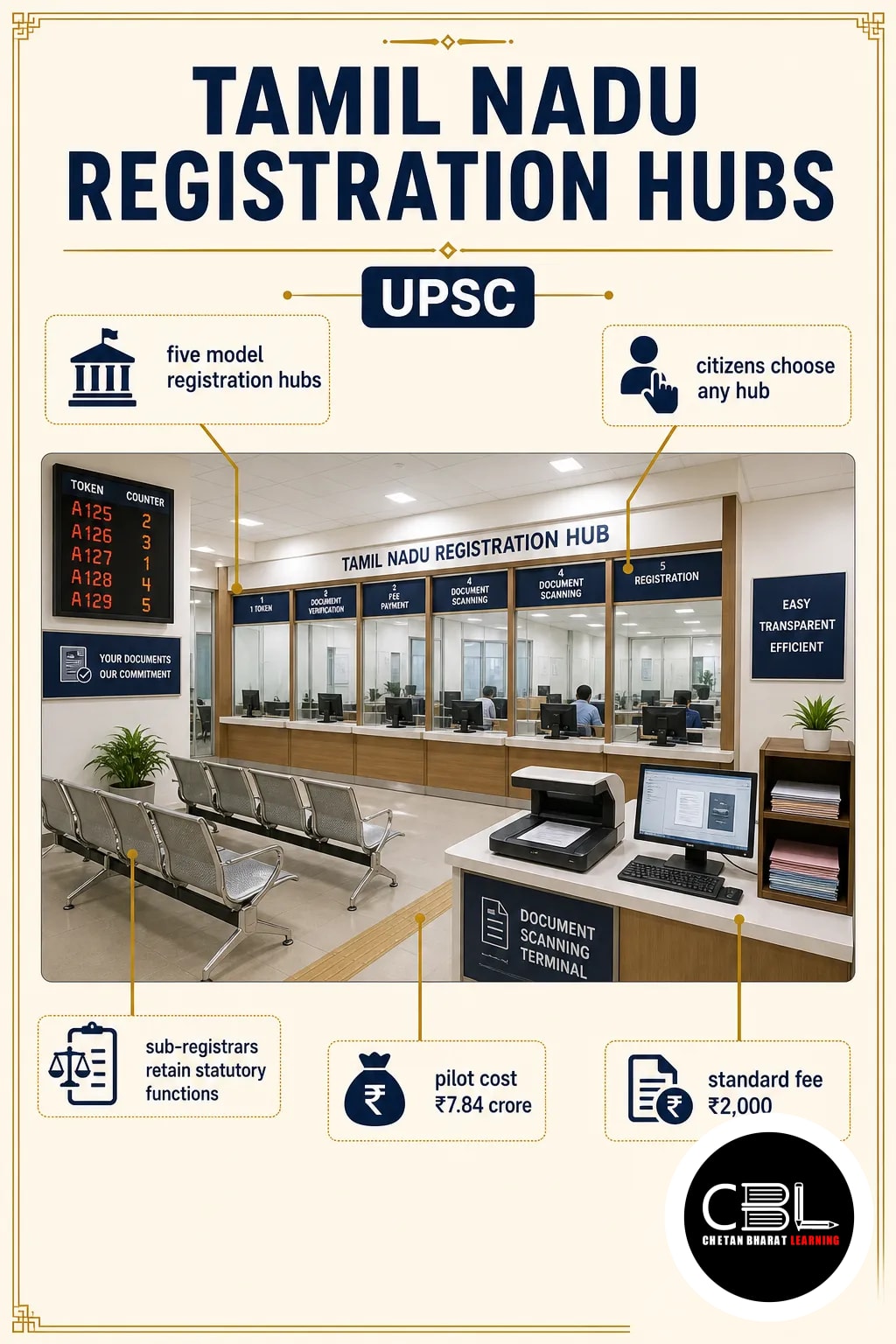
Tamil Nadu registration hubs will allow citizens to choose where they register documents and marriages, regardless of Sub-Registrar Office jurisdiction. The pilot offers a case study in governance and public service delivery.
Quick answer: Tamil Nadu has sanctioned five Model Registration Hubs at a pilot cost of ₹7.84 crore. They will operate across three Chennai registration districts, Chengalpattu and Coimbatore. Citizens can choose any hub for document or marriage registration, while Sub-Registrars retain statutory functions. The government plans 20 additional locations in later phases.
What are Tamil Nadu registration hubs?
The hubs expand a single-window, jurisdiction-free facility for registering documents and marriages. Citizens can choose any Model Registration Hub (MRH), irrespective of the territorial jurisdiction of the Sub-Registrar Office concerned over the property or parties.
However, jurisdiction-free access concerns the choice of hub; it does not remove statutory registration requirements. A government order from the Commercial Taxes and Registration Department authorises the pilot. The reform also illustrates how states can redesign service access without transferring statutory decisions to a private operator.
Where will the first hubs operate?
The first phase covers Chennai North, Chennai Central, Chennai South, Chengalpattu and Coimbatore registration districts. The sanctioned pilot has a cost of ₹7.84 crore; subsequently, the state plans expansion to 20 more locations.
Meanwhile, the order divides hubs into three categories according to document and marriage registration volumes. All categories must maintain uniform service standards and a consistent citizen experience.
| Category | Area | Seating | Workstations |
|---|---|---|---|
| I | 8,000 sq. ft. | 100 | 20 |
| II | 5,000 sq. ft. | 75 | 15 |
| III | 3,000 sq. ft. | 50 | 10 |
Each category will have the necessary information technology and non-technology equipment. Thus, capacity varies by expected volume rather than by a different prescribed service standard.
How will fees and management work?
The hubs will offer standard and premium services, including tatkal options, with different fees and revenue shares. The following shares run in the order Registration Department : service provider.
| Service | Fee | Revenue share |
|---|---|---|
| Standard | ₹2,000 | 80:20 |
| Tatkal standard | ₹5,000 | 80:20 |
| Premium | ₹5,000 | 50:50 |
| Tatkal premium | ₹10,000 | 65:35 |
A Managed Service Provider (MSP), selected through competitive tendering, will handle capital expenditure and operational responsibilities. However, the Sub-Registrar concerned will retain all statutory registration processes.
The state will redeploy District Registrars and Sub-Registrars rather than create additional posts. Therefore, the model combines outsourced infrastructure and operations with public control over statutory work. For broader context, see CBL’s discussion of business environment and administrative reforms.
Why does the reform matter for governance?
The reform separates a citizen’s choice of service location from the territorial link to a particular office. This design could improve convenience, but its results will depend on implementation.
- Choice and access: Citizens can select a hub instead of approaching only the office linked to the property or parties. Therefore, the model may reduce location-related inconvenience.
- Service capacity: Different hub sizes allow facilities to reflect registration volumes. In addition, common standards can support a consistent experience across categories.
- Public accountability: Sub-Registrars retain statutory functions, although the MSP manages infrastructure and operations. Thus, the state remains responsible for the public decision-making role.
- Administrative efficiency: Redeployment avoids new posts. However, it may also affect staffing at existing offices if workloads are not balanced.
The Tamil Nadu registration hubs also raise a distinction for property governance: registration records a transaction under the applicable process, but it should not automatically be equated with a government guarantee of ownership. Similarly, easier access does not itself resolve underlying title disputes.
What challenges need attention?
Affordability, oversight and record security will shape whether the pilot delivers equitable and reliable services.
- Fee burden: The standard fee is ₹2,000, while tatkal premium costs ₹10,000. Therefore, policymakers should assess whether the service charges discourage low-income users.
- Unequal access: The initial locations cover selected registration districts rather than the whole state. Consequently, travel and access barriers may persist outside the pilot areas.
- Private-provider oversight: Revenue sharing creates an incentive to generate service income. However, clear oversight is needed so premium services do not undermine standard-service quality.
- Records and privacy: Registration involves sensitive personal and property information. Therefore, secure access controls and audit trails deserve attention across hubs.
- Continuity and staffing: Redeployment and shared technology can create operational pressures. For example, a system failure or staffing shortage could disrupt service delivery.
What should the way forward prioritise?
The state should assess the pilot against access, service quality and accountability before expanding it. First, it can publish waiting times, transaction volumes and grievance-resolution performance for each hub. In addition, comparing standard and premium service outcomes would reveal whether service tiers receive equitable treatment.
Second, tender conditions should specify security, uptime, accessibility and independent audit requirements. Moreover, citizens need clear fee disclosures and a route to challenge errors or delays. Finally, staffing reviews should consider both hubs and existing offices, so redeployment does not simply shift queues elsewhere.
Overall, the Tamil Nadu registration hubs can serve as a useful governance experiment if the state measures outcomes rather than infrastructure alone. Their expansion should follow evidence on affordability, reliability and the protection of registration records.
Source: The Hindu, 30 October 2026
State PCS General Studies can use this pilot to test jurisdiction-free services, outsourcing and accountability. In addition, candidates can compare the governance issues with registration and citizen-service delivery in their own state without assuming identical rules.
Prelims Practice Corner
Mains Practice Questions
Frequently Asked Questions
Where are the first five registration hubs planned?
They are planned in Chennai North, Chennai Central, Chennai South, Chengalpattu and Coimbatore registration districts. Together, these locations form the ₹7.84 crore pilot.
Can citizens register marriages at any model hub?
Yes, because the model permits citizens to choose any hub irrespective of the concerned office’s territorial jurisdiction. However, applicable statutory registration processes remain with the Sub-Registrar.
What is the fee for standard registration at a hub?
The standard service fee is ₹2,000. In contrast, tatkal standard service costs ₹5,000.
Will a private provider perform statutory registrations?
No, because statutory registration processes remain with the Sub-Registrar concerned. The selected provider will instead handle capital expenditure and operations.
Related Current Affairs
Preparing for UPSC, PCS or HCS?
Talk to a mentor at Chetan Bharat Learning, Chandigarh. Free guidance on choosing the right exam and building a study plan.
Chat on WhatsAppCall 97793 53345UPSC / IAS / PCS coaching in Chandigarh · Trusted by aspirants across Punjab & Haryana
Leave a Reply
You must be logged in to post a comment.