

UPSC Mapping
| Exam | Topic |
|---|---|
| Prelims | Economy |
| Mains | GS Paper 3 |
Article
What is UPI Pricing?
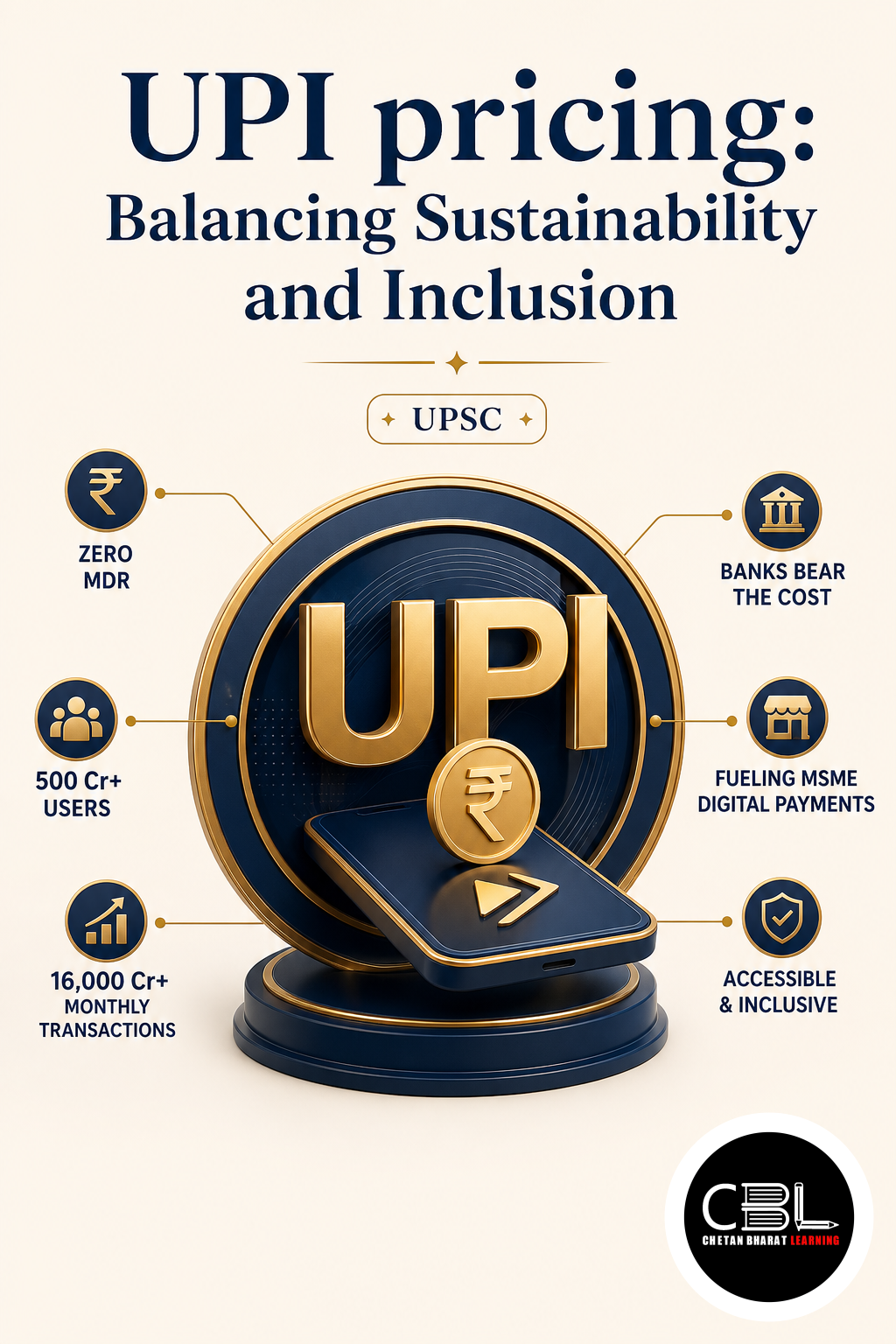
UPI pricing refers to the cost structure associated with Unified Payments Interface transactions, including Merchant Discount Rate (MDR) and other fees. Currently, most UPI transactions are zero-cost for consumers and merchants under the government’s zero-MDR regime.
However, the infrastructure behind UPI—including technology, cybersecurity, fraud prevention, and processing—incurs significant costs. The question of who pays for this infrastructure has become increasingly important as UPI scales to billions of transactions monthly.
Why is UPI Pricing in News?
The Parliamentary Standing Committee on Finance has tabled a report citing industry estimates of Rs 20,700 crore in annual operating costs for UPI, against a Rs 2,000 crore allocation. The Department of Financial Services is examining two options: restoring MDR for certain high-threshold transactions and phasing out government support through a tiered incentive structure.
This has sparked debate on ensuring UPI’s financial sustainability without compromising its inclusion gains. According to a PIB release, the government remains committed to keeping UPI affordable while exploring sustainable funding models.
Key Features of the UPI Ecosystem
- Zero-Cost Model: Most UPI transactions are free for consumers and merchants, driving rapid adoption across income groups.
- Digital Public Infrastructure: UPI is a key pillar of India’s DPI, combining public infrastructure with private innovation.
- Interoperability: UPI enables seamless transactions across different banks and payment apps.
- 24×7 Availability: The platform is available round-the-clock, facilitating real-time payments.
- Scale and Reach: UPI processes billions of transactions monthly, making it one of the world’s largest digital payment systems.
Challenges in UPI Pricing and Sustainability
- Cost Recovery: The gap between operating costs (Rs 20,700 cr) and government support (Rs 2,000 cr) is unsustainable in the long run.
- Merchant Asymmetry: A uniform MDR may be manageable for large businesses but burdensome for small street vendors.
- Geographic Disparities: MDR could slow merchant onboarding in areas where the network is still developing.
- Inclusion Concerns: Charging fees could undermine UPI’s role in financial inclusion and digital adoption.
- Public vs Private Funding: Balancing public subsidy with private investment remains a policy challenge.
Way Forward for Sustainable UPI Pricing
A workable UPI pricing principle would keep the service free for consumers and small merchants while allowing a capped MDR for larger commercial users and high-value transactions. Incentives should remain available where acceptance networks are still developing, with thresholds based on merchant margins and local adoption effects.
Additionally, firms can build commercial services around UPI while the underlying payment remains free. Anonymised and aggregated transaction data can support public planning, as seen with PhonePe’s PulsePro integration with PM GatiShakti. As suggested by a NITI Aayog consultation, policymakers need an ecosystem-view combining UPI data with official statistics for better economic insights.
Prelims Practice Corner
-
Q1. What is the estimated annual operating cost of the UPI network according to industry estimates?
- a) Rs 2,000 crore
- b) Rs 10,000 crore
- c) Rs 20,700 crore
- d) Rs 50,000 crore
Answer: (c) Rs 20,700 crore.
-
Q2. What does MDR stand for in the context of digital payments?
- a) Minimum Daily Return
- b) Merchant Discount Rate
- c) Maximum Deposit Rate
- d) Monthly Dividend Ratio
Answer: (b) Merchant Discount Rate.
-
Q3. Which of the following is NOT a challenge in UPI pricing?
- a) Cost recovery
- b) Merchant asymmetry
- c) Low transaction volume
- d) Inclusion concerns
Answer: (c) Low transaction volume.
-
Q4. Who developed the Unified Payments Interface?
- a) RBI
- b) NPCI
- c) SEBI
- d) NITI Aayog
Answer: (b) National Payments Corporation of India.
-
Q5. What is Digital Public Infrastructure (DPI) in the context of UPI?
- a) Physical banking network
- b) Digital platforms enabling public service delivery
- c) Private payment gateways
- d) Government-owned banks
Answer: (b) Digital platforms enabling public service delivery.
Mains Practice Questions
Q1. “UPI’s success in financial inclusion must be balanced with the need for financial sustainability.” Discuss the policy options available. (15 Marks)
- Introduction: Contextualize UPI’s role in financial inclusion and the emerging sustainability challenge.
- Body: Discuss options like tiered MDR, government subsidy reform, commercial services, and data monetisation. Evaluate each option’s impact on inclusion.
- Conclusion: Recommend a balanced approach keeping UPI free for small users while enabling cost recovery from larger transactions.
Q2. Examine the role of Digital Public Infrastructure in India’s economic development, with UPI as a case study. (10 Marks)
- Introduction: Define DPI and its significance in India’s digital transformation.
- Body: Discuss UPI as a DPI success story, its economic impact, and challenges like sustainability, privacy, and governance.
- Conclusion: Emphasize the need for institutional frameworks to guide DPI evolution.
FAQs on UPI Pricing
- Why is UPI pricing becoming a policy concern?
- With annual operating costs estimated at Rs 20,700 crore against Rs 2,000 crore in government support, ensuring UPI’s financial sustainability without compromising inclusion is a key policy challenge.
- What is the zero-MDR regime for UPI?
- The zero-MDR regime means merchants are not charged any fee for accepting UPI payments, making the service free for consumers and businesses.
- How can UPI be made sustainable without charging users?
- Options include a tiered MDR for larger merchants, commercial services around UPI, and using anonymised payment data for public planning while keeping basic transactions free.
Related Current Affairs
Preparing for UPSC, PCS or HCS?
Talk to a mentor at Chetan Bharat Learning, Chandigarh. Free guidance on choosing the right exam and building a study plan.
Chat on WhatsAppCall 97793 53345UPSC / IAS / PCS coaching in Chandigarh · Trusted by aspirants across Punjab & Haryana
Leave a Reply
You must be logged in to post a comment.