
UPSC Mapping
| Prelims | Polity & Economy |
|---|---|
| Mains | GS Paper 2 (Cooperative Societies) |
Quick Facts
| Total Societies | 8 lakh+ |
|---|---|
| Members | 30 crore+ |
| PACS Computerised | 80,000 |
What is the NCDC Amendment Bill?
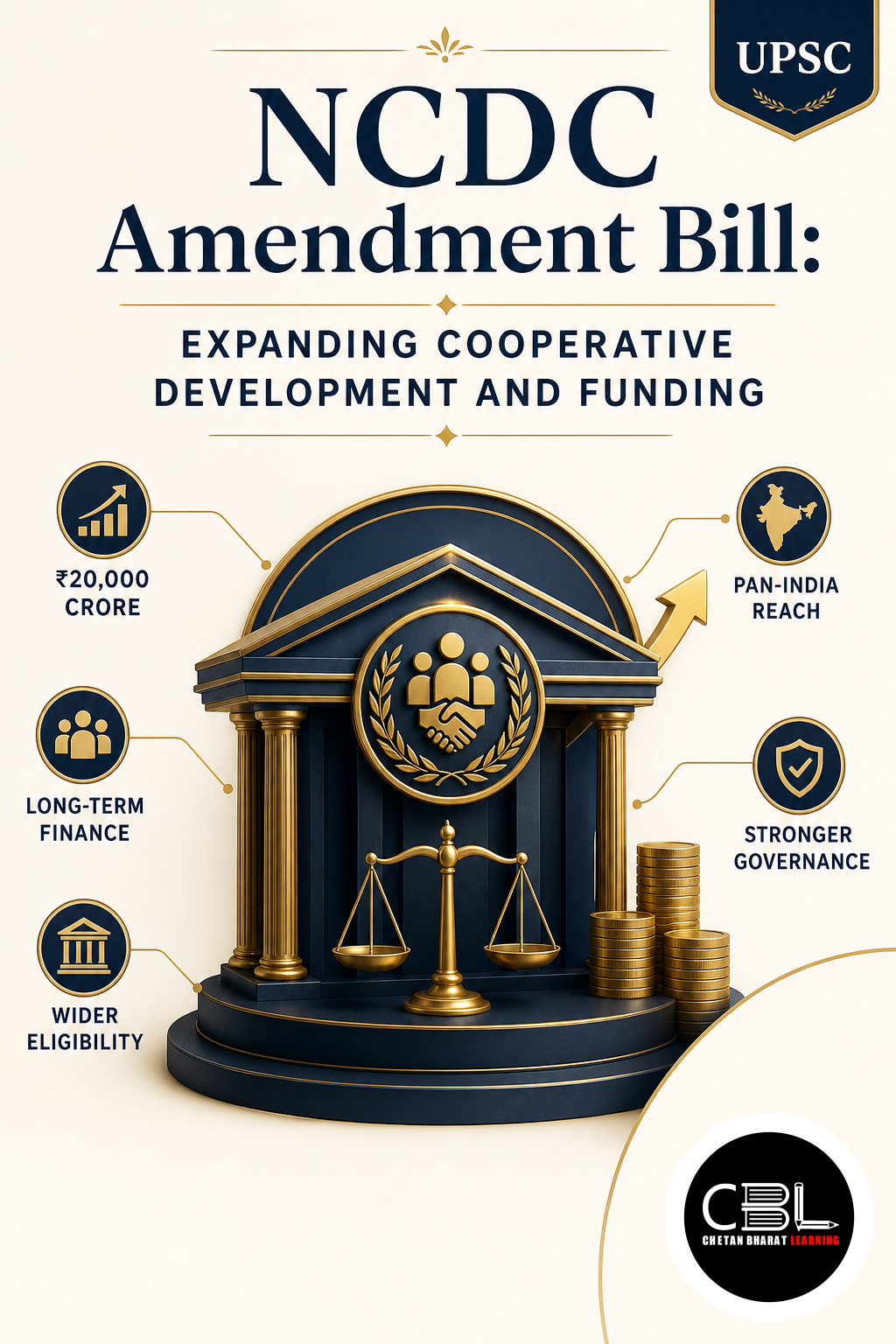
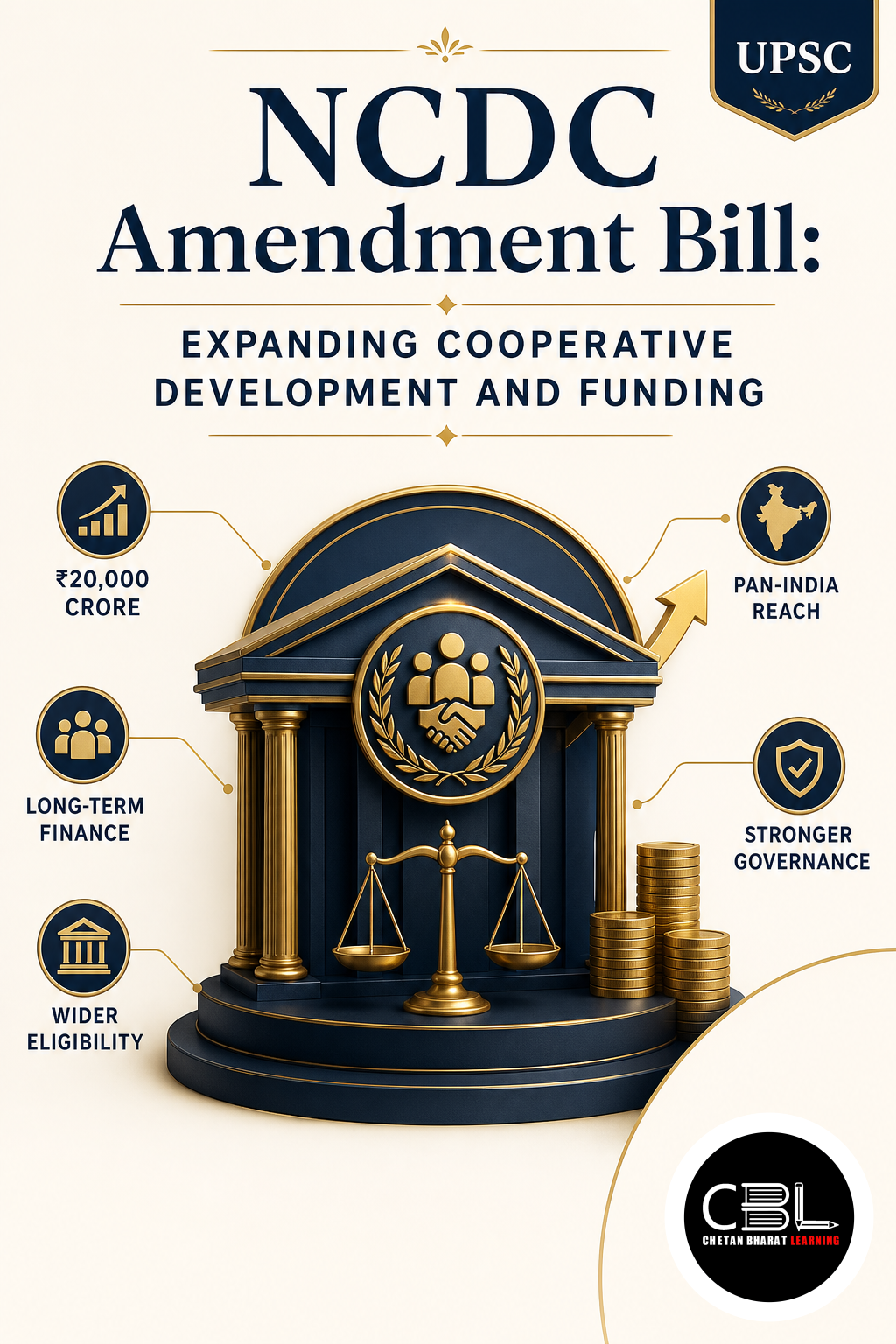
The NCDC Amendment Bill, 2026, amends the National Co-operative Development Corporation Act, 1962, to expand the functions and scope of the NCDC. The Bill empowers the corporation to plan, promote, and finance programmes for co-operative development in specified areas, including providing assistance directly or through any intermediary.
Key changes include expanding the definition of foodstuff to include processed food and other edible products, and allowing the corporation to undertake activities in industrial goods without the requirement of being situated in rural areas. The Bill also widens the eligibility for funding and investments, allowing state governments to extend funding to any entity engaged in co-operative development.
Why is NCDC Amendment Bill in News?
The NCDC Amendment Bill is in the news because Parliament recently passed it, signalling the government’s commitment to strengthening the cooperative sector. The Bill is part of a broader push to empower cooperatives, with initiatives like the computerisation of 80,000 Primary Agricultural Credit Societies (PACS) enabling them to undertake diverse business activities.
The Bill also allows the NCDC to collect and furnish credit information to the central government, RBI, and other financial institutions, enhancing transparency and coordination.
Key Features of NCDC Amendment Bill
- Expanded Definition of Foodstuff: Includes processed food, edible products, and other notified food items, broadening the scope of assistance.
- Industrial Goods Activities: Allows the corporation to undertake activities in industrial goods, removing the rural-area requirement.
- Broadened Funding Eligibility: Enables funding to any entity engaged in co-operative development, not just those within states.
- Share Capital Participation: Allows NCDC to participate in share capital of cooperative societies and other entities, subject to central government approval.
- Information Sharing: Empowers the corporation to collect and share credit and other information with RBI, banks, and other financial institutions.
Challenges in Implementation
- State-Level Adoption: Cooperative societies are a state subject; cooperation from state governments is essential for effective implementation.
- Financial Discipline: With expanded funding, ensuring prudent financial management and preventing defaults is crucial.
- Capacity Building: Many cooperative societies lack modern management and technical skills, affecting project outcomes.
- Data Privacy: Information sharing provisions must comply with data protection norms to prevent misuse.
- Coordination: Effective coordination between NCDC, state governments, and financial institutions is needed.
Way Forward
To realise the potential of the NCDC Amendment Bill, the government should focus on building the capacity of cooperative societies through training and digital integration. Financial literacy programmes for members and professionals can enhance project implementation and governance.
Strengthening the NCDC’s monitoring and evaluation mechanisms, along with transparent funding criteria, will ensure efficient resource utilisation. Collaborative efforts with state governments and financial institutions, coupled with robust data-sharing protocols, can create a vibrant cooperative ecosystem.
Prelims Practice Corner
Q1. The NCDC Amendment Bill amends which Act?
- a) Cooperative Societies Act, 1912
- b) National Co-operative Development Corporation Act, 1962
- c) Multi-State Cooperative Societies Act, 2002
- d) Banking Regulation Act, 1949
Answer: (b) National Co-operative Development Corporation Act, 1962.
Q2. What does the Bill expand the definition of foodstuff to include?
- a) Only fresh produce
- b) Processed food and other edible products
- c) Only cereals
- d) Only dairy products
Answer: (b) Processed food and other edible products.
Q3. What is removed regarding industrial goods activities?
- a) The requirement for central approval
- b) The requirement to be situated in rural areas
- c) The requirement for profit motive
- d) The requirement for cooperative registration
Answer: (b) The requirement to be situated in rural areas.
Q4. Can NCDC participate in the share capital of cooperative societies?
- a) No
- b) Yes, with central government approval
- c) Yes, without approval
- d) Only for PACS
Answer: (b) Yes, with central government approval.
Q5. How many Primary Agricultural Credit Societies (PACS) are being computerised?
- a) 50,000
- b) 80,000
- c) 100,000
- d) 150,000
Answer: (b) 80,000 PACS.
Mains Practice Questions
Q1. Discuss the significance of the NCDC Amendment Bill, 2026, in strengthening India’s cooperative movement. (250 words, 15 marks)
Answer Structure:
- Intro: Introduce the NCDC Amendment Bill and its objectives.
- Body: Discuss key provisions: expanded definition, industrial goods, funding eligibility, information sharing. Analyse impact and challenges.
- Conclusion: Emphasise capacity building and financial discipline.
Q2. What is the role of the National Co-operative Development Corporation in India’s cooperative sector? (150 words, 10 marks)
Answer Structure:
- Intro: Define NCDC and its mandate.
- Body: Outline functions: planning, promoting, financing cooperative development; roles in foodstuffs, industrial goods, funding, information sharing.
- Conclusion: Conclude that NCDC is a key driver of cooperative growth.
FAQs on NCDC Amendment Bill
What is the NCDC Amendment Bill, 2026?
It amends the NCDC Act, 1962, to expand the corporation’s functions, funding, definitions, and information-sharing capabilities to strengthen the cooperative sector.
What changes does it bring to foodstuff definition?
It expands the definition to include processed food, edible products, and other notified food items, broadening the scope of assistance.
How does the Bill impact funding for cooperatives?
It allows NCDC to provide loans and grants directly to any cooperative society or entity engaged in cooperative development, and participate in share capital with central approval.
Related Current Affairs
Preparing for UPSC, PCS or HCS?
Talk to a mentor at Chetan Bharat Learning, Chandigarh. Free guidance on choosing the right exam and building a study plan.
Chat on WhatsAppCall 97793 53345UPSC / IAS / PCS coaching in Chandigarh · Trusted by aspirants across Punjab & Haryana
Leave a Reply
You must be logged in to post a comment.