
UPSC Mapping
- Prelims: Economy & Banking
- Mains: GS Paper 3 (Economic Development & Banking)
Quick Facts
| Proposed MDR | 0.3% |
|---|---|
| Threshold | ₹2,000 and above |
| Credit Card MDR | 1.3% |
Article
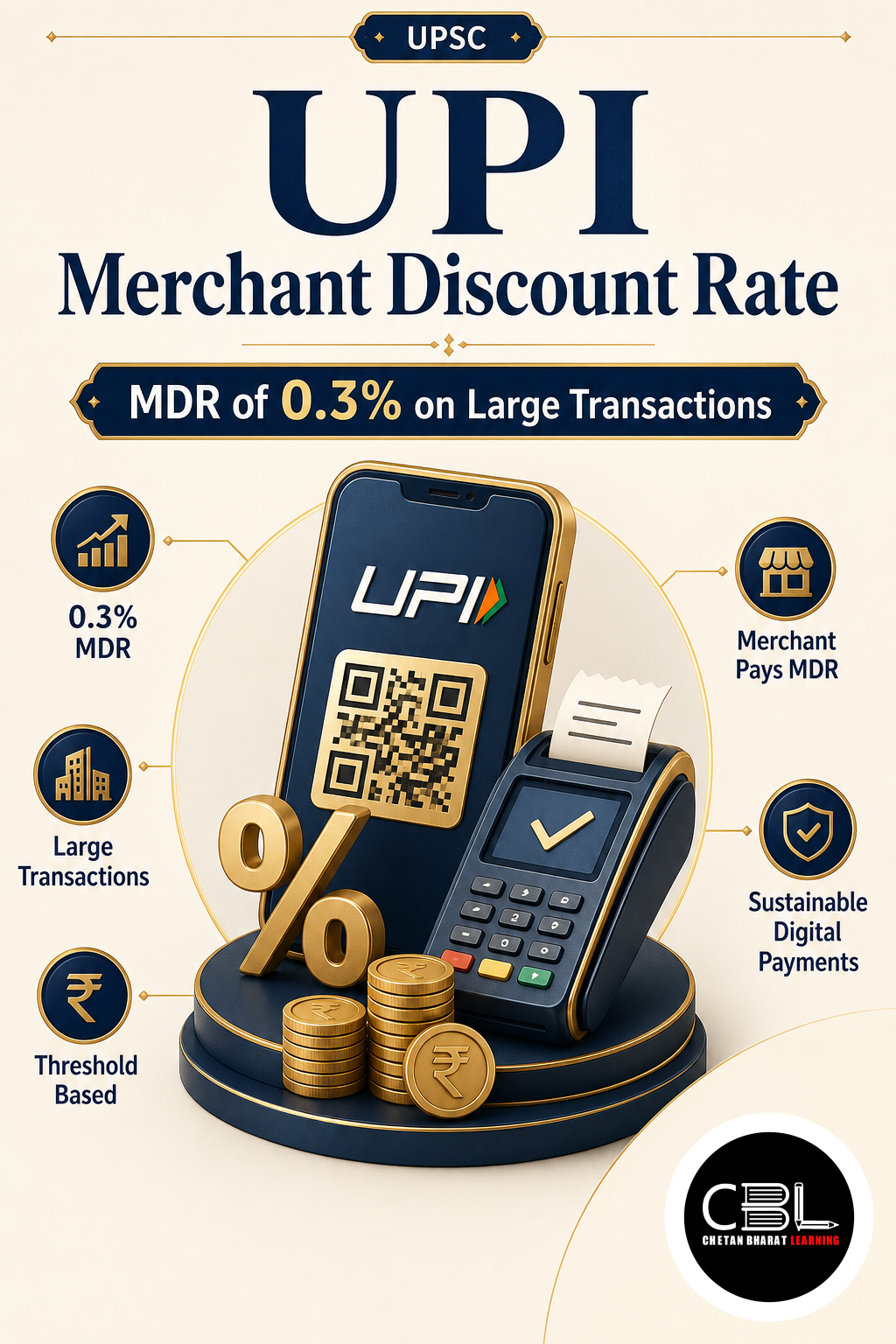
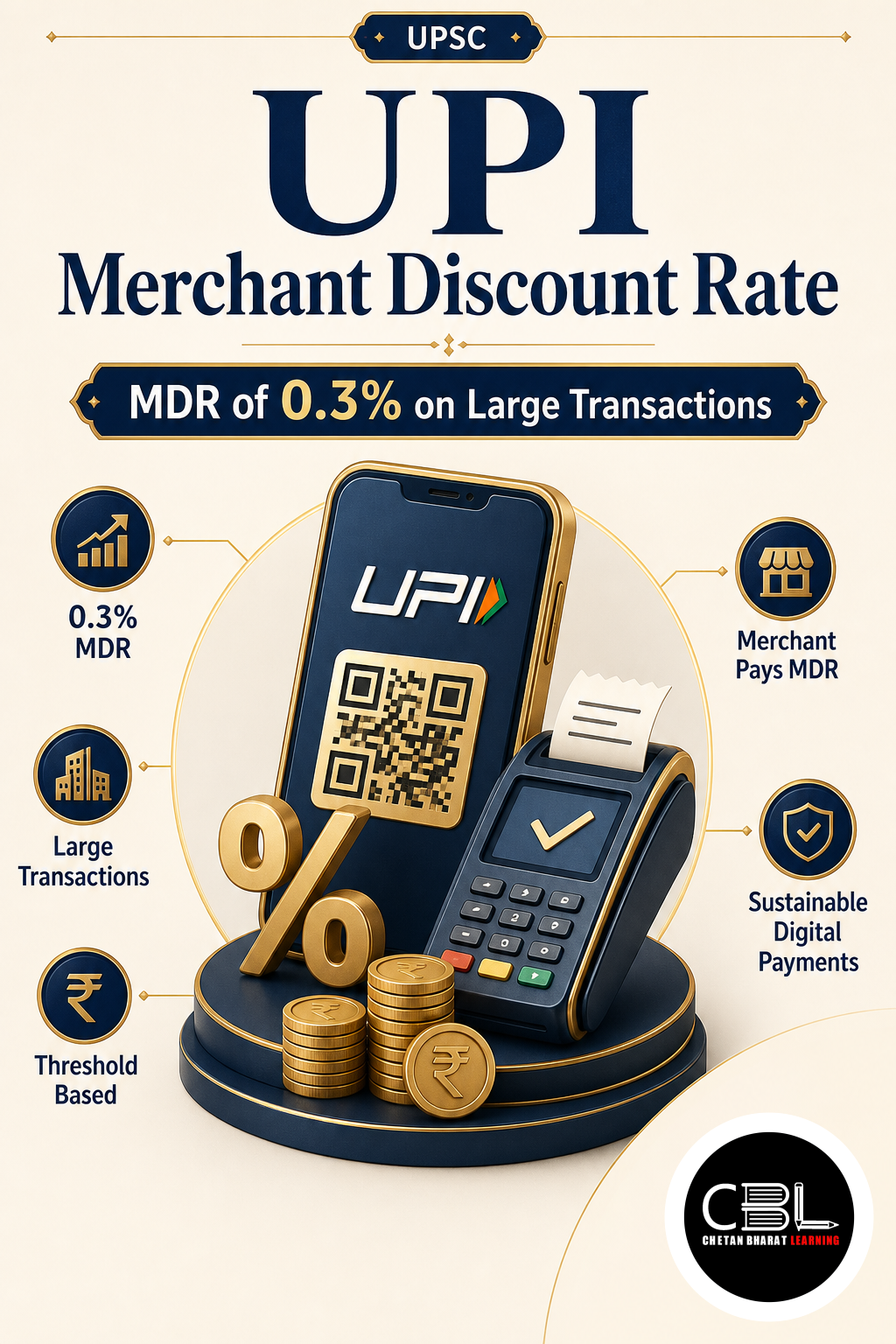
UPI Merchant Discount Rate is set to be reintroduced, with a proposed MDR of up to 0.3% on UPI transactions of ₹2,000 and above. The Department of Financial Services will issue a gazette notification specifying which electronic payment modes will continue to receive statutory protection from charges, after which the UPI and Services Steering Committee (headed by NPCI) will determine the MDR structure. For more such economic updates, explore the economy archive.
UPI Merchant Discount Rate (MDR) is a fee paid by businesses to payment processors for accepting digital payments. The proposed MDR of 0.3% on UPI transactions of ₹2,000 and above would apply to person-to-merchant (P2M) transactions. Consumers will continue to use UPI without any direct transaction charges.
MDR existed on UPI P2M transactions (up to 0.3%) until December 2019, after which Zero MDR was introduced in January 2020 to accelerate digital payment adoption. With UPI processing 241.62 billion transactions worth ₹314.23 lakh crore in FY26 and accounting for 85% of India’s digital payments by volume, the reintroduction of MDR aims to create a sustainable financing model for the payment ecosystem.
Why is UPI Merchant Discount Rate in News?
UPI Merchant Discount Rate is in the news because the government is set to reintroduce it after years of zero MDR. The Department of Financial Services will issue a notification specifying which modes continue to receive protection from charges, followed by the NPCI-led committee determining the MDR structure. The Parliamentary Standing Committee on Finance has called for early implementation of a tiered MDR framework, warning that delays could leave payment service providers dependent on inadequate government subsidies.
The reintroduction of MDR at 0.3% on transactions above ₹2,000 is still much lower than the prevailing MDR of 1.3% on credit cards and up to 0.9% on debit cards. For more details, refer to this PIB release.
Key Features of UPI Merchant Discount Rate
- Proposed Rate: 0.3% on P2M transactions of ₹2,000 and above.
- Consumer-Free: Consumers will continue to use UPI without direct charges.
- Ecosystem Sustainability: Aimed at financing the UPI infrastructure.
- Governance: UPI & Services Steering Committee (NPCI) will determine the structure.
- Competitive Rate: Much lower than card MDR (1.3% for credit cards).
Challenges in UPI Merchant Discount Rate
- Merchant Resistance: Small merchants may resist paying MDR, potentially shifting back to cash.
- Implementation: Determining the exact scope and structure of MDR requires careful calibration.
- Consumer Perception: While consumers are not charged, merchants may pass on costs indirectly.
- Comparison with Cards: Ensuring UPI remains competitive against cash and cards.
- Regulatory Clarity: Clear guidelines are needed to avoid confusion. For more on digital payments, visit the economy section.
Way Forward for UPI Merchant Discount Rate
To successfully implement UPI Merchant Discount Rate, the government should ensure a tiered structure that exempts small merchants and low-value transactions to protect financial inclusion. Clear communication about the benefits of a sustainable payment ecosystem can build merchant acceptance.
The rate should be periodically reviewed to balance ecosystem sustainability and merchant burden. The Parliamentary Standing Committee’s recommendation for a tiered framework provides a useful starting point. For international best practices, refer to the BIS.
Prelims Practice Corner
Q1. What is the proposed MDR on UPI transactions of ₹2,000 and above?
- (a) 0.1%
- (b) 0.3%
- (c) 0.5%
- (d) 1.0%
Show answer
Answer: (b) The proposed MDR is 0.3%.
Q2. Who will continue to use UPI without any transaction charge?
- (a) Merchants
- (b) Consumers
- (c) Banks
- (d) Payment aggregators
Show answer
Answer: (b) Consumers will continue to use UPI without direct charges.
Q3. What is the MDR on credit card transactions?
- (a) 0.3%
- (b) 0.9%
- (c) 1.3%
- (d) 2.0%
Show answer
Answer: (c) Credit card MDR is around 1.3%.
Q4. Which body will determine the scope and structure of MDR?
- (a) RBI
- (b) NPCI’s UPI & Services Steering Committee
- (c) Ministry of Finance
- (d) SEBI
Show answer
Answer: (b) The NPCI-led committee will determine the MDR structure.
Q5. Why is MDR being reintroduced?
- (a) To increase government revenue
- (b) To make the UPI ecosystem sustainable
- (c) To reduce digital payments
- (d) To charge consumers
Show answer
Answer: (b) The aim is to make the payment ecosystem sustainable.
Mains Practice Questions
Q1. Discuss the rationale for reintroducing MDR on UPI transactions and its implications for India’s digital payment ecosystem. (250 words, 15 marks)
Answer Structure
- Intro: Introduce UPI’s success and the zero-MDR policy.
- Body: Explain the need for a sustainable financing model, the proposed 0.3% MDR, and the tiered approach. Analyse the potential impact on merchants, consumers, and the ecosystem. Suggest safeguards for small merchants.
- Conclusion: Emphasise the need for a balanced approach to sustain UPI’s growth.
Q2. What is the Merchant Discount Rate (MDR) and how does it differ from a consumer transaction fee? (150 words, 10 marks)
Answer Structure
- Intro: Define MDR as a merchant fee.
- Body: Explain that MDR is paid by merchants, not consumers. Consumers do not pay transaction fees. UPI’s success is partly due to this consumer-centric approach.
- Conclusion: Conclude that MDR is a merchant-side cost for digital payment acceptance.
FAQs on UPI Merchant Discount Rate
What is UPI MDR?
It is a fee paid by merchants to payment processors for accepting UPI payments, proposed at 0.3% on transactions above ₹2,000.
Will consumers pay more for UPI?
No, consumers will continue to use UPI without direct transaction charges.
Why is MDR being reintroduced?
To create a sustainable financing model for the UPI ecosystem, which has grown massively.
Related Current Affairs
Preparing for UPSC, PCS or HCS?
Talk to a mentor at Chetan Bharat Learning, Chandigarh. Free guidance on choosing the right exam and building a study plan.
Chat on WhatsAppCall 97793 53345UPSC / IAS / PCS coaching in Chandigarh · Trusted by aspirants across Punjab & Haryana
Leave a Reply
You must be logged in to post a comment.