
UPSC Mapping
Prelims
- Sangam Age, Cholas and Ancient Ports
Mains
- GS Paper I — Indian History and Culture
| Ancient Name | Kaveripoompattinam |
|---|---|
| Location | Mayiladuthurai, Tamil Nadu |
| Geographical Setting | Mouth of River Cauvery |
| Historical Association | Early Cholas |
| Research Agencies | TNSDA and Indian Maritime University |
What is Poompuhar Excavations?
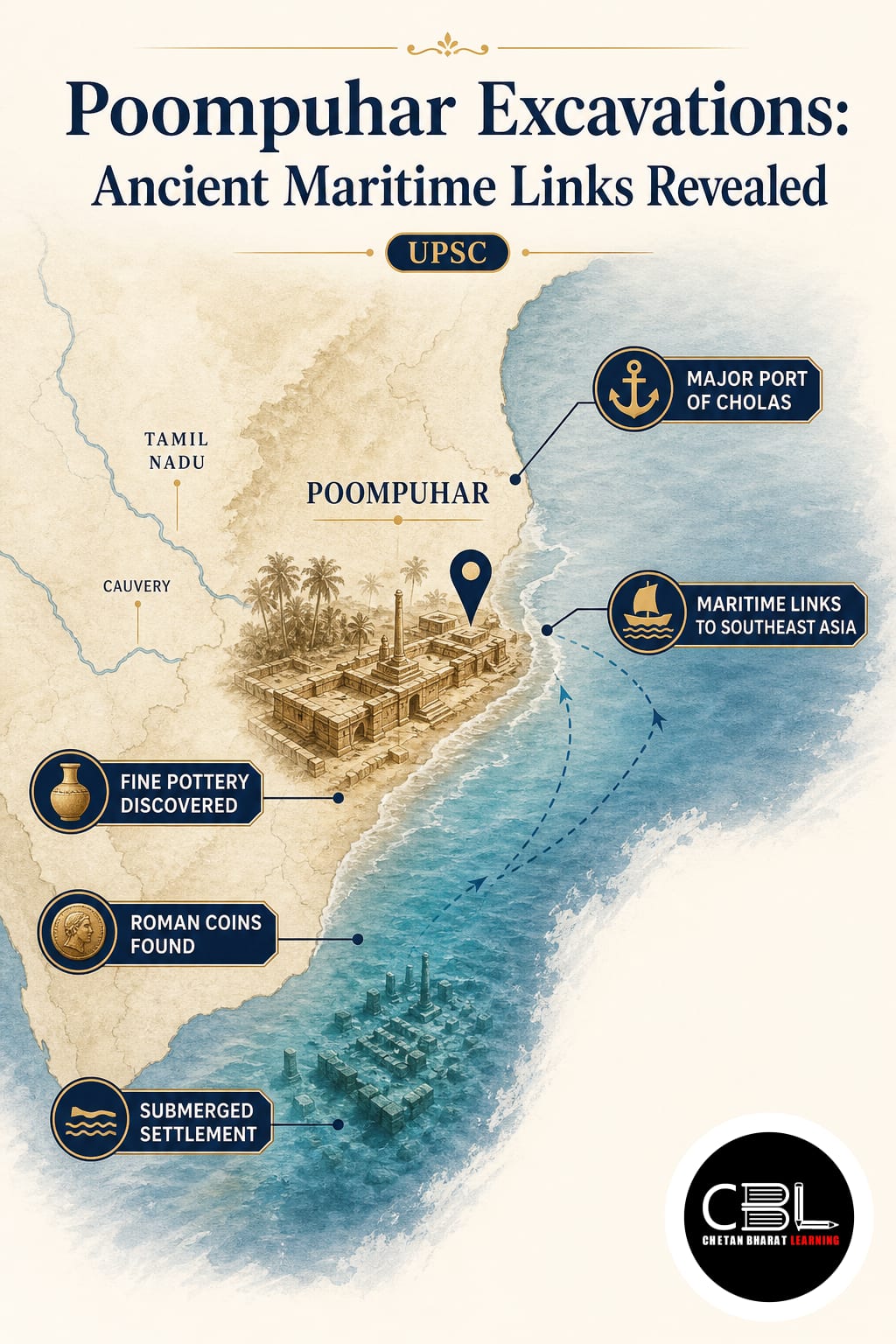
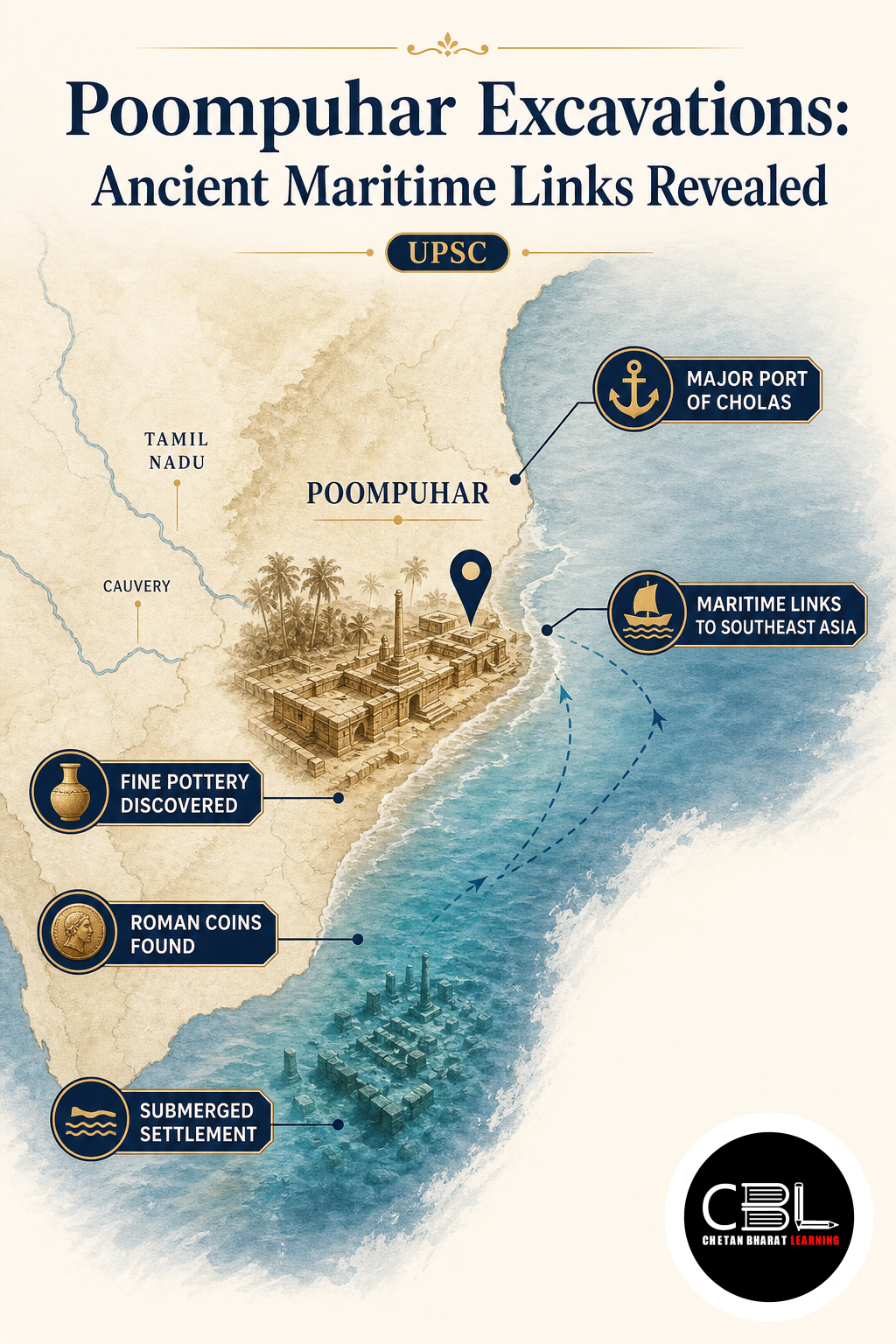
The Poompuhar Excavations comprise terrestrial and underwater archaeological investigations around the ancient port of Poompuhar in Tamil Nadu. The town, also called Kaveripoompattinam or Puhar, developed near the point where the Cauvery enters the Bay of Bengal and served as an important port and political centre of the early Cholas during the Sangam period.
Archaeologists study the area through seabed surveys, diving, excavation, sediment analysis and artefact documentation. Earlier investigations recovered brick structures, storage jars, pottery, ring wells and remains associated with port activity. Much of the ancient settlement appears to extend beyond the present shoreline.
Why is Poompuhar Excavations in News?
Recent Poompuhar Excavations produced new material evidence during an 18-day underwater exploration by the Tamil Nadu State Department of Archaeology and Indian Maritime University. Researchers found a fragment of a West Asian torpedo jar, four terracotta ring wells and more than 250 ceramic fragments. The fine ceramic jar fragment had an estimated diameter of approximately 30–35 centimetres.
Ancient merchants commonly used torpedo-shaped jars to transport liquid commodities, including wine and olive oil, across maritime routes. The recovered fragment strengthens evidence of exchange between the Tamil coast and West Asian trading networks. The underwater ring wells also indicate that areas now beneath the sea may once have formed part of an inhabited terrestrial landscape.
Key Features
The discoveries illuminate port infrastructure, overseas exchange and environmental change along the Cauvery delta.
- West Asian pottery: The torpedo-jar fragment provides material evidence that commodities, containers or merchants moved between Poompuhar and western maritime trading zones.
- Terracotta ring wells: Four circular wells found underwater may represent freshwater facilities constructed when the surrounding area remained dry and inhabited.
- Large ceramic assemblage: More than 250 pottery fragments can reveal storage practices, food habits, manufacturing techniques and contact with external trading regions.
- Literary connections: Sangam and post-Sangam works describe Puhar as a busy port containing merchants, warehouses, markets, ships and imported commodities.
- Submerged landscape: Offshore structures and artefacts suggest that shoreline retreat, erosion and marine processes covered portions of the ancient settlement.
Challenges
Underwater archaeology must overcome difficult marine conditions, disturbed sediments and limited chronological evidence.
- Difficult excavation environment: Currents, waves, poor visibility and shifting sediments restrict diving time and complicate the accurate recording of structures and artefacts.
- Loss of archaeological context: Coastal movement can displace pottery and structural material, making it difficult to determine their original position or association.
- Dating limitations: Ceramic forms suggest broad cultural links, but researchers need stratified samples and scientific dating before assigning precise historical periods.
- Competing submergence theories: Floods, coastal erosion, shoreline change, sea-level variation and possible tsunami events require testing rather than acceptance through legend alone.
- Site protection: Fishing equipment, construction, coastal pollution, illegal collection and unregulated tourism can damage fragile remains before scholars document them.
Way Forward
Researchers should combine underwater excavation with sonar mapping, sediment coring, residue analysis and ceramic provenance studies. High-resolution bathymetric surveys can identify buried channels, wharves and habitation zones across a wider coastal area. Specialists should conserve recovered objects immediately because salts can damage artefacts after removal from seawater.
Future Poompuhar Excavations should publish detailed site plans, dating results and laboratory reports for independent scholarly assessment. Authorities must create protected marine-heritage zones without unnecessarily disrupting fishing communities. Digital reconstructions and improved museum displays can make discoveries accessible while keeping fragile remains secure. Interdisciplinary research can transform Poompuhar into a major source for understanding ancient Indian Ocean trade, coastal change and early Tamil urbanisation.
Prelims Practice Corner
Q1. Poompuhar was historically situated near the mouth of which river?
(a) Krishna (b) Godavari (c) Cauvery (d) Vaigai
Answer: (c) Poompuhar developed where the Cauvery enters the Bay of Bengal.
Q2. The ancient name Kaveripoompattinam refers to:
(a) Arikamedu (b) Poompuhar (c) Korkai (d) Muziris
Answer: (b) Poompuhar was also known as Kaveripoompattinam or Puhar.
Q3. Torpedo jars were historically used mainly for transporting:
(a) Liquid commodities (b) War elephants (c) Stone pillars (d) Cotton looms
Answer: (a) Merchants used these elongated jars to transport liquids such as wine and olive oil.
Q4. Consider the following works: 1. Pattinappalai 2. Silappadikaram 3. Manimekalai. Which contain traditions or descriptions associated with Puhar?
(a) 1 only (b) 1 and 2 only (c) 2 and 3 only (d) 1, 2 and 3
Answer: (d) All three literary works contain important references connected with Puhar.
Q5. Why are underwater ring wells at Poompuhar archaeologically significant?
(a) They were built exclusively for naval warfare (b) They may indicate a formerly dry and inhabited landscape (c) They prove Roman political control (d) They were used for minting coins
Answer: (b) Freshwater ring wells would ordinarily stand on land, suggesting later shoreline or landscape change.
Mains Practice Questions
Q1. Explain how archaeological evidence from Poompuhar enriches our understanding of Sangam-age maritime trade. (150 words, 10 marks)
- Intro: Identify Poompuhar as an early Chola port at the Cauvery’s mouth.
- Body: Discuss imported pottery, ring wells, ceramics, port administration, literary references and overseas connections.
- Conclusion: Highlight the value of combining material and literary sources.
Q2. Underwater archaeology can reconstruct both cultural history and long-term coastal change. Discuss with reference to Poompuhar. (250 words, 15 marks)
- Intro: Explain the interdisciplinary nature of marine archaeology.
- Body: Cover trade artefacts, submerged habitation, palaeochannels, erosion, dating problems and marine-site preservation.
- Conclusion: Recommend scientific surveys, community participation and conservation-led research.
FAQs on Poompuhar Excavations
What did the recent underwater exploration discover?
Researchers found a West Asian torpedo-jar fragment, four terracotta ring wells and more than 250 ceramic fragments. The finds strengthen evidence of habitation and maritime exchange.
Why was Poompuhar important to the Cholas?
Its river-and-sea location supported trade between the Cauvery basin and overseas markets. It also functioned as an important urban and political centre of the early Cholas.
Why is much of ancient Poompuhar underwater?
The Poompuhar Excavations indicate that shoreline change, erosion, floods, sea-level variation or major marine events may have submerged parts of the settlement. Scientists require further geological and chronological evidence to determine the relative contribution of each process.
Related Current Affairs
Preparing for UPSC, PCS or HCS?
Talk to a mentor at Chetan Bharat Learning, Chandigarh. Free guidance on choosing the right exam and building a study plan.
Chat on WhatsAppCall 97793 53345UPSC / IAS / PCS coaching in Chandigarh · Trusted by aspirants across Punjab & Haryana
Leave a Reply
You must be logged in to post a comment.