

UPSC Mapping
- Prelims: Constitution, Elections and Representation Laws
- Mains: GS Paper II — Constitution and Governance
Article
Quick Facts
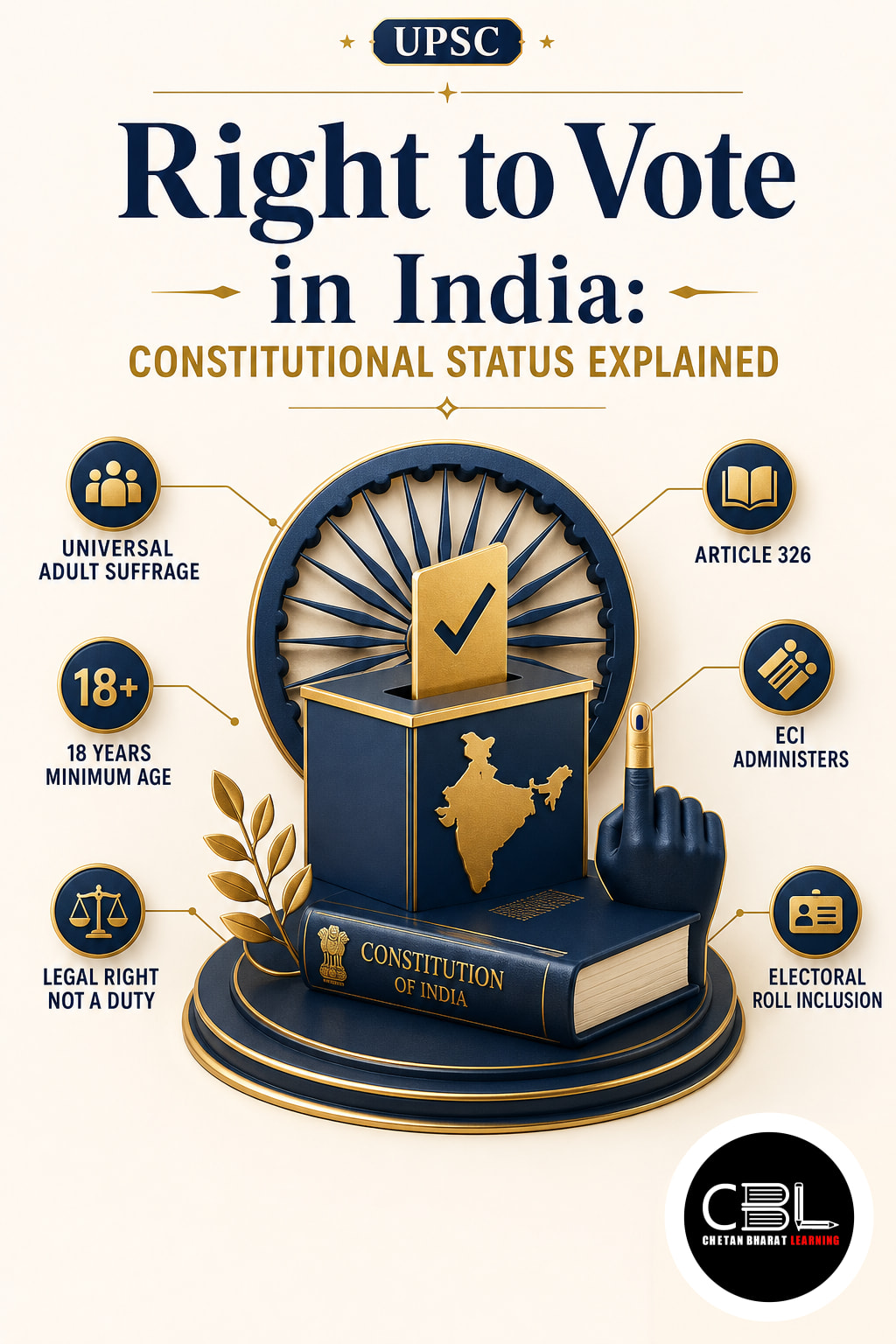
| Constitutional Basis | Article 326 |
|---|---|
| Voting Age | 18 Years |
| Electoral Rolls Law | RPA, 1950 |
| Election Conduct Law | RPA, 1951 |
| Election Authority | Election Commission of India |
What is Right to Vote?
The Right to Vote is the legal and constitutional entitlement of an eligible citizen to participate in an election. Article 326 provides that elections to the Lok Sabha and State Legislative Assemblies shall follow adult suffrage. Every Indian citizen who has attained 18 years of age may register, subject to lawful disqualifications. These can relate to non-residence, unsoundness of mind, crime or corrupt and illegal electoral practices.
The Constitution establishes the democratic foundation, while parliamentary legislation determines operational details. The Representation of the People Act, 1950 governs allocation of seats, voter qualifications and electoral-roll preparation. The Representation of the People Act, 1951 regulates election conduct, candidates, political parties, corrupt practices and disputes. Section 62 of the 1951 Act provides the statutory entitlement to vote for persons entered in the relevant electoral roll.
Why is Right to Vote in News?
The Right to Vote has returned to public discussion amid disputes over electoral-roll revision, voter documentation and the risk of excluding eligible citizens. A Supreme Court judgment delivered on 27 May 2026 described voting under Article 326 as a constitutional right subject to lawful limitations. It also stated that reasonable identity, residence and eligibility verification can preserve electoral integrity. The Supreme Court judgment emphasised both inclusion of eligible citizens and exclusion of ineligible entries.
The discussion also highlights changes in judicial terminology over time. Kuldip Nayar v. Union of India in 2006 characterised the right to elect as a statutory right. Rajbala v. State of Haryana in 2015 treated voting in Lok Sabha and Assembly elections as a constitutional entitlement under Article 326. Later judgments have described it as constitutional and statutory, while continuing to clarify that it is not an independent fundamental right. The freedom to express a political choice through the ballot receives separate protection under Article 19(1)(a).
Key Features
India’s electoral framework combines universal participation, statutory regulation and constitutional supervision.
- Universal adult suffrage: India granted voting eligibility without property, gender, educational, religious or caste qualifications from the beginning of the Republic.
- Constitutional foundation: Article 326 establishes adult suffrage for Lok Sabha and State Legislative Assembly elections while permitting only specified categories of disqualification.
- Statutory implementation: The Representation of the People Acts translate the constitutional commitment into rules governing registration, voting, election administration and electoral offences.
- Independent supervision: Article 324 vests the Election Commission with superintendence, direction and control over electoral-roll preparation and the conduct of specified elections.
- Expressive dimension: Casting a vote communicates political approval, rejection or preference and therefore engages the freedom of expression protected by Article 19(1)(a).
India’s adoption of universal adult franchise was historically significant because the country began electoral democracy amid poverty, low literacy and considerable social inequality. The first general election involved approximately 173 million eligible voters. Election symbols enabled citizens who could not read candidate or party names to make an identifiable choice. This administrative innovation helped convert constitutional equality into mass democratic participation.
The Constitution initially set the voting age at 21 years. The Constitution Sixty-first Amendment Act, 1988 reduced it to 18 years, expanding political participation among younger citizens. Age alone does not place a person on the roll automatically. The citizen must satisfy the ordinary-residence requirement and complete the prescribed registration process for the relevant constituency.
Section 19 of the 1950 Act requires citizenship, the prescribed minimum age and ordinary residence within a constituency. Section 21 provides for preparation and revision of electoral rolls. The Election Commission may order revisions to add eligible citizens, remove invalid entries and correct voter details. The official Representation of the People Act, 1950 contains the principal legal provisions governing these rolls.
Challenges
Electoral administration must balance roll accuracy, procedural verification and protection against wrongful exclusion.
- Exclusion errors: Missing names, incorrect deletions or inadequate notice can prevent eligible citizens from participating despite satisfying constitutional and statutory conditions.
- Ineligible entries: Duplicate registrations, deceased electors and entries lacking ordinary residence can undermine the principle of one person, one vote.
- Documentation barriers: Rigid proof requirements may disproportionately affect migrants, homeless citizens, married women, older persons and communities with limited official records.
- Digital vulnerabilities: Database errors, weak cybersecurity, inaccessible online processes and poor integration between records can create large-scale administrative problems.
- Limited public awareness: Citizens may discover an omission only near polling day, when available correction mechanisms become difficult to use effectively.
A clean electoral roll requires both inclusion and exclusion safeguards. Authorities must not treat these objectives as opposing principles. Removing demonstrably invalid entries protects the equal weight of every legitimate ballot. At the same time, deletion without notice, evidence or an accessible appeal can cause irreversible democratic harm during an election cycle.
Judicial review becomes especially important when administrative procedures affect large groups of electors. Courts must examine whether verification requirements serve a legitimate purpose, provide reasonable alternatives and comply with natural justice. Election administrators should publish reasons, timelines and correction procedures in accessible languages. Aspirants can track related electoral developments through the daily current affairs archive.
Way Forward
The Election Commission should combine periodic door-to-door verification with continuous online and offline registration facilities. Every proposed deletion should carry prior notice, recorded reasons and a meaningful opportunity to respond. Electoral Registration Officers need clear accountability standards and adequate field staff. Special assistance must reach migrants, persons with disabilities, senior citizens and voters lacking easy access to digital services.
Protecting the Right to Vote requires accurate rolls, transparent technology and timely remedies. Parliament can clarify procedural safeguards without limiting the Election Commission’s constitutional independence. Independent audits, secure databases and searchable correction records can strengthen public confidence. The system should ultimately protect electoral integrity without transferring an unreasonable documentation burden to eligible citizens.
Prelims Practice Corner
Q1. Which constitutional provision establishes adult suffrage for Lok Sabha and State Assembly elections?
(a) Article 324 (b) Article 326 (c) Article 329 (d) Article 356
Show answer
Answer: (b) Article 326 provides for these elections on the basis of adult suffrage.
Q2. Which legislation principally governs the preparation and revision of electoral rolls?
(a) Representation of the People Act, 1950 (b) Representation of the People Act, 1951 (c) Delimitation Act only (d) Citizenship Act, 1955
Show answer
Answer: (a) The 1950 Act contains the principal statutory framework for electoral rolls and voter registration.
Q3. The voting age in India was reduced from 21 to 18 years through which amendment?
(a) Forty-second Amendment (b) Fifty-second Amendment (c) Sixty-first Amendment (d) Seventy-third Amendment
Show answer
Answer: (c) The Constitution Sixty-first Amendment Act, 1988 reduced the voting age to 18 years.
Q4. Consider the following statements: 1. Article 324 gives the Election Commission control over electoral-roll preparation. 2. Every citizen’s name enters an electoral roll automatically upon turning 18. Which is correct?
(a) 1 only (b) 2 only (c) Both 1 and 2 (d) Neither 1 nor 2
Show answer
Answer: (a) Article 324 grants supervision, but eligible citizens must satisfy registration and ordinary-residence requirements.
Q5. The freedom expressed by selecting or rejecting a candidate through a ballot is linked primarily with:
(a) Article 14 only (b) Article 19(1)(a) (c) Article 23 (d) Article 32 only
Show answer
Answer: (b) Judicial decisions connect the act of expressing an electoral choice with freedom of speech and expression.
Mains Practice Questions
Q1. Distinguish between the entitlement to vote and the freedom expressed through voting under the Indian Constitution. (150 words, 10 marks)
Answer Structure
- Intro: Mention Article 326 and the statutory election framework.
- Body: Explain constitutional entitlement, Section 62, judicial decisions and the expressive protection under Article 19(1)(a).
- Conclusion: Link both dimensions with meaningful democratic participation.
Q2. Accurate electoral rolls require an equal commitment to inclusion and integrity. Discuss. (250 words, 15 marks)
Answer Structure
- Intro: Explain how voter registration determines practical access to elections.
- Body: Discuss omissions, duplicates, documentation, migration, natural justice, technology and Election Commission accountability.
- Conclusion: Recommend transparent verification, accessible appeals and independent audits.
FAQs on Right to Vote
Is voting a fundamental right in India?
Voting is not recognised as an independent fundamental right. Courts have described it as a constitutional and statutory entitlement, while the freedom expressed through a ballot engages Article 19(1)(a).
Does turning 18 automatically make someone a registered voter?
No. The citizen must satisfy ordinary-residence requirements and have a valid entry in the electoral roll of the relevant constituency.
Why are accurate electoral rolls essential?
The Right to Vote can be exercised only when an eligible citizen appears on the appropriate roll. Accurate records prevent wrongful exclusion, duplicate voting and inclusion of ineligible entries.
Related Current Affairs
Preparing for UPSC, PCS or HCS?
Talk to a mentor at Chetan Bharat Learning, Chandigarh. Free guidance on choosing the right exam and building a study plan.
Chat on WhatsAppCall 97793 53345UPSC / IAS / PCS coaching in Chandigarh · Trusted by aspirants across Punjab & Haryana
Leave a Reply
You must be logged in to post a comment.