
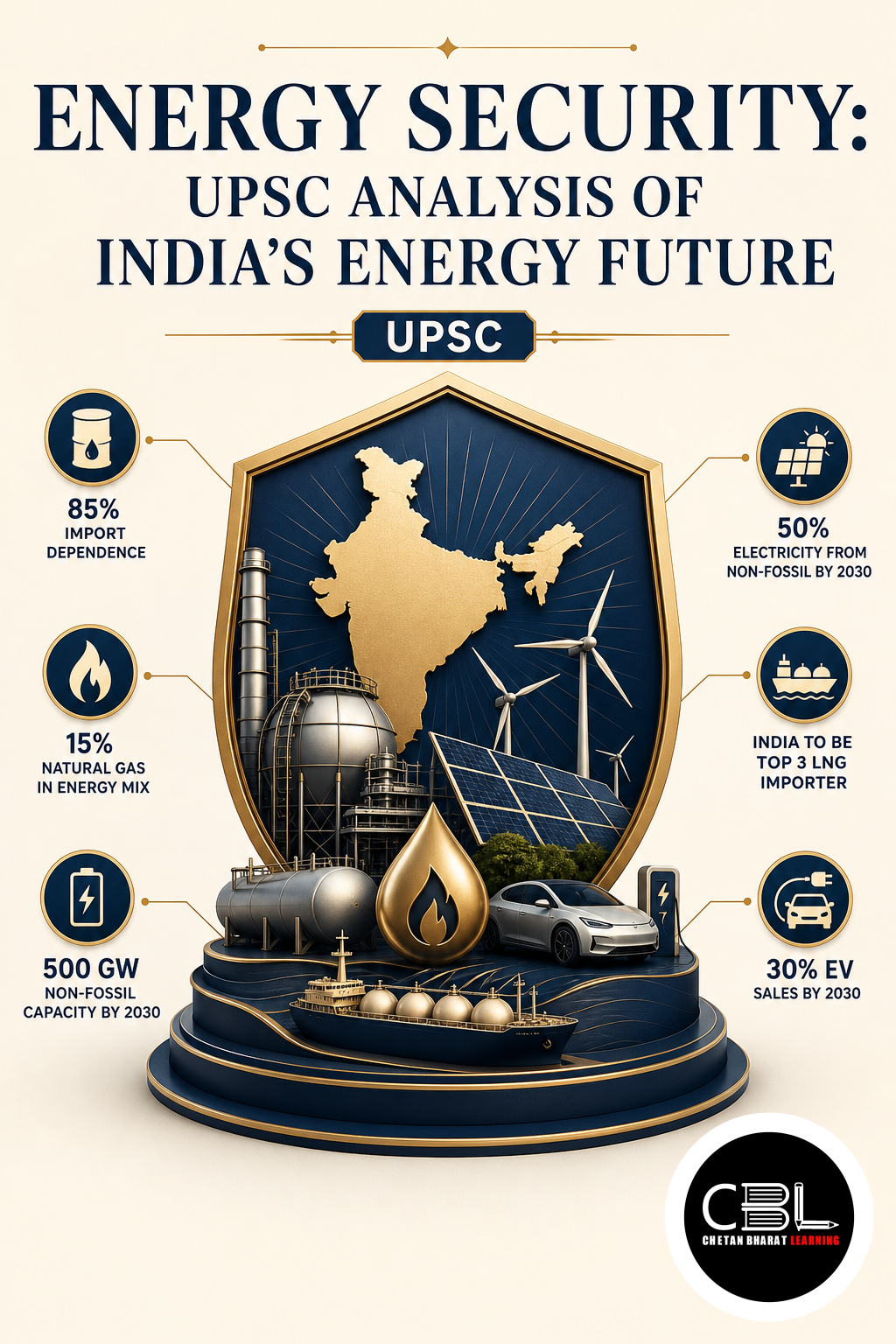

Energy security is central to India’s economic growth because reliable and affordable energy supports industry, transport, households and national resilience. The supplied current-affairs material argues that India needs a public-private partnership rather than relying exclusively on either state-owned or private companies. It also links energy security with import dependence, maritime chokepoints, strategic petroleum reserves, domestic production and the transition towards cleaner sources. For wider UPSC preparation, use the daily current affairs archive to connect this issue with economy, infrastructure and international relations.
What is energy security?
Energy security means ensuring that energy is available in sufficient quantity, at affordable prices, with reliable delivery and resilience against major disruptions. The supplied material presents four broad dimensions: availability, affordability, accessibility and acceptability.
Availability concerns whether adequate energy can be sourced. Affordability concerns the cost to consumers and businesses, accessibility concerns dependable physical access, while acceptability relates to environmental and social sustainability. A strong energy strategy therefore requires more than simply producing or importing large quantities of fuel.
For India, the concept is closely connected with economic development. Industrialisation, urbanisation, transport demand and rising electricity consumption increase the need for dependable energy. Disruptions can raise production costs, transport expenses and inflationary pressure, making energy policy an important component of macroeconomic stability.
Why is energy security in News?
The supplied material examines whether India should rely on public-sector companies, private firms or a combination of both to strengthen energy security. Its central conclusion is that both sectors are necessary, with public institutions providing strategic capacity and private enterprises contributing investment, efficiency and commercial capabilities.
The issue is especially important because the material highlights India’s dependence on imported crude oil. A disruption in global supply can increase oil prices, raise India’s import bill and put pressure on the current account and the rupee. Higher energy costs can also feed into transportation, production and consumer prices.
The article further links energy security with maritime routes. Oil and energy supplies move through strategic passages such as the Strait of Hormuz, the Bab-el-Mandeb and other chokepoints. Any disruption in these narrow routes can affect global trade flows and potentially increase freight, insurance and energy costs.
For official energy-policy developments, aspirants should track the Press Information Bureau alongside relevant ministries and government agencies.
Key Features
The supplied material presents energy security as a whole-of-system challenge involving domestic capacity, imports, infrastructure and strategic preparedness.
- Four dimensions: Effective energy policy must consider availability, affordability, accessibility and acceptability together.
- Import dependence: Heavy reliance on imported crude exposes India to global price movements, supply disruptions and foreign-exchange pressures.
- Maritime vulnerability: Chokepoints such as the Strait of Hormuz can become strategically important because large volumes of global energy trade pass through narrow sea routes.
- Strategic reserves: Strategic Petroleum Reserves can provide a buffer against severe supply disruptions and strengthen short-term resilience.
- Mixed institutional capacity: Public-sector enterprises provide strategic depth, while private companies can add investment, innovation, operational efficiency and market responsiveness.
The role of state-owned energy enterprises remains important because the supplied material identifies them as major contributors to domestic production, refining and national energy capacity. Private participation can complement this role by bringing additional capital, technology and efficiency.
Challenges
India faces interconnected vulnerabilities that make a narrow approach to energy policy inadequate.
- Import dependence: Dependence on imported crude exposes the economy to international price volatility and geopolitical disruptions.
- Chokepoint risks: Disruption in major maritime passages can affect the movement and cost of energy supplies reaching India.
- Infrastructure gaps: Storage, transport, refining, distribution and transmission capacity must expand alongside energy demand.
- Investment requirements: Energy infrastructure requires large and sustained investment, technological capabilities and long-term planning.
- Transition complexity: Moving towards cleaner energy while meeting present energy demand requires balancing reliability, affordability, sustainability and economic growth.
Privatisation alone cannot resolve these challenges because markets do not automatically provide all forms of strategic resilience. Some capabilities involve long-term national-interest considerations, including emergency preparedness, strategic reserves and energy diplomacy. Aspirants can connect this discussion with the broader UPSC economy and infrastructure cluster.
Way Forward
India needs a diversified energy strategy that combines domestic production, strategic reserves, diversified imports and faster energy transition. Strengthening domestic capabilities can reduce vulnerability, while diversified sourcing can limit dependence on any single supplier or route.
Public and private institutions should work as complementary pillars. The public sector can maintain strategic capacity and long-term national resilience, while private firms can contribute investment, technology, operational efficiency and innovation. The supplied material also calls for stronger maritime routes and energy diplomacy to protect India’s access to international supplies.
Accelerating renewable-energy deployment can reduce long-term dependence on imported fossil fuels, but the transition must preserve grid reliability and affordability. India therefore needs a balanced pathway involving cleaner energy, storage, domestic capacity, resilient infrastructure and international partnerships.
The broader UPSC lesson is that energy security is not synonymous with energy self-sufficiency. A resilient system can combine domestic production, strategic reserves, diversified imports, secure maritime access, efficient markets and a gradual transition towards cleaner sources.
FAQs on energy security
What is energy security?
Energy security means ensuring adequate, affordable, accessible and environmentally acceptable energy supplies. For India, it also involves resilience against global price shocks, geopolitical disruptions and interruptions in maritime supply routes.
Why is the Strait of Hormuz important to India?
The Strait of Hormuz is a major maritime chokepoint associated with global energy trade. Disruption there can affect supply routes, energy prices, freight costs and the security of India’s imported energy supplies.
Why does India need both public and private energy companies?
The supplied material presents public and private sectors as complementary. Public institutions can provide strategic capacity and long-term resilience, while private enterprises can contribute capital, technology, efficiency and innovation.
Related Current Affairs
Preparing for UPSC, PCS or HCS?
Talk to a mentor at Chetan Bharat Learning, Chandigarh. Free guidance on choosing the right exam and building a study plan.
Chat on WhatsAppCall 97793 53345UPSC / IAS / PCS coaching in Chandigarh · Trusted by aspirants across Punjab & Haryana
Leave a Reply
You must be logged in to post a comment.