

UPSC Mapping
| Prelims | Environment, Green Hydrogen and Indian Ports |
|---|---|
| Mains | GS Paper III — Environment, Energy and Infrastructure |
Quick Facts
| Location | Kandla, Gujarat |
|---|---|
| Port Authority | Deendayal Port Authority |
| Planned Capacity | 150 Tonnes Per Day |
| Project Partners | DPA and Assam Petro-Chemicals |
| Total Investment | ₹2,300 Crore |
What is E-Methanol Plant?
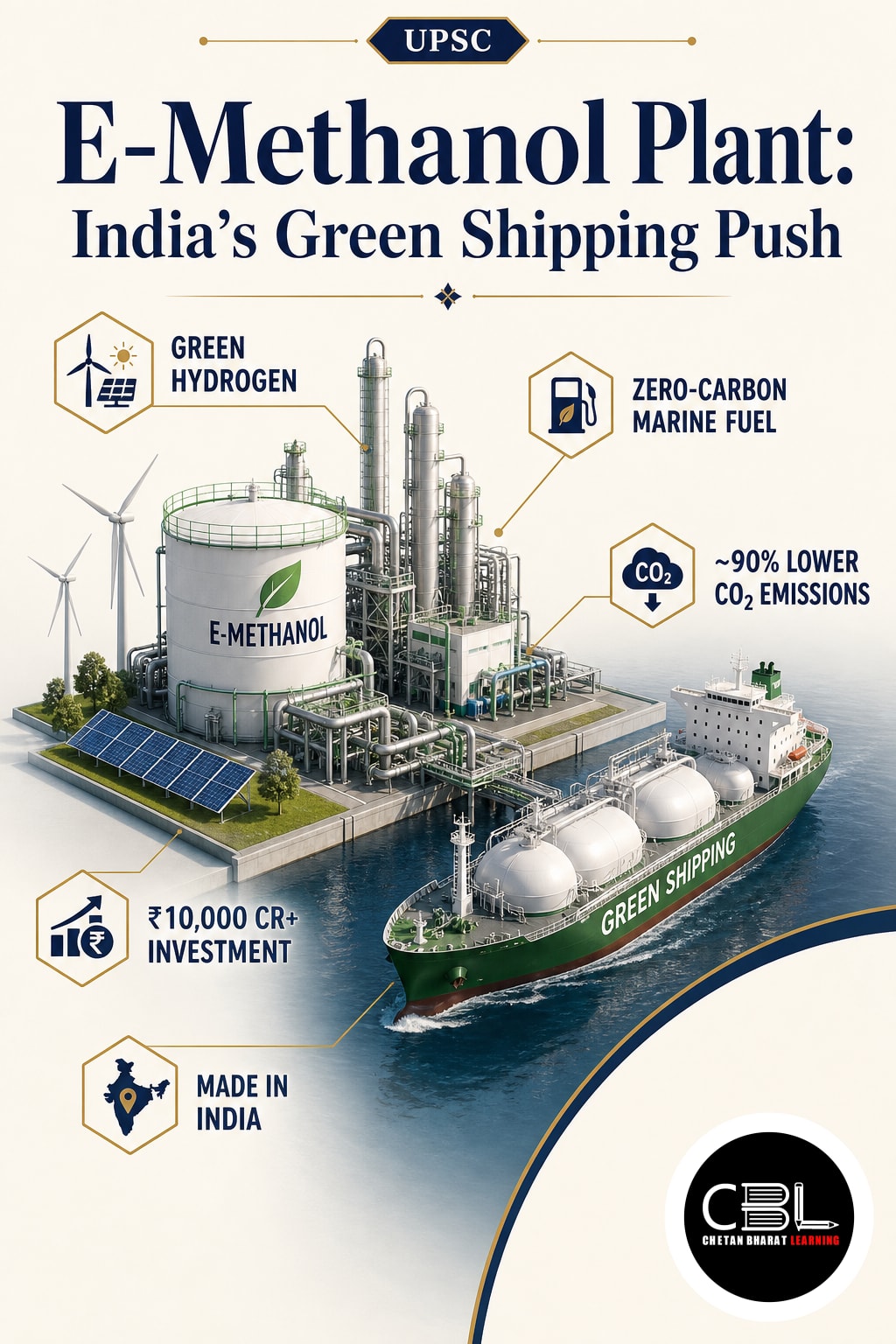
An E-Methanol Plant produces synthetic methanol by combining green hydrogen with captured carbon dioxide. Renewable electricity powers an electrolyser that separates water into hydrogen and oxygen. The hydrogen subsequently reacts with purified carbon dioxide inside a catalytic synthesis system. Distillation removes water and other impurities, producing methanol suitable for industrial or fuel applications.
The prefix “e” indicates that electricity forms the foundation of the production pathway. Its environmental performance depends upon renewable electricity and a verifiable source of captured carbon. Unlike conventional methanol derived mainly from fossil-based synthesis gas, e-methanol can reduce lifecycle emissions when producers follow robust sustainability standards. The resulting liquid remains easier to store and transport than gaseous hydrogen, making it relevant for long-distance shipping and other difficult-to-electrify sectors.
Why is E-Methanol Plant in News?
India laid the foundation stone for its first port-based E-Methanol Plant at Deendayal Port Authority in Kandla, Gujarat, on 26 September 2026. The ₹2,300-crore project is a joint initiative of the port authority and Assam Petro-Chemicals Limited. Its planned capacity is 150 tonnes per day, and the developers will install it through scalable modules. The official PIB announcement identifies it as India’s first port-based facility of this kind.
The facility will use renewable power, water and biogenic carbon dioxide to manufacture marine fuel. It aims to supply vessels operating along the Asia–Europe international trade corridor. Phase I will add 50 tonnes of daily capacity with an investment of ₹1,200 crore and a January 2027 completion target. Phase II will add another 100 tonnes per day through ₹1,100 crore, with completion targeted for March 2027. The government expects the project to create more than 3,500 direct and indirect employment opportunities.
Key Features
- Strategic port location: Direct bunkering access and reduced inland transport along a major shipping route.
- Renewable production pathway: Combines renewable power, water and biogenic CO₂ to lower lifecycle carbon footprint.
- Phased development: Modular installation allows gradual capacity scaling and demand response.
- Institutional partnership: DPA provides port infrastructure; Assam Petro-Chemicals brings chemical expertise.
- Export orientation: Positions India in the emerging global green-fuel market via international shipping corridors.
Challenges
- High energy requirement: Electrolysis demands substantial renewable power, affecting costs and emissions.
- Carbon verification: Ensuring biogenic or captured CO₂ traceability to maintain claimed environmental benefits.
- Initial demand constraints: Shipping companies need compatible vessels, contracts and regulatory clarity.
- Safety and toxicity: Methanol is flammable and toxic, requiring robust handling and emergency systems.
- Global standards: Inconsistent certification and carbon-accounting rules complicate exports.
Way Forward
India should establish credible green methanol standards covering renewable electricity, hydrogen origin, carbon sourcing and lifecycle emissions. Independent certification can prevent greenwashing and improve overseas acceptance. Regulators should align domestic rules with evolving international shipping requirements and enforce safety guidelines.
The E-Methanol Plant should anchor a wider network of renewable power, desalinated water, verified carbon capture and safe bunkering facilities. Long-term purchase agreements can provide predictable demand while helping shipping companies plan fleet conversion. Port authorities must train workers, conduct emergency drills and monitor environmental impacts. India can integrate these measures with the Harit Sagar guidelines to build competitive and responsible green shipping corridors.
Prelims Practice Corner
- India’s first port-based e-methanol facility is being developed at: (a) Paradip Port (b) Deendayal Port (c) Chennai Port (d) Cochin Port
Answer: (b) Deendayal Port Authority in Kandla, Gujarat. - E-methanol is primarily produced by combining captured carbon dioxide with: (a) Green hydrogen (b) Uranium (c) Helium (d) Limestone
Answer: (a) Green hydrogen. - Which organisations are jointly developing the Kandla project? (a) ONGC & Cochin Port (b) NTPC & Paradip Port (c) DPA & Assam Petro-Chemicals (d) GAIL & Chennai Port
Answer: (c) DPA and Assam Petro-Chemicals Ltd. - Consider statements about e-methanol: 1. Liquid at ordinary temperatures. 2. Can serve as marine fuel. 3. Sustainability independent of electricity source. Which are correct? (a) 1 only (b) 1 & 2 only (c) 2 & 3 only (d) 1, 2 & 3
Answer: (b) 1 and 2 only. - The Harit Sagar guidelines are primarily associated with: (a) Sustainable port development (b) Deep-sea mineral auctions (c) Inland crop insurance (d) Nuclear-fuel transport
Answer: (a) Sustainable port development.
Mains Practice Questions
- Explain the significance of port-based e-methanol production for India’s maritime decarbonisation strategy. (150 words, 10 marks)
- Intro: Define e-methanol and mention the Kandla project.
- Body: Cleaner shipping, bunkering access, hydrogen demand, export potential, employment.
- Conclusion: Link to standards and green shipping corridors.
- Discuss the opportunities and challenges associated with e-methanol as an alternative marine fuel. (250 words, 15 marks)
- Intro: Synthetic fuel based on renewable hydrogen and captured carbon.
- Body: Storage, emission reduction, costs, energy needs, safety, certification, market demand.
- Conclusion: Recommend lifecycle accounting, technology neutrality, coordinated infrastructure.
FAQs on E-Methanol Plant
What is the planned capacity of the Kandla facility?
The facility will have a total capacity of 150 tonnes per day, with 50 tonnes added in Phase I and 100 tonnes in Phase II.
Is e-methanol completely emission-free?
Its combustion releases CO₂, but production recycles captured carbon with renewable hydrogen. Actual benefit depends on full lifecycle emissions.
Why locate an e-methanol facility at a port?
A port-based plant enables direct vessel bunkering and reduces inland transport, leveraging existing storage and maritime infrastructure.
Related Current Affairs
Preparing for UPSC, PCS or HCS?
Talk to a mentor at Chetan Bharat Learning, Chandigarh. Free guidance on choosing the right exam and building a study plan.
Chat on WhatsAppCall 97793 53345UPSC / IAS / PCS coaching in Chandigarh · Trusted by aspirants across Punjab & Haryana
Leave a Reply
You must be logged in to post a comment.