

UPSC Mapping
- Prelims: United Nations, UNGA and UNSC
- Mains: GS Paper II – International Relations
Quick Facts
| Established | 1945 |
|---|---|
| UN Members | 193 Countries |
| Security Council | 15 Members |
| Permanent Members | Five with Veto Power |
What is UN Trust Deficit?
The UN Trust Deficit refers to declining confidence among countries and citizens in the United Nations’ fairness, effectiveness and accountability. It becomes visible when the organisation cannot prevent conflicts, enforce common rules or represent present-day geopolitical realities. The problem concerns institutional credibility rather than the relevance of international cooperation itself.
The United Nations remains central to diplomacy, humanitarian relief, development and international law. Its legitimacy, however, depends upon consistent decision-making and equitable participation by all regions. When powerful states avoid accountability while weaker countries face pressure, perceptions of selective multilateralism deepen.
Why is UN Trust Deficit in News?
Debates surrounding the 81st United Nations General Assembly renewed attention on the UN Trust Deficit. Continuing wars, humanitarian emergencies and geopolitical rivalry have exposed the limits of collective security. Member states increasingly demand an organisation that can respond without allowing strategic interests to override human suffering.
Developing countries have also questioned the slow pace of Security Council reform and inadequate development finance. The Council’s structure still reflects the power distribution that existed after the Second World War. The United Nations’ Pact for the Future recognises the need for more representative, effective and responsive international institutions.
Key Features
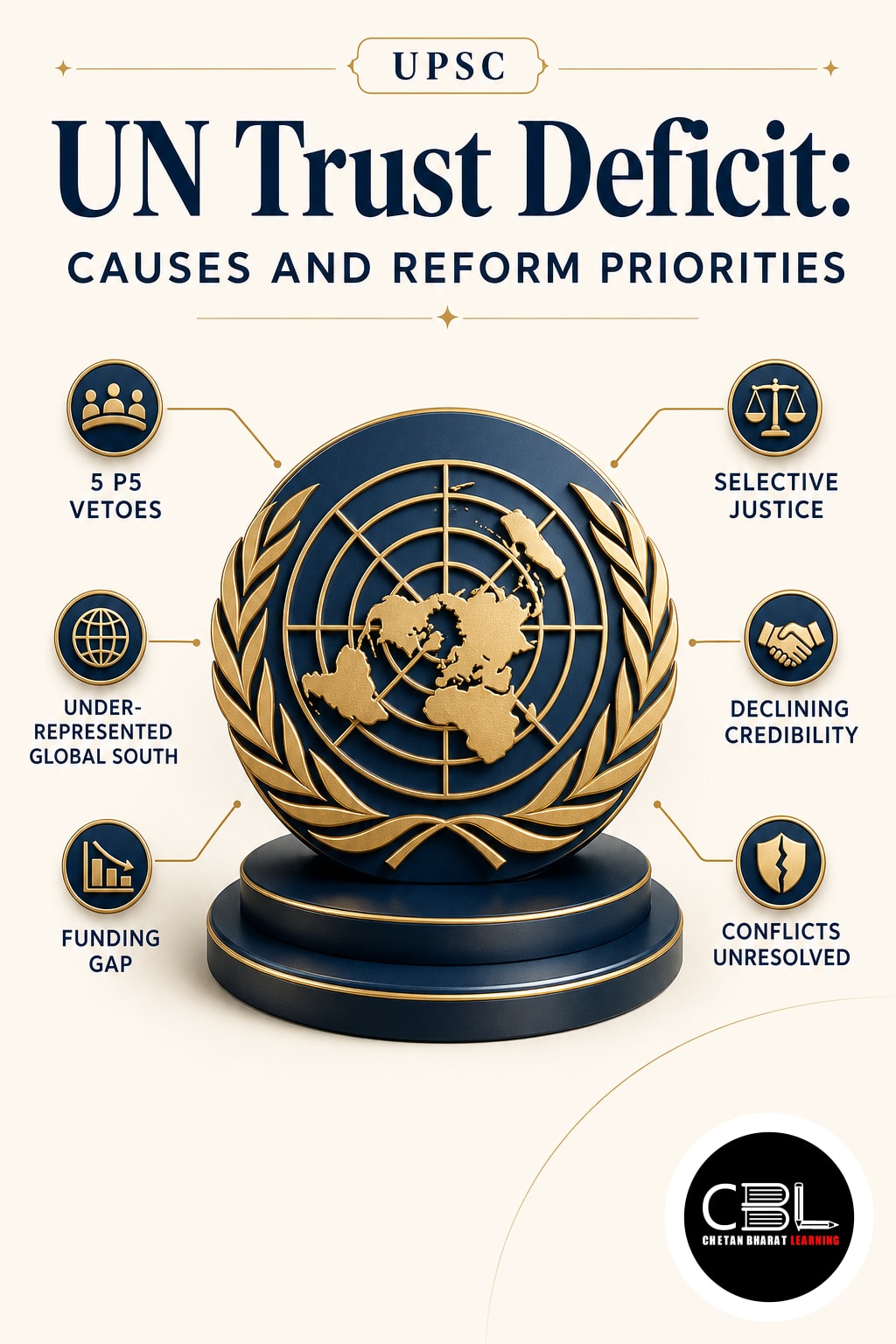
The crisis combines failures of representation, decision-making, financing, enforcement and institutional accountability.
- Security Council paralysis: Rivalries among the permanent members frequently block unified action during conflicts, allowing veto politics to weaken ceasefire efforts, humanitarian access and enforcement of Council decisions.
- Representation imbalance: Africa lacks permanent representation while Asia and Latin America remain underrepresented, although these regions contain most of the world’s population and many UN member states.
- Selective rule enforcement: Uneven responses to territorial violations, civilian casualties and human rights concerns create perceptions that strategic alliances determine how international rules operate.
- Development delivery gap: Financial constraints, debt distress and inadequate climate finance weaken progress on the Sustainable Development Goals, especially across vulnerable developing economies.
- Accountability concerns: Allegations involving procurement failures, misconduct or peacekeeping abuses damage public confidence when investigations, remedies and institutional reforms appear delayed or insufficient.
The veto represents the most visible source of institutional frustration. China, France, Russia, the United Kingdom and the United States can block substantive Security Council resolutions. This arrangement aimed to retain major-power participation, but repeated deadlocks have weakened the Council’s ability to discharge its collective security responsibility.
The UN General Assembly gives each member one vote, but most of its resolutions remain recommendatory. This contrast between inclusive deliberation and limited enforcement concentrates decisive authority within the Security Council. Smaller states often view this arrangement as an unequal division between formal sovereignty and actual institutional influence.
Representation has become increasingly important as the Global South gains economic and demographic weight. The absence of permanent African representation remains particularly difficult to justify. India also argues that the Council cannot retain legitimacy while excluding the world’s most populous country and a major contributor to UN peacekeeping.
A widening gap between humanitarian activity and political settlement adds another dimension. UN agencies may deliver food, shelter and medical assistance, while diplomatic divisions prevent durable peace agreements. This separation forces the organisation to manage prolonged emergencies without addressing their political causes.
Challenges
Restoring credibility remains difficult because reform affects entrenched power structures and competing national interests.
- P5 resistance: Amending the UN Charter requires ratification by all five permanent Security Council members, giving existing powers decisive influence over reforms that may dilute their privileges.
- Competing reform models: Member states disagree over permanent membership, regional representation, veto expansion, Council size and the distribution of additional non-permanent seats.
- Financial dependence: Heavy reliance on a limited group of major donors can distort programme priorities, while delayed contributions weaken peacekeeping, development and humanitarian operations.
- Sovereignty constraints: Governments support international action selectively and often resist scrutiny when human rights, domestic conflicts or strategic security interests become involved.
- Information fragmentation: Disinformation, geopolitical narratives and weak public communication reduce understanding of UN achievements while amplifying institutional failures and allegations of bias.
Security Council reform requires amendments under Article 108 of the UN Charter. Adoption needs a two-thirds General Assembly majority followed by ratification from two-thirds of UN members, including every permanent Council member. This demanding threshold makes broad political consensus essential.
Expansion alone may not improve effectiveness if new members reproduce existing divisions. Reform must balance representation with the Council’s ability to act quickly during emergencies. Negotiators must also prevent any arrangement that creates new permanent inequalities without strengthening institutional accountability.
Funding presents a second structural challenge. Earmarked voluntary contributions may direct resources towards donor priorities rather than collectively determined needs. Predictable and timely financing would help UN agencies plan operations, retain expertise and respond rapidly to emerging crises.
India supports reformed multilateralism that reflects contemporary realities and strengthens developing-country representation. Its case rests on population, democratic credentials, economic capacity, peacekeeping contributions and engagement with the Global South. Readers can examine connected diplomatic developments in the international relations section.
Way Forward
Member states should begin text-based negotiations for Security Council reform and expand representation for Africa, Asia and Latin America. A reformed Council must provide a stronger voice to the Global South while preserving operational effectiveness. India’s inclusion as a permanent member would improve the Council’s demographic and geopolitical legitimacy.
Permanent members should exercise voluntary veto restraint during genocide, war crimes and crimes against humanity. The General Assembly should continue scrutinising every veto under Resolution 76/262. Greater transparency would require vetoing states to explain how their decisions serve international peace rather than narrow strategic interests.
The UN should strengthen independent oversight, protect whistle-blowers and publish clear findings on procurement and misconduct cases. Senior appointments require transparent criteria and wider geographic diversity. These changes can demonstrate that accountability applies equally across nationalities, ranks and agencies.
Predictable assessed contributions should support essential peacekeeping, humanitarian and development functions. Member states must also align military expenditure with investments in poverty reduction, climate resilience and sustainable development. Effective multilateralism requires resources that match the responsibilities assigned to international institutions.
The UN Trust Deficit can narrow only when institutional promises produce visible and impartial outcomes. Governments must uphold the UN Charter consistently, including when compliance conflicts with immediate strategic interests. The official United Nations Charter remains the legal foundation for sovereign equality, peaceful dispute resolution and collective security.
Prelims Practice Corner
-
Q1. How many members does the United Nations Security Council have?
- (a) 10 (b) 12 (c) 15 (d) 20
Answer: (c) The Security Council consists of five permanent and ten elected members.
-
Q2. Which UN organ has primary responsibility for maintaining international peace and security?
- (a) General Assembly (b) Security Council (c) Economic and Social Council (d) International Court of Justice
Answer: (b) Article 24 of the UN Charter assigns this primary responsibility to the Security Council.
-
Q3. Consider the following statements:
1. All five permanent Security Council members possess veto power.
2. General Assembly resolutions are ordinarily binding on every member state.
Which statement is correct?- (a) 1 only (b) 2 only (c) Both 1 and 2 (d) Neither 1 nor 2
Answer: (a) The P5 possess veto power, while most General Assembly resolutions are recommendatory.
-
Q4. UN General Assembly Resolution 76/262 is associated with:
- (a) Climate finance (b) General Assembly debate after a Security Council veto (c) Peacekeeper deployment (d) Election of the Secretary-General
Answer: (b) The resolution provides for a General Assembly meeting after a permanent member casts a veto.
-
Q5. Article 108 of the UN Charter concerns:
- (a) Charter amendments (b) Admission of new members (c) International Court jurisdiction (d) Peacekeeping finance
Answer: (a) Article 108 establishes the adoption and ratification requirements for Charter amendments.
Mains Practice Questions
Q1. Analyse the structural and functional causes behind declining confidence in the United Nations. (250 words, 15 marks)
Answer Structure
Intro: Define the credibility crisis within the wider context of contemporary multilateralism.
Body: Examine veto paralysis, representation, selective enforcement, financial dependence, development gaps and oversight concerns.
Conclusion: Emphasise representative institutions, consistent rules and accountable international cooperation.
Q2. Reformed multilateralism is essential for making the United Nations fit for contemporary global challenges. Discuss India’s role. (250 words, 15 marks)
Answer Structure
Intro: Explain why the post-war institutional order requires reform.
Body: Cover Security Council expansion, India’s candidature, Global South representation, peacekeeping and development cooperation.
Conclusion: Present India as a bridge-builder supporting representative and effective multilateral institutions.
FAQs on UN Trust Deficit
Why has confidence in the United Nations declined?
Veto-based deadlocks, unequal representation, inconsistent rule enforcement and inadequate accountability have weakened confidence. The gap between humanitarian action and political settlement also prolongs major crises.
Can the General Assembly override a Security Council veto?
The General Assembly cannot directly cancel a veto. It can debate the situation, adopt recommendations and mobilise political pressure through mechanisms such as Resolution 76/262.
What reforms does India seek at the United Nations?
India supports expanded permanent and non-permanent Security Council membership with stronger developing-country representation. It also advocates transparent decision-making, effective multilateralism and institutions reflecting contemporary geopolitical realities.
Related Current Affairs
Preparing for UPSC, PCS or HCS?
Talk to a mentor at Chetan Bharat Learning, Chandigarh. Free guidance on choosing the right exam and building a study plan.
Chat on WhatsAppCall 97793 53345UPSC / IAS / PCS coaching in Chandigarh · Trusted by aspirants across Punjab & Haryana
Leave a Reply
You must be logged in to post a comment.