
UPSC Mapping
| Prelims | AFSPA Sections 3, 4, 5 and 6 |
|---|---|
| Mains | GS Paper III – Internal Security |
| Enacted | 1958 |
|---|---|
| Key Provision | Section 3 |
| Extension Period | Six months |
| Effective From | 1 October 2026 |
| Nodal Ministry | Ministry of Home Affairs |
What is AFSPA Extension?
AFSPA Extension means continuing a disturbed-area notification under the Armed Forces (Special Powers) Act, 1958 for a specified period. The notification activates statutory powers only within the territory that the government identifies. It does not automatically place an entire state or the whole Northeast under one uniform arrangement.
Section 3 permits the Central Government, a state Governor or a Union Territory Administrator to declare an area disturbed. The authority must form an opinion that the area faces such a disturbed or dangerous condition that armed forces assistance becomes necessary. This declaration provides the legal basis for personnel to exercise powers under Section 4.
The law emerged during the Naga insurgency and drew from a colonial-era ordinance issued in 1942. Parliament enacted the present legislation in 1958, initially for Assam and Manipur, before expanding its territorial scope. A separate 1990 legislation governs the application of similar special powers in Jammu and Kashmir.
AFSPA supplements civil administration during exceptional insecurity; it does not replace the Constitution or ordinary criminal law. Section 5 requires personnel to hand an arrested person to the nearest police station with the least possible delay. Police investigation, judicial scrutiny and constitutional remedies continue to operate alongside the special framework.
Why is AFSPA Extension in News?
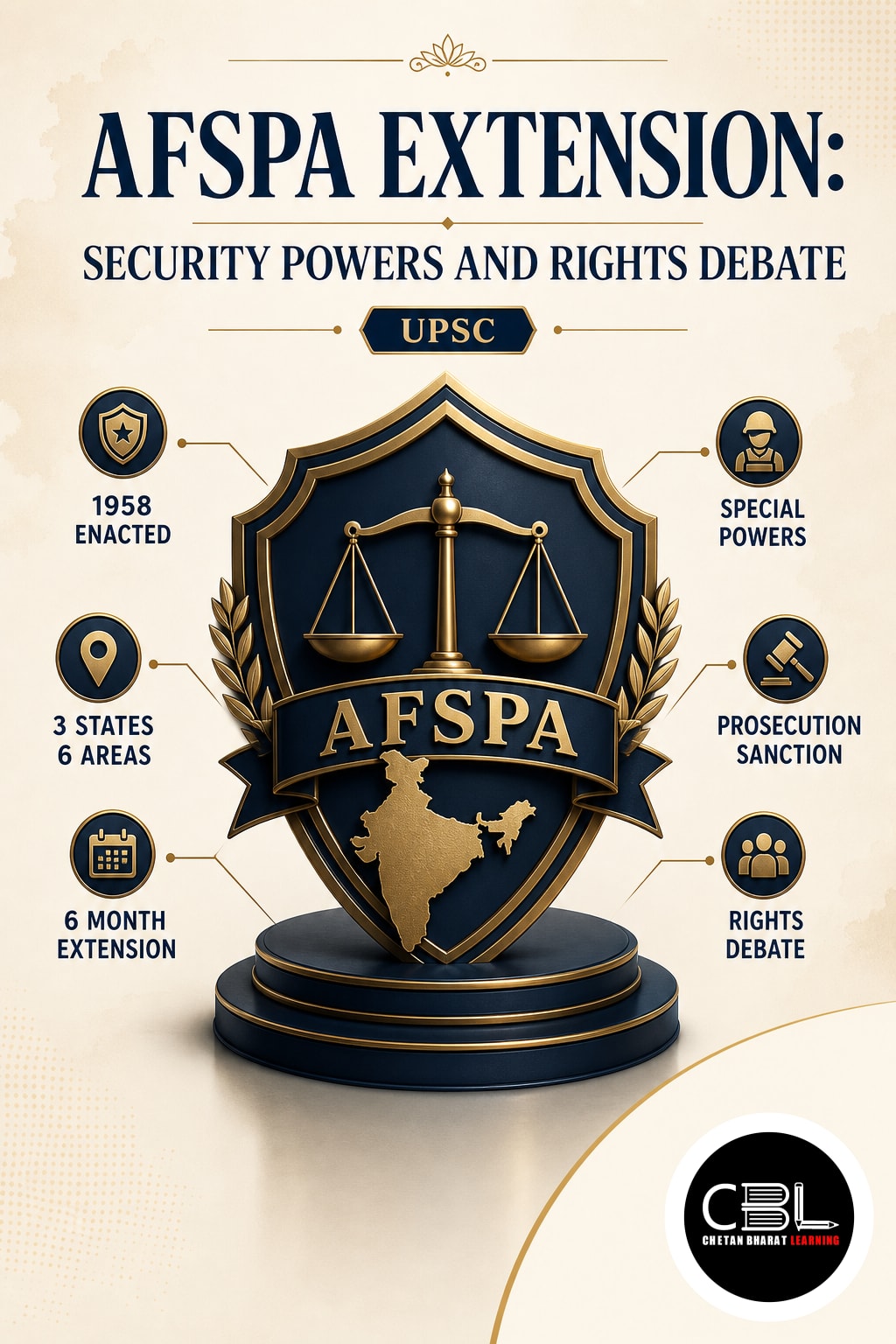
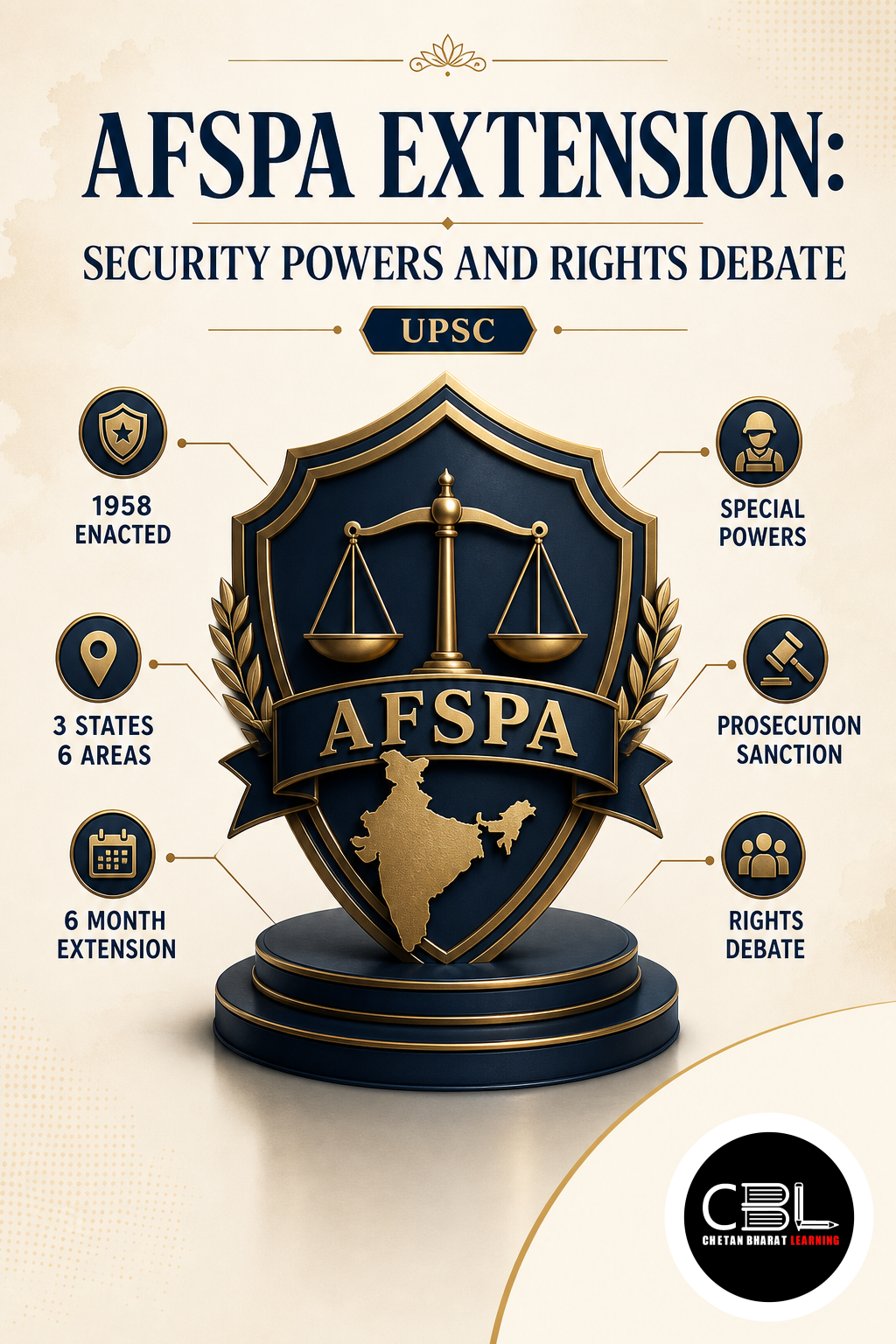
The latest AFSPA Extension continues disturbed-area status for six months from 1 October 2026 in designated parts of Manipur, Nagaland and Arunachal Pradesh. The decision followed a review of security conditions by the Union government and the concerned states. It retains special powers where authorities assess that insurgency, armed activity or serious instability still exceeds normal policing capacity.
The geographical limits matter because the government has gradually withdrawn the law from several areas after security improvements. This calibrated approach allows authorities to distinguish relatively stable districts from locations facing persistent threats. Readers can examine the current notifications on the Ministry of Home Affairs portal.
A six-month notification also creates a defined point for periodic reassessment. Authorities can renew, reduce or withdraw disturbed-area status after examining violence, extortion, recruitment, civilian administration and police preparedness. The review should consider local variations instead of treating an entire region as one security unit.
The development carries constitutional significance because public order ordinarily falls within the state domain. The Union also carries responsibilities under Article 355 to protect states against external aggression and internal disturbance. AFSPA operates at this sensitive intersection between federal coordination, operational necessity and fundamental rights.
Key Features
The law combines territorial notification, operational authority and procedural safeguards within a single statutory framework.
- Disturbed-area declaration: Section 3 allows the competent government authority to notify the whole or part of a state or Union Territory after assessing dangerous conditions.
- Use of proportionate force: Section 4 permits specified personnel to use necessary force after due warning against particular prohibited conduct, subject to statutory conditions.
- Arrest and search powers: Personnel may arrest without a warrant on reasonable suspicion and search premises connected with specified offences or unlawfully held arms.
- Police handover requirement: Section 5 requires every arrested person and the circumstances of arrest to reach the nearest police station without avoidable delay.
- Prior sanction provision: Section 6 requires Central Government sanction before prosecution, suit or another legal proceeding for acts purportedly performed under the law.
The AFSPA Extension does not create an unrestricted licence to use force. Personnel must connect an action to powers granted by the Act, observe applicable operational instructions and remain answerable to constitutional standards. Courts can examine whether an alleged act genuinely arose from official duty or departed from lawful authority.
In Naga People’s Movement of Human Rights v. Union of India, the Supreme Court upheld the legislation while insisting on safeguards and periodic review. The judgment treated deployment as assistance to civil power rather than a transfer of civil administration to the military. It also emphasised compliance with operational instructions governing arrest, search and the use of force.
Challenges
The central policy challenge involves reconciling effective counter-insurgency with constitutional accountability and public confidence.
- Risk to civil liberties: Broad arrest, search and force-related powers can produce serious rights concerns when personnel apply them without restraint or adequate supervision.
- Accountability delays: Prolonged decisions on prosecution sanction can weaken victim confidence and create perceptions that procedural protection amounts to substantive immunity.
- Community trust deficit: A long security deployment may deepen alienation when residents experience checkpoints, searches and force without transparent grievance redress.
- Uneven institutional capacity: Weak local policing, forensic systems and prosecution mechanisms can prolong dependence on the armed forces during recurring disturbances.
- Quality of periodic review: Repeated extensions require current, area-specific evidence so exceptional powers do not continue merely through administrative routine.
The Supreme Court addressed accountability in EEVFAM v. Union of India in 2016. It held that excessive or retaliatory force cannot escape investigation merely because the area remains disturbed. The Court rejected the idea that prolonged deployment converts every death during an operation into a legally protected action.
Past expert bodies also proposed substantial reform. The Justice B.P. Jeevan Reddy Committee recommended repealing AFSPA and incorporating necessary provisions into the Unlawful Activities (Prevention) Act. The Second Administrative Reforms Commission supported repeal, while the Justice Santosh Hegde Commission rejected blanket immunity for unlawful killings.
Security policy must also address political disputes, border vulnerabilities, illegal arms, extortion and limited economic opportunities. Force can contain immediate violence but cannot independently resolve every underlying grievance. Related dimensions appear in CBL’s polity and governance coverage.
Way Forward
Each AFSPA Extension should follow an evidence-based review at district and police-station levels. Authorities should examine violence trends, civilian access, local police readiness and the capacity of courts before renewing a notification. They should publish clear reasons and territorial boundaries wherever operational security permits.
Governments should strengthen independent investigation, preserve evidence and decide requests for prosecution sanction within a reasonable timeframe. Accessible complaint systems, recorded operations and enforceable standard procedures can protect citizens and responsible personnel. The Supreme Court’s EEVFAM judgment provides an important judicial framework for accountability.
States must simultaneously improve police training, intelligence coordination, forensic capacity and prosecution quality. Stronger civilian institutions can gradually reduce the operational space in which exceptional powers appear necessary. Security forces should support this transition through coordinated handovers and regular assessments with state authorities.
A durable solution requires dialogue and development alongside firm action against armed groups. Better connectivity, responsive administration, livelihood opportunities and inclusive political engagement can reduce recruitment and restore confidence. The long-term objective should remain normal policing under ordinary law wherever conditions permit.
Prelims Practice Corner
Q1. Which section of AFSPA authorises the declaration of a disturbed area?
(a) Section 2 (b) Section 3 (c) Section 5 (d) Section 6
Show answer
Answer: (b) Section 3 empowers the competent authority to declare an area disturbed.
Q2. Who may issue a disturbed-area declaration under the 1958 Act?
(a) District Magistrate only (b) Parliament only (c) Central Government, Governor or UT Administrator (d) Chief of Defence Staff only
Show answer
Answer: (c) Section 3 identifies these authorities for issuing the notification.
Q3. What does Section 5 of AFSPA require after an arrest?
(a) Military trial (b) Immediate preventive detention (c) Handover to the nearest police station without unnecessary delay (d) Approval from Parliament
Show answer
Answer: (c) The arrested person must reach the nearest police station with the least possible delay.
Q4. Section 6 of the 1958 Act primarily concerns:
(a) Financial emergency (b) Prior Central sanction for legal proceedings (c) Creation of military courts (d) Interstate deployment costs
Show answer
Answer: (b) It requires Central Government sanction for proceedings concerning acts purportedly done under the Act.
Q5. What principle emerged from the EEVFAM judgment?
(a) Disturbed areas lie outside judicial review (b) Every encounter receives automatic immunity (c) Excessive force may be investigated (d) State police acquire military powers
Show answer
Answer: (c) The Supreme Court held that statutory protection does not shield excessive or retaliatory force from investigation.
Mains Practice Questions
Q1. Examine how India can balance counter-insurgency requirements with constitutional rights in areas governed by AFSPA. (250 words, 15 marks)
Answer Structure
Intro: Define AFSPA and explain the purpose of disturbed-area notifications.
Body: Cover operational necessity, fundamental rights, Supreme Court safeguards, sanction-related concerns and institutional accountability.
Conclusion: Support narrowly tailored powers backed by review, transparency and stronger civilian institutions.
Q2. Periodic territorial review is essential for preventing exceptional security laws from becoming permanent. Discuss. (150 words, 10 marks)
Answer Structure
Intro: Link the exceptional nature of AFSPA powers with the disturbed-area declaration.
Body: Discuss local security indicators, police capacity, federal consultation, judicial guidance and transparent geographical limits.
Conclusion: Recommend evidence-based renewal and phased withdrawal wherever ordinary policing becomes sufficient.
FAQs on AFSPA Extension
Does an AFSPA notification amount to a constitutional emergency?
No. It is a statutory disturbed-area notification and does not constitute an emergency proclamation under the Constitution. Civil governments, police forces and courts continue to function.
Does AFSPA provide complete immunity to security personnel?
No. Section 6 requires prior Central sanction for specified legal proceedings, but courts have rejected blanket immunity. Allegations of excessive or unlawful force can undergo investigation and judicial scrutiny.
Does the law apply throughout Northeast India?
No. Its operation depends on valid disturbed-area notifications covering identified states, districts or police-station areas. Governments can reduce or withdraw coverage when their security assessments support normal policing.
Related Current Affairs
Preparing for UPSC, PCS or HCS?
Talk to a mentor at Chetan Bharat Learning, Chandigarh. Free guidance on choosing the right exam and building a study plan.
Chat on WhatsAppCall 97793 53345UPSC / IAS / PCS coaching in Chandigarh · Trusted by aspirants across Punjab & Haryana
Leave a Reply
You must be logged in to post a comment.