
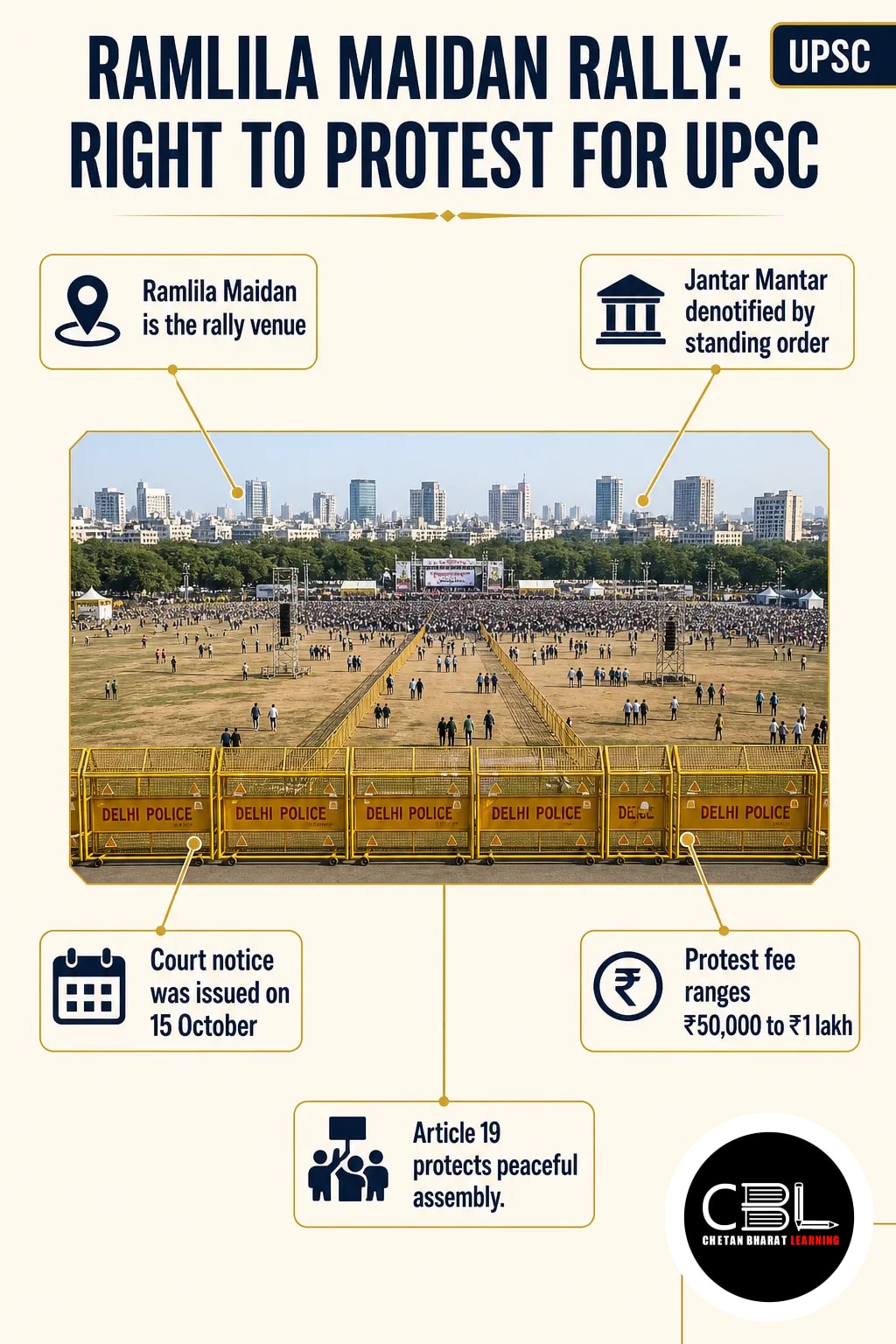

The Ramlila Maidan rally on 1 November 2026 has brought protest venues and their cost into focus. The INDIA bloc seeks Chief Election Commissioner Gyanesh Kumar’s resignation over alleged irregularities in the Special Intensive Revision of electoral rolls. For related constitutional issues, see CBL’s polity current affairs.
Quick answer: The Ramlila Maidan rally in New Delhi is the first major demonstration at the newly designated site since Jantar Mantar’s denotification. Ramlila Maidan is about 6 km by road from Parliament and costs ₹50,000–₹1 lakh a day to book. The debate concerns access, affordability and reasonable restrictions on peaceful assembly.
Why is the Ramlila Maidan rally significant?
The rally tests the practical accessibility of Delhi’s designated protest venues after Jantar Mantar’s removal from the list. Delhi Police denotified Jantar Mantar through an 11 October standing order. On 15 October, the Supreme Court issued notice to the Centre and Delhi Police on a writ petition challenging that order.
The notice starts judicial consideration; it is not a final ruling on the order’s validity. Meanwhile, the rally’s demand concerns alleged electoral-roll irregularities, not a finding that those allegations are established. For the separate constitutional question, read about the Chief Election Commissioner’s removal rules.
What have the Supreme Court judgments said?
The Supreme Court has protected peaceful protest while also recognising competing claims over public spaces.
Mazdoor Kisan Shakti Sangathan case, 2018
In Mazdoor Kisan Shakti Sangathan v. Union of India, the Court considered protesters’ rights alongside the interests of residents affected by prolonged demonstrations. It set aside a National Green Tribunal order barring protests at Jantar Mantar. It also allowed the site to continue for protests, subject to administrative permissions, including conditions concerning crowd size.
The case recognised the practice of earmarking protest spaces. However, the source distinguishes this administrative mechanism from a constitutional or statutory requirement that every protest must use a designated site.
Amit Sahni case, 2020
In Amit Sahni v. Commissioner of Police, concerning the Shaheen Bagh protest, the Court considered the impact of demonstrations on commuters. It held that peaceful protest cannot extend so far that it severely affects citizens’ daily lives. Thus, the right to assemble must be considered alongside access to public roads.
Which constitutional provisions apply?
Articles 19 and 21 frame the competing rights involved in regulating peaceful assemblies.
| Provision | Relevance |
|---|---|
| Article 19(1)(a) | Protects citizens’ freedom of speech and expression, subject to Article 19(2). |
| Article 19(1)(b) | Protects citizens’ right to assemble peacefully and without arms. |
| Article 19(3) | Allows reasonable restrictions on assembly in the interests of sovereignty and integrity of India or public order. |
| Article 19(1)(d) | Protects citizens’ freedom of movement throughout India, subject to permissible restrictions. |
| Article 21 | Protects life and personal liberty except according to procedure established by law. |
These provisions do not make a protest immune from regulation. However, a restriction must satisfy the applicable constitutional standard; administrative convenience alone does not settle whether it is reasonable.
How do distance and fees affect protest?
Distance and booking costs can affect whether a protest reaches decision-makers and whether smaller groups can organise it.
| Location | Approximate distance from Parliament |
|---|---|
| Jantar Mantar | 2 km |
| Ramlila Maidan | 6 km by road |
| Central Business District ground, Shahdara | 14 km |
| Burari ground | 23 km |
Senior Advocate Shadan Farasat argues that a site too distant from the seat of power can weaken a protest’s purpose. Moreover, the ₹50,000–₹1 lakh daily booking range at Ramlila Maidan can deter groups with limited resources. A fee of ₹50,000 for a 50-person demonstration illustrates the burden.
Senior Advocate Nipun Saxena notes that the venue’s commercial fee was also a concern in the 2018 case. However, the present challenge to Jantar Mantar’s denotification remains distinct from that earlier judgment.
Can protests take place outside designated sites?
Yes, designation is an administrative arrangement, not a general constitutional prerequisite for peaceful protest. However, organisers must account for applicable permissions and lawful restrictions, including prohibitory orders in a specific area.
Farasat suggests that people may seek permission for another public space when an accessible designated site is unavailable. Saxena similarly argues that denotification alone should not automatically prevent peaceful assembly. These are the lawyers’ interpretations; they do not amount to a final decision in the current challenge. See also CBL’s analysis of Delhi rally restrictions and fundamental rights.
What are the governance concerns and way forward?
Protest regulation must protect meaningful access while reducing disruption to residents and commuters.
- Availability: A ground occupied by other events may not serve protesters; therefore, authorities should identify a suitable alternative when necessary.
- Affordability: Transparent fees and arrangements for groups with limited resources could reduce financial barriers without presuming that every charge is unlawful.
- Proximity and visibility: Authorities should assess whether a venue permits demonstrators to communicate effectively with the intended audience.
- Public order: Crowd conditions and traffic management can protect other users of public space; however, restrictions should remain reasonable.
- Accountability: Clear permission criteria and reasoned decisions can help organisers understand conditions and challenge restrictions where appropriate.
Overall, the issue is not simply whether a venue exists. Its cost, location and availability also determine whether peaceful assembly can function in practice.
Source: Indian Express Explained, 1 November 2026
- CEC Impeachment 2026: Protest and Removal Rules (31 Oct 2026)
- Delhi Rally Restrictions: Rights and UPSC Analysis (30 Oct 2026)
- CEC Impeachment Protest: Constitutional Rules for UPSC (29 Oct 2026)
Punjab PCS and Haryana HCS General Studies may test peaceful assembly, reasonable restrictions and public-order administration. For a governance answer, apply these principles to venue access and traffic management without assuming identical local rules.
Prelims Practice Corner
Mains Practice Questions
Frequently Asked Questions
Why is the INDIA bloc holding the Ramlila Maidan rally?
The bloc seeks Chief Election Commissioner Gyanesh Kumar’s resignation over alleged electoral-roll irregularities. The allegations concern the Special Intensive Revision; they are not presented here as established findings.
Must every protest be held at a designated site?
No, because designation is an administrative mechanism rather than a general constitutional prerequisite. However, applicable permissions and lawful restrictions remain relevant.
Did the Supreme Court settle the challenge to Jantar Mantar’s denotification?
No, because the Court issued notice on 15 October 2026 rather than a final ruling on the challenge. The petition contests the 11 October standing order.
How much does Ramlila Maidan cost to book?
The reported booking cost is ₹50,000 to ₹1 lakh per day. Therefore, affordability is a concern for groups with limited resources.
Related Current Affairs
Preparing for UPSC, PCS or HCS?
Talk to a mentor at Chetan Bharat Learning, Chandigarh. Free guidance on choosing the right exam and building a study plan.
Chat on WhatsAppCall 97793 53345UPSC / IAS / PCS coaching in Chandigarh · Trusted by aspirants across Punjab & Haryana

 Ananya RanaIAS · AIR 60
 Aditya SharmaIAS · AIR 70
 Ria Kaur SethiIPS · AIR 89
 Aman AloonIRS · AIR 295
 Sumer Singh VirkIRS · AIR 335
 Shivani PanchalIAS

Leave a Reply
You must be logged in to post a comment.