
UPSC Mapping
| Exam | Topics |
|---|---|
| Prelims | Polity & Social Issues |
| Mains | GS Paper 1 (Social Issues) & GS Paper 2 (Polity) |
Article
What are Offences Against Religion?
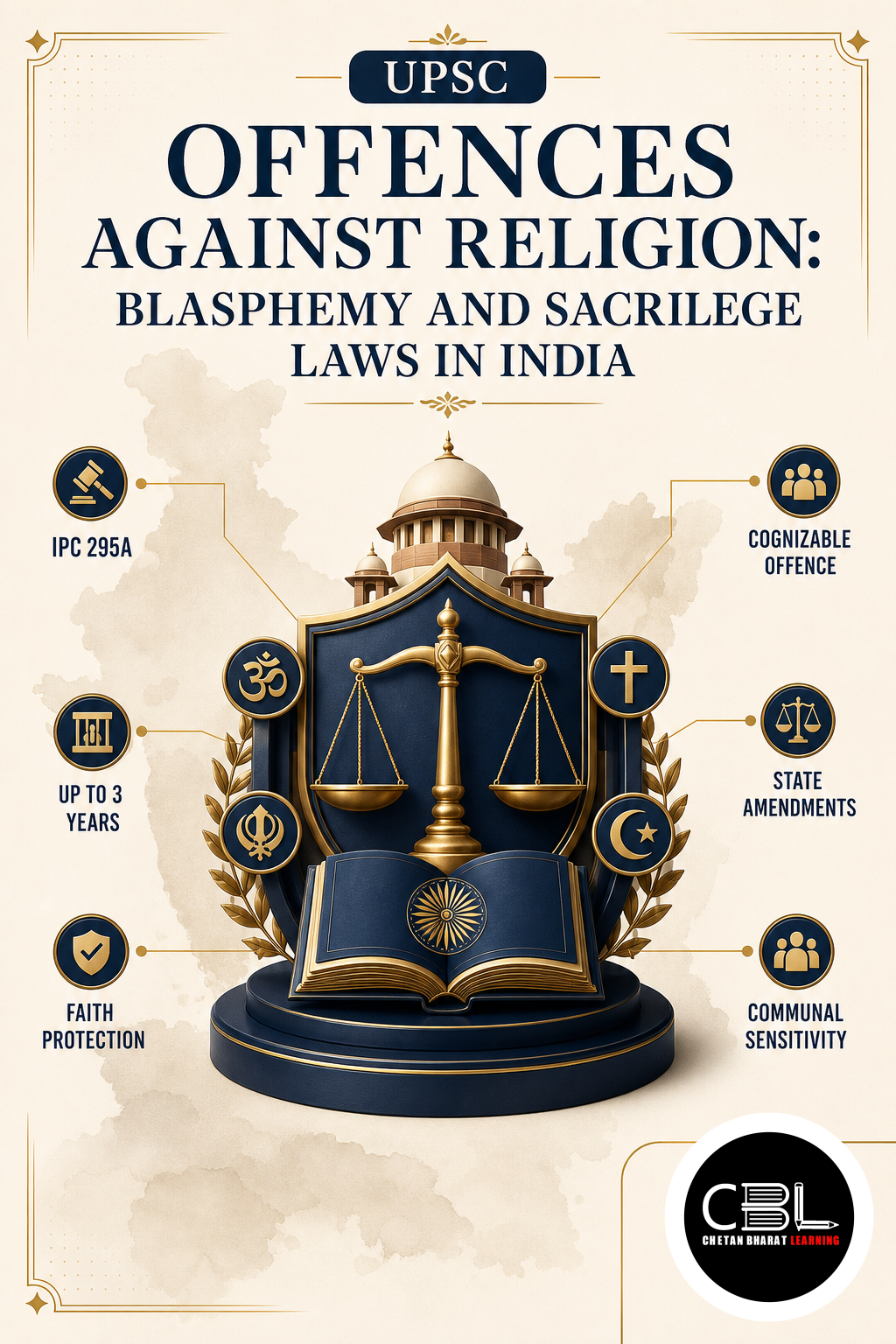
Offences Against Religion in Indian law distinguish between expressive offences (blasphemy) and acts of physical defilement (sacrilege). Blasphemy, governed under Section 299 of the Bharatiya Nyaya Sanhita (BNS), refers to contemptuous, insulting, or irreverent expression concerning religious beliefs, deities, scriptures, or religious figures. It requires clear proof of deliberate and malicious intent to outrage religious feelings. Sacrilege, governed under Section 298 of the BNS, refers to the physical desecration, defilement, or damage of something regarded as sacred, such as a place of worship or a religious text, performed with explicit intention of insulting or disrespecting a religion.
The debate centres on whether these provisions strike the right balance between protecting religious sentiments and safeguarding freedom of expression under Article 19(1)(a). The Supreme Court in Ramji Lal Modi v. State of Uttar Pradesh upheld the constitutionality of Section 295A on grounds of maintaining public order.
Why are Offences Against Religion in News?
Offences Against Religion are in the news following Punjab’s act providing stringent punishment for acts of sacrilege against the Guru Granth Sahib. The law has reignited debate over the constitutional balance between protection of religious sentiments and freedom of speech. The arrest of editor B.V. Seetaram over published articles questioning religious practices has also raised concerns about the chilling effect of such laws.
Critics argue that terms such as ‘insult’, ‘outrage’, and ‘hurt religious feelings’ are vague and subjective, creating scope for arbitrary enforcement and misuse. For more details, refer to this PIB release.
Key Features of Offences Against Religion
- Distinction: Blasphemy (expressive) vs Sacrilege (physical acts).
- Legal Standard: Requires deliberate and malicious intent for blasphemy; explicit intention for sacrilege.
- Constitutional Basis: Article 25 protects freedom of religion, while Article 19(1)(a) protects free speech.
- Public Order: Supreme Court upheld such laws on grounds of maintaining communal harmony.
- Religion-Specific: Some provisions may be specific to certain religions, raising Article 14 concerns.
Challenges in Offences Against Religion
- Freedom of Expression: Broad restrictions may criminalise criticism, satire, and scholarly inquiry.
- Vagueness: Terms like ‘insult’ and ‘outrage’ are subjective, leading to arbitrary enforcement.
- Social Reform: Overbroad laws may discourage challenging religious orthodoxy and discrimination.
- Heckler’s Veto: Offended groups can effectively veto public discourse through threats of FIR and arrest.
- Undermines Secularism: Unequal protection to different faiths may violate state neutrality.
Way Forward for Offences Against Religion
To balance Offences Against Religion with constitutional rights, the government should ensure that laws are applied strictly with clear intent, not used to suppress legitimate criticism. Judicial oversight can prevent misuse. The Supreme Court’s jurisprudence on the ‘clear and present danger’ test can guide enforcement.
Promoting interfaith dialogue and mutual respect can reduce communal tensions. A nuanced approach—distinguishing between genuine religious hatred and legitimate critique—is essential. For international best practices, refer to the UNHRC.
Prelims Practice Corner
Q1. Which section of the BNS deals with blasphemy?
- (a) Section 295
- (b) Section 298
- (c) Section 299
- (d) Section 300
Answer: Section 299 of the BNS deals with blasphemy.
Q2. What is sacrilege?
- (a) Insulting religious beliefs
- (b) Physical desecration of sacred objects
- (c) Blasphemy
- (d) Religious conversion
Answer: Sacrilege refers to physical defilement of sacred things.
Q3. Which Article protects freedom of religion?
- (a) Article 14
- (b) Article 19
- (c) Article 25
- (d) Article 21
Answer: Article 25 protects freedom of conscience and religion.
Q4. Which case upheld the constitutionality of Section 295A?
- (a) Kesavananda Bharati
- (b) Ramji Lal Modi v. State of U.P.
- (c) Maneka Gandhi v. Union of India
- (d) Golaknath v. State of Punjab
Answer: Ramji Lal Modi v. State of U.P. upheld the provision.
Q5. What is the ‘Heckler’s Veto’ in the context of religious offences?
- (a) A legal right to protest
- (b) The ability of offended groups to stifle speech through threats of legal action
- (c) A judicial doctrine
- (d) A parliamentary procedure
Answer: The Heckler’s Veto allows offended groups to silence speech through threats.
Mains Practice Questions
Q1. Critically examine the constitutional validity of laws on offences against religion in India, with reference to the balance between freedom of speech and protection of religious sentiments. (250 words, 15 marks)
- Intro: Introduce the debate over offences against religion.
- Body: Discuss the legal framework (blasphemy vs sacrilege), constitutional rights (Articles 19, 25), and the Ramji Lal Modi precedent. Analyse arguments for and against such laws. Suggest a nuanced approach.
- Conclusion: Emphasise the need for clear intent and judicial safeguards against misuse.
Q2. What is the difference between blasphemy and sacrilege under Indian law? (150 words, 10 marks)
- Intro: Define both terms.
- Body: Blasphemy is expressive (Section 299 BNS) and requires malicious intent to outrage religious feelings. Sacrilege is physical (Section 298 BNS) and requires explicit intention to desecrate sacred objects.
- Conclusion: Conclude that the distinction is important for legal interpretation.
FAQs on Offences Against Religion
What is the legal basis for offences against religion?
They are based on Sections 298 and 299 of the Bharatiya Nyaya Sanhita (BNS), which replaced the IPC provisions.
Are these laws constitutional?
The Supreme Court has upheld them as reasonable restrictions on free speech to maintain public order.
What are the concerns with these laws?
Concerns include vagueness, chilling effect on free speech, misuse, and undermining secularism.
Related Current Affairs
Preparing for UPSC, PCS or HCS?
Talk to a mentor at Chetan Bharat Learning, Chandigarh. Free guidance on choosing the right exam and building a study plan.
Chat on WhatsAppCall 97793 53345UPSC / IAS / PCS coaching in Chandigarh · Trusted by aspirants across Punjab & Haryana
Leave a Reply
You must be logged in to post a comment.