

UPSC Mapping
| Exam | Topic |
|---|---|
| Prelims | Environment & Ecology |
| Mains | GS Paper 3 (Environment & Urban Development) |
Quick Facts
| Developer | Dr. Akira Miyawaki |
|---|---|
| Planting Density | 3–5 saplings per sq m |
| Key Principle | Multi-layered canopy, native species |
What is the Miyawaki Method?
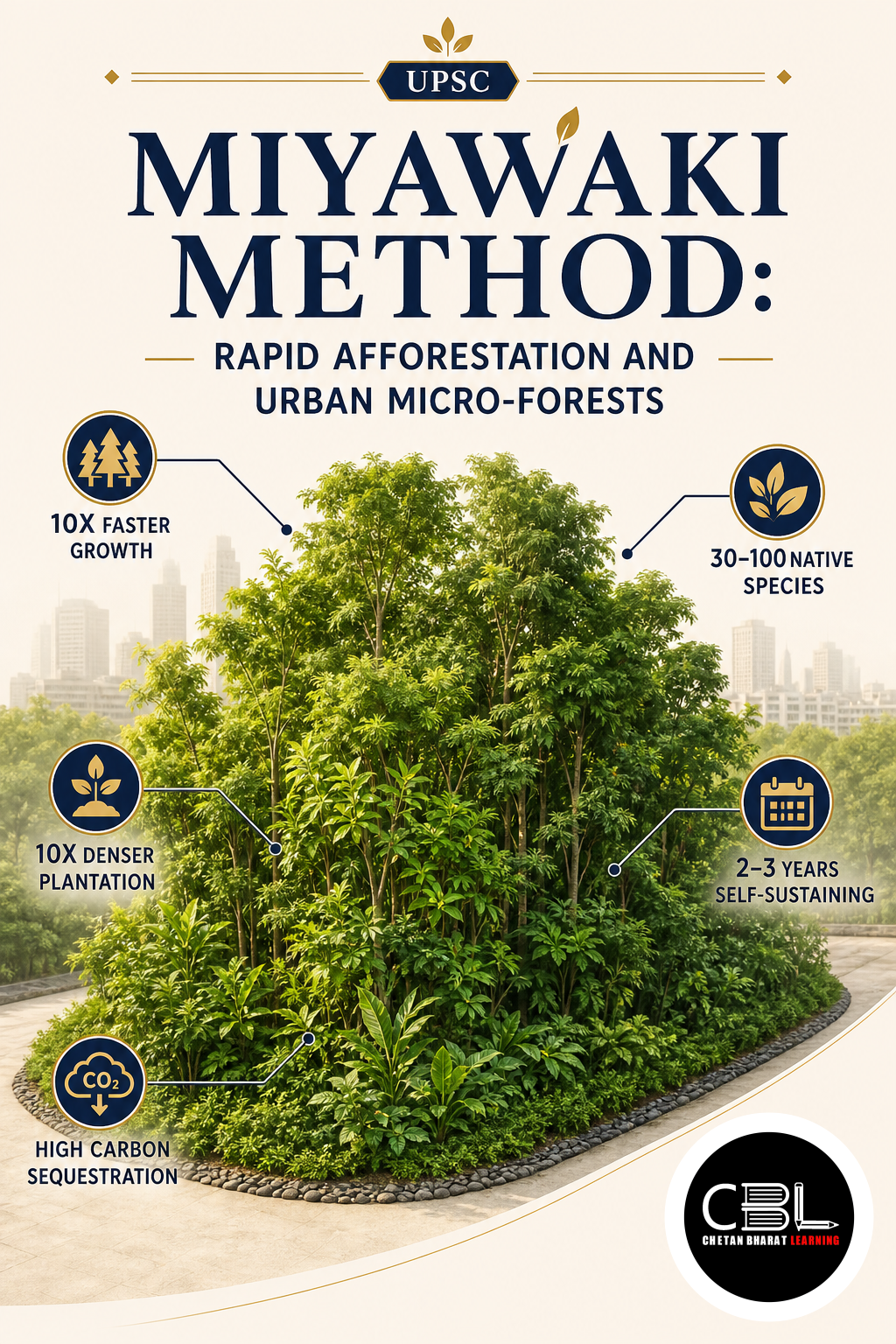
Miyawaki Method is an ultra-dense, rapid afforestation technique developed by Japanese botanist Dr. Akira Miyawaki in the 1970s. It creates self-sustaining native micro-forests by using only species that would naturally thrive in the area, planting 3–5 saplings per square meter, and ensuring a multi-layered canopy with random sapling arrangement. This method mimics natural forest regeneration and accelerates growth, with trees growing several times faster than conventional plantations.
Miyawaki micro-forests transform small, degraded urban spaces into green lungs, reducing the urban heat island effect, filtering dust and pollution, and serving as localized sound barriers. The technique is particularly effective in cities where land is scarce and rapid greening is needed.
Why is the Miyawaki Method in News?
Miyawaki Method is in the news because it was successfully used to transform a dumpsite in Raichur, Karnataka, into a micro-forest under the Swachh Bharat Mission-Urban 2.0. The project showcases how the technique can rehabilitate degraded urban spaces and improve environmental quality.
The method’s ability to create dense, biodiverse forests in small areas makes it attractive for cities facing space constraints. It aligns with India’s afforestation goals and urban sustainability targets. For more details, refer to the PIB release.
Key Features of the Miyawaki Method
- Native Species: Uses only species that naturally thrive in the area, ensuring ecological fit.
- High Density: Plants 3–5 saplings per square meter, promoting competition and rapid growth.
- Multi-Layered Canopy: Creates a stratified forest structure with trees, shrubs, and ground cover.
- Random Arrangement: Saplings are planted randomly, mimicking natural forests.
- Self-Sustaining: After initial maintenance, the forest becomes self-sustaining.
Challenges in the Miyawaki Method
- Site Preparation: Requires soil improvement and mulching, which can be labour-intensive and costly.
- Watering: Needs regular watering in the first few years, which can be a constraint in water-scarce areas.
- Space Requirements: While small, it still requires dedicated land, which is scarce in dense cities.
- Species Selection: Requires careful selection of native species to ensure survival.
- Maintenance: Initial maintenance (weeding, watering) is critical; failure can lead to forest loss.
Way Forward for the Miyawaki Method
To scale up Miyawaki Method in India, the government should integrate it into urban planning and waste-land rehabilitation projects. Providing technical guidance and funding for site preparation and maintenance can encourage adoption. Public-private partnerships can finance micro-forests in schools, parks, and industrial areas.
Awareness campaigns about the benefits and techniques can promote community involvement. Monitoring and documenting the growth and ecological benefits of existing Miyawaki forests can build evidence for wider replication. For international best practices, refer to the UNEP.
Prelims Practice Corner
Q1. Who developed the Miyawaki Method?
- (a) Dr. Akira Miyawaki
- (b) Dr. Norman Borlaug
- (c) Dr. M.S. Swaminathan
- (d) Dr. Wangari Maathai
Answer: (a) Dr. Akira Miyawaki developed the technique.
Q2. What is the planting density in the Miyawaki Method?
- (a) 1-2 saplings per sq m
- (b) 3-5 saplings per sq m
- (c) 6-8 saplings per sq m
- (d) 10+ saplings per sq m
Answer: (b) The density is 3–5 saplings per square meter.
Q3. Which mission funded the Raichur micro-forest project?
- (a) National Clean Air Programme
- (b) Swachh Bharat Mission-Urban 2.0
- (c) Green India Mission
- (d) National Afforestation Programme
Answer: (b) The project was under Swachh Bharat Mission-Urban 2.0.
Q4. What is a key principle of the Miyawaki Method?
- (a) Monoculture planting
- (b) Multi-layered canopy with native species
- (c) Sparse planting
- (d) Use of exotic species
Answer: (b) The method uses a multi-layered canopy and native species.
Q5. What is a major environmental benefit of Miyawaki micro-forests?
- (a) High timber yield
- (b) Reducing urban heat island effect
- (c) Increasing groundwater
- (d) Providing grazing land
Answer: (b) Micro-forests reduce urban heat islands and filter pollutants.
Mains Practice Questions
Q1. Discuss the significance of the Miyawaki Method for urban greening and environmental sustainability in India. (250 words, 15 marks)
Answer Structure
- Intro: Introduce the Miyawaki Method and its recent application in Raichur.
- Body: Explain the technique, its benefits (rapid growth, biodiversity, cooling), and challenges (cost, maintenance). Assess its role in urban sustainability and waste-land rehabilitation.
- Conclusion: Suggest scaling up through policy support and community participation.
Q2. What are the principles of the Miyawaki Method, and why is it considered more effective than conventional afforestation? (150 words, 10 marks)
Answer Structure
- Intro: Outline the core principles: native species, high density, multi-layered canopy, random planting.
- Body: Explain why it is more effective: faster growth, self-sustaining, higher biodiversity, better carbon sequestration, and suitability for small spaces.
- Conclusion: Conclude that it is a powerful tool for urban greening.
FAQs on Miyawaki Method
What is the Miyawaki Method?
It is a rapid afforestation technique using native species, high density, and multi-layered canopies to create self-sustaining micro-forests.
Where was the Miyawaki Method recently used in India?
It transformed the Yakalaspura dumpsite in Raichur, Karnataka, into a micro-forest.
What are the benefits of Miyawaki forests?
They reduce urban heat islands, filter pollution, absorb noise, and provide biodiversity in small spaces.
Related Current Affairs
Preparing for UPSC, PCS or HCS?
Talk to a mentor at Chetan Bharat Learning, Chandigarh. Free guidance on choosing the right exam and building a study plan.
Chat on WhatsAppCall 97793 53345UPSC / IAS / PCS coaching in Chandigarh · Trusted by aspirants across Punjab & Haryana
Leave a Reply
You must be logged in to post a comment.