
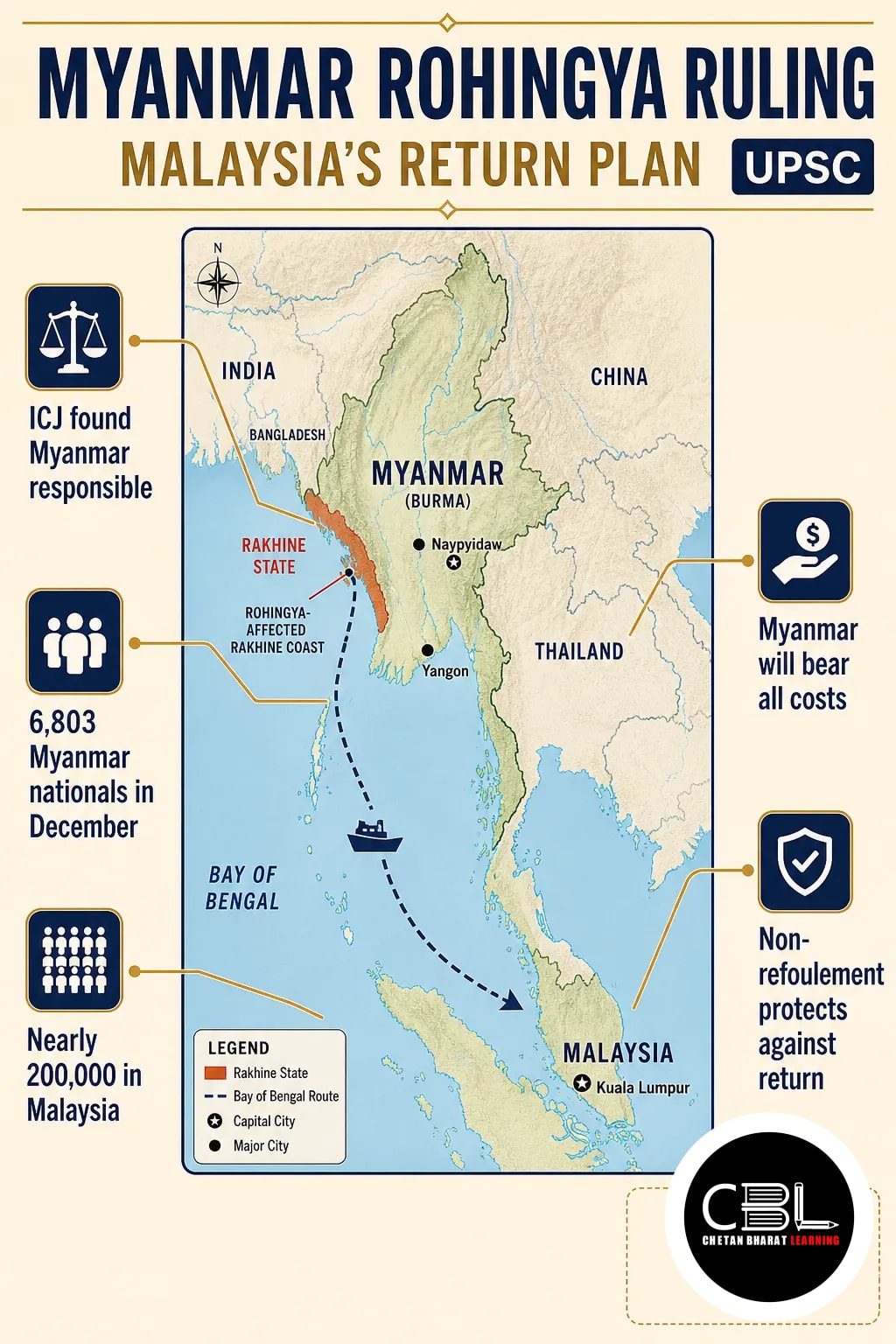
The Myanmar Rohingya ruling has acquired a new dimension: Malaysia plans to return another 6,803 Myanmar nationals. For the wider regional context, see CBL’s international relations coverage.
Quick answer: After the Myanmar Rohingya ruling, Malaysia announced plans on 24 November 2026 to repatriate 6,803 Myanmar nationals in December. Prime Minister Anwar Ibrahim said Malaysia respects the International Court of Justice’s genocide ruling but would continue talks with Myanmar. The source does not identify how many planned returnees are Rohingya.
What did the court hold?
The International Court of Justice (ICJ) found Myanmar responsible for genocide against its Rohingya minority. The court, based in The Hague, reached its ruling in the week before Malaysia’s announcement. However, Myanmar’s government rejected the ruling as unfair.
The source says evidence showed that Myanmar forces killed about 10,000 Rohingya during a 2017 military operation. It also describes mass rape, killings and the destruction of thousands of homes. The source does not specify the court’s orders on remedies or repatriation; therefore, those should not be inferred from the verdict alone.
Why is Malaysia’s repatriation plan in the news?
Malaysia announced the next phase of returns after the genocide ruling, while defending its engagement with Myanmar’s leadership. On 24 November, Anwar told Parliament that talks with Myanmar leader Min Aung Hlaing had advanced the issue.
Malaysia hosts nearly 200,000 refugees from Myanmar, including Rohingya and members of other ethnic minorities. According to Anwar, third-country resettlement efforts had failed, and Malaysia could not bear the burden indefinitely. The figures for planned and completed returns cover Myanmar nationals; the source does not provide an ethnic breakdown.
| Measure | Details announced |
|---|---|
| Sea returns | 1,500 people on three Myanmar naval vessels on 6 and 7 December 2026 |
| Air returns | 5,303 people throughout December 2026 |
| Costs | Myanmar will bear all costs, according to Anwar |
| Earlier returns | 10,476 in 2026, including 1,476 aboard a Myanmar naval vessel on 29 September |
Anwar said Malaysia had secured a guarantee of safe and dignified returns. He also cited Malaysian intelligence monitoring to say that none of the 10,476 people already returned had faced pressure. This is the government’s assessment, rather than an independently verified finding in the source.
Which international law concepts matter?
The case raises distinct questions about state responsibility, genocide and protection against unsafe return. These concepts should not be treated as interchangeable.
| Instrument or concept | What it means |
|---|---|
| ICJ Statute | The ICJ settles legal disputes between states and gives advisory opinions; it does not conduct individual criminal trials. |
| Genocide Convention, 1948 | It defines genocide through specified acts committed with intent to destroy a protected group, wholly or partly. |
| 1951 Refugee Convention | It defines refugee status and establishes protections, including the principle of non-refoulement. |
| Non-refoulement | It protects against return to a territory where a person faces specified threats; its precise legal application depends on the obligation involved. |
The ICJ examines state responsibility, whereas the International Criminal Court deals with individual criminal responsibility. Therefore, a finding against a state is not itself a criminal conviction of its officials. Equally, the ruling does not by itself establish the legal status or individual risk of every person in Malaysia’s return plan.
What are the implications for the region and India?
The Myanmar Rohingya ruling puts accountability and refugee safety alongside regional diplomacy. Consequently, governments must distinguish engagement with Myanmar from evidence that conditions are safe for each returnee.
The Association of Southeast Asian Nations (ASEAN) has a peace plan for Myanmar. Anwar reaffirmed Malaysia’s commitment to that plan, even as he defended direct talks. Meanwhile, the 11-member bloc has restricted Myanmar’s top leaders from major summits over inadequate implementation; Myanmar calls its treatment unfair.
Myanmar’s military seized power from Aung San Suu Kyi’s elected government in 2021, and widespread opposition followed. For India, Myanmar’s neighbourhood and cross-border displacement make the issue relevant to foreign policy, humanitarian protection and coordination with regional partners. However, the source does not announce a new Indian policy or action.
What concerns and policy choices arise?
The central concern is whether each return can be voluntary, safe and dignified in practice. A general assurance can support diplomacy; however, it does not replace an assessment of individual circumstances.
- Individual risk: Authorities should assess potential persecution or violence before return, because Myanmar nationals are not a uniform group.
- Independent monitoring: Access to returnees and credible follow-up can test safety assurances; moreover, it can identify problems after arrival.
- Informed choice: Clear information, access to procedures and opportunities to raise objections can help establish whether return is voluntary.
- Shared responsibility: Host states need support for displaced people; in addition, third-country resettlement can complement protection where available.
- Regional diplomacy: ASEAN engagement can address the wider conflict, while protection decisions remain sensitive to individual risks.
Overall, the Myanmar Rohingya ruling makes the gap between legal accountability and conditions on the ground an important policy test. Therefore, a durable response needs both regional engagement and verifiable safeguards for people facing return.
Source: The Hindu International, 25 November 2026
Asked in State PCS: Previous Year Questions
- Punjab PCS Mains 2018 (GS Paper 4): India is neither a signatory to the 1951 UN Refugee Convention nor its 1967 Protocol. Evaluate India’s stance on Rohingya refugees.
State PCS links the Rohingya issue to India’s refugee policy and international protection.
Punjab PCS has asked about India’s position on Rohingya refugees and the Refugee Convention. Similarly, state PCS General Studies can test the ICJ, ASEAN and non-refoulement.
Prelims Practice Corner
Mains Practice Questions
Frequently Asked Questions
What did the ICJ rule on the Rohingya?
The ICJ found Myanmar responsible for genocide against its Rohingya minority. However, Myanmar rejected the ruling as unfair.
How many Myanmar nationals does Malaysia plan to return?
Malaysia plans to return 6,803 people in December 2026. Of these, 1,500 are scheduled to travel by sea and 5,303 by air.
Are all the planned returnees Rohingya?
The source does not say how many are Rohingya. It identifies the group as Myanmar nationals and, separately, notes that Malaysia hosts refugees from several ethnic communities.
What is non-refoulement?
Non-refoulement protects people against return to specified threats. Its legal application depends on the particular obligation and individual circumstances.
Related Current Affairs
Preparing for UPSC, PCS or HCS?
Talk to a mentor at Chetan Bharat Learning, Chandigarh. Free guidance on choosing the right exam and building a study plan.
Chat on WhatsAppCall 97793 53345UPSC / IAS / PCS coaching in Chandigarh · Trusted by aspirants across Punjab & Haryana




Leave a Reply
You must be logged in to post a comment.