
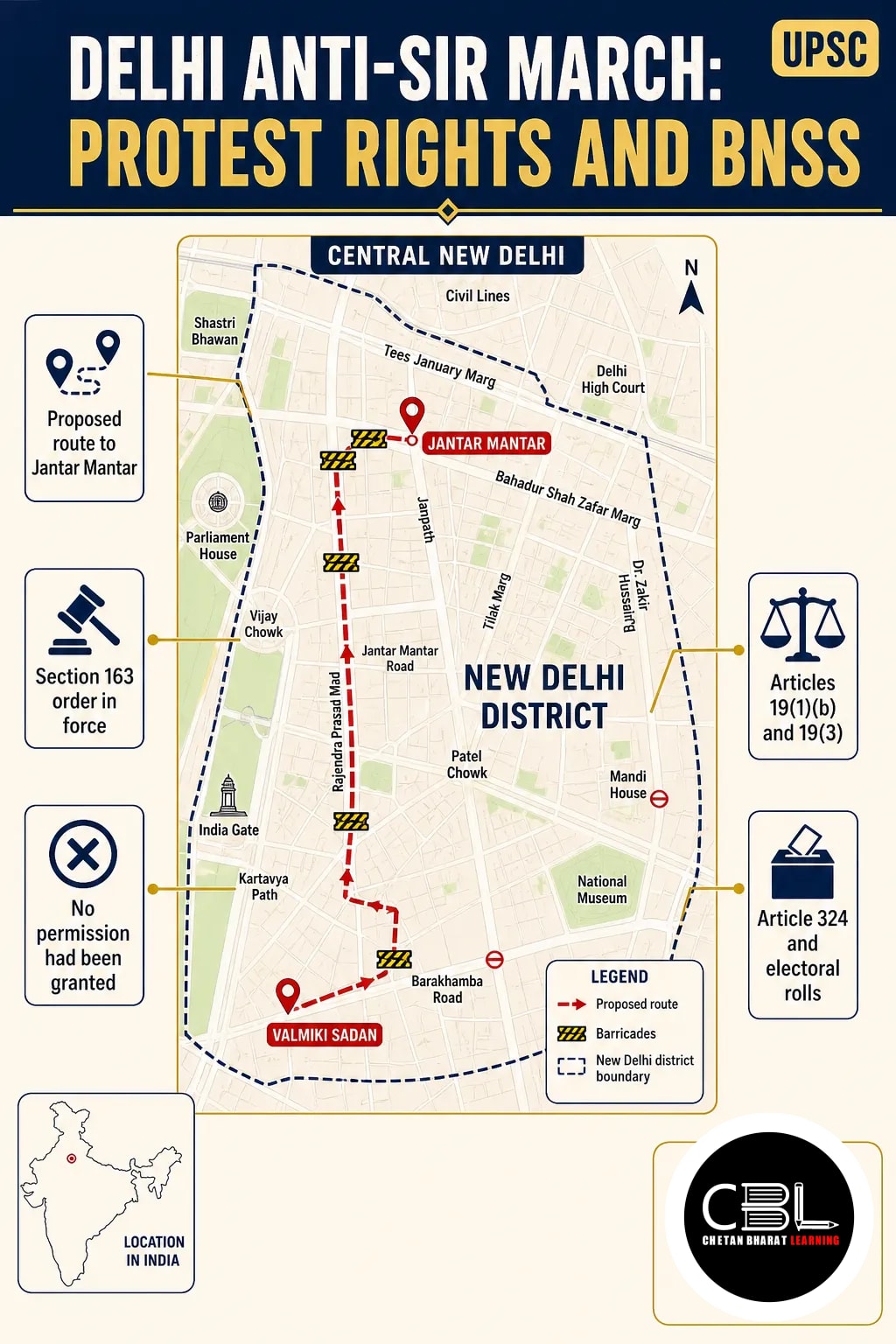

The Delhi anti-SIR march planned for 26 November 2026 has raised questions about protest restrictions and electoral rolls. For the constitutional background, see CBL’s polity current affairs.
Quick answer: The Delhi anti-SIR march was planned from Valmiki Sadan to Jantar Mantar on 26 November 2026 against the Special Intensive Revision of electoral rolls. Organisers said they emailed police an intimation. Police denied receiving it, said no permission had been sought or granted, and cited Section 163 restrictions.
What does the protest order say?
Delhi Police said a Section 163 order prohibits unauthorised gatherings and processions in New Delhi district. The provision is part of the Bharatiya Nagarik Suraksha Sanhita (BNSS), 2023.
In its notice, police also included demonstrations, speeches, sloganeering and dharnas among prohibited unauthorised activities. They warned of legal action for violations and said no application for the march had been received or granted.
Police outlined preventive measures, including multi-layer barricading and additional personnel. They also mentioned preventive detentions if required. The source does not establish that the march occurred or that detentions took place.
Why was the Delhi anti-SIR march planned?
The Delhi wing of People Against SIR called the march to oppose the electoral roll revision and demand access to a protest site. It chose Constitution Day, which marks the adoption of the Constitution on 26 November 1949.
| Detail | Reported position |
|---|---|
| Assembly | Outside Valmiki Sadan on Mandir Marg at 12.30 p.m. |
| Proposed route | Towards Jantar Mantar via Kali Bari Marg |
| Dated 23 November 2026 and sent to inform police, according to the organisers | |
| Demands | Scrap SIR, restore pre-SIR rolls and restore Jantar Mantar as a designated peaceful protest site |
Organisers also opposed elections based on revised rolls and sought repeal of the 2023 law governing election commissioners’ appointments. In addition, they demanded impeachment of and legal action against Chief Election Commissioner Gyanesh Kumar.
The platform claimed that over 50% of Delhi voters who were on the January 2025 rolls and voted in the February 2025 Assembly election had been deleted or marked doubtful after revision. This is an organisers’ claim; the source does not independently establish it.
Intimation and permission: what is disputed?
The dispute concerns both receipt of the email and whether organisers sought permission. The Hindu saw an email dated 23 November describing the proposed programme. Organiser Maimoona Mollah said the platform intended to inform police rather than request permission.
Mollah also claimed police acknowledged the intimation and received further details by telephone. However, New Delhi police officers denied receiving the intimation. The account does not resolve that factual disagreement.
An intimation communicates a plan; it is not, by itself, proof of official permission. Moreover, the applicable order and any relevant permission requirements must be examined before deciding whether a particular procession is lawful.
Which constitutional and legal provisions matter?
The Constitution protects speech and peaceful assembly while allowing legally prescribed reasonable restrictions. The following distinctions are central to analysing the Delhi anti-SIR march.
| Provision | Relevance |
|---|---|
| Article 19(1)(a) | Protects citizens’ freedom of speech and expression, subject to Article 19(2). |
| Articles 19(1)(b) and 19(3) | Protect peaceful, unarmed assembly; reasonable restrictions may serve public order or India’s sovereignty and integrity. |
| BNSS Section 163 | Empowers specified magistrates to issue written orders in urgent cases of nuisance or apprehended danger, subject to statutory conditions. |
| Article 324 | Vests superintendence, direction and control of electoral roll preparation and specified elections in the Election Commission. |
| Article 326 | Provides for adult suffrage in elections to the House of the People and state legislative assemblies, subject to constitutional and legal conditions. |
Public order is a constitutionally recognised ground for reasonable restrictions. However, its invocation does not eliminate the need to examine an order’s legal basis and scope. The reported notice alone does not establish whether the particular restriction would survive judicial scrutiny.
Why does the dispute matter for governance?
The case brings electoral participation, public safety and the freedom to dissent into the same administrative decision.
- Democratic expression: Peaceful assembly lets citizens communicate collective demands; therefore, accessible protest arrangements matter.
- Public order: Authorities must manage competing uses of public space; in addition, they must act within their legal powers.
- Electoral inclusion: Accurate rolls support credible elections, while wrongful exclusion can obstruct eligible voters’ participation.
- Accountability: Clear orders and reasons make restrictions easier to understand and contest; similarly, transparent correction processes help address roll-related grievances.
What is the way forward?
Authorities and organisers can reduce uncertainty through clear communication and proportionate arrangements. First, police should make applicable restrictions and procedures easily accessible. They should also acknowledge communications and specify whether an application requires further action.
Second, organisers and authorities can discuss routes, timings and safety measures without treating intimation as automatic approval. Meanwhile, electoral authorities should provide accessible avenues to check entries and seek corrections. Such steps address distinct concerns without prejudging the disputed claims.
Source: The Hindu National, 26 November 2026
Punjab PCS and Haryana HCS may test the distinction between peaceful assembly and lawful public-order restrictions. In addition, revise electoral roll administration and grievance redress as state General Studies topics.
Prelims Practice Corner
Mains Practice Questions
Frequently Asked Questions
Why was the Delhi anti-SIR march planned?
It was planned to oppose the Special Intensive Revision of electoral rolls. Organisers also sought restoration of Jantar Mantar as a designated peaceful protest site.
Did organisers have police permission for the march?
Police said no permission had been granted. Organisers, however, said they sent an intimation rather than a permission request.
What is Section 163 of the BNSS?
It empowers specified magistrates to issue written orders in urgent cases of nuisance or apprehended danger, subject to statutory conditions. In this case, police said a Section 163 order was in force in New Delhi district.
Is peaceful assembly protected by the Constitution?
Yes, Article 19(1)(b) protects citizens’ right to assemble peacefully and without arms. However, Article 19(3) permits reasonable restrictions on specified grounds, including public order.
Related Current Affairs
Preparing for UPSC, PCS or HCS?
Talk to a mentor at Chetan Bharat Learning, Chandigarh. Free guidance on choosing the right exam and building a study plan.
Chat on WhatsAppCall 97793 53345UPSC / IAS / PCS coaching in Chandigarh · Trusted by aspirants across Punjab & Haryana






Leave a Reply
You must be logged in to post a comment.