

UPSC Mapping
Important for
| Prelims | Agriculture & Environment |
|---|---|
| Mains | GS Paper 3 (Agriculture & Biodiversity) |
Quick Facts
| Global Rank (Production) | 2nd |
|---|---|
| Production (2025-26) | 1,51,000 tonnes |
| Top Producer | Uttar Pradesh (16.7%) |
Article
What is Honey Sector India?
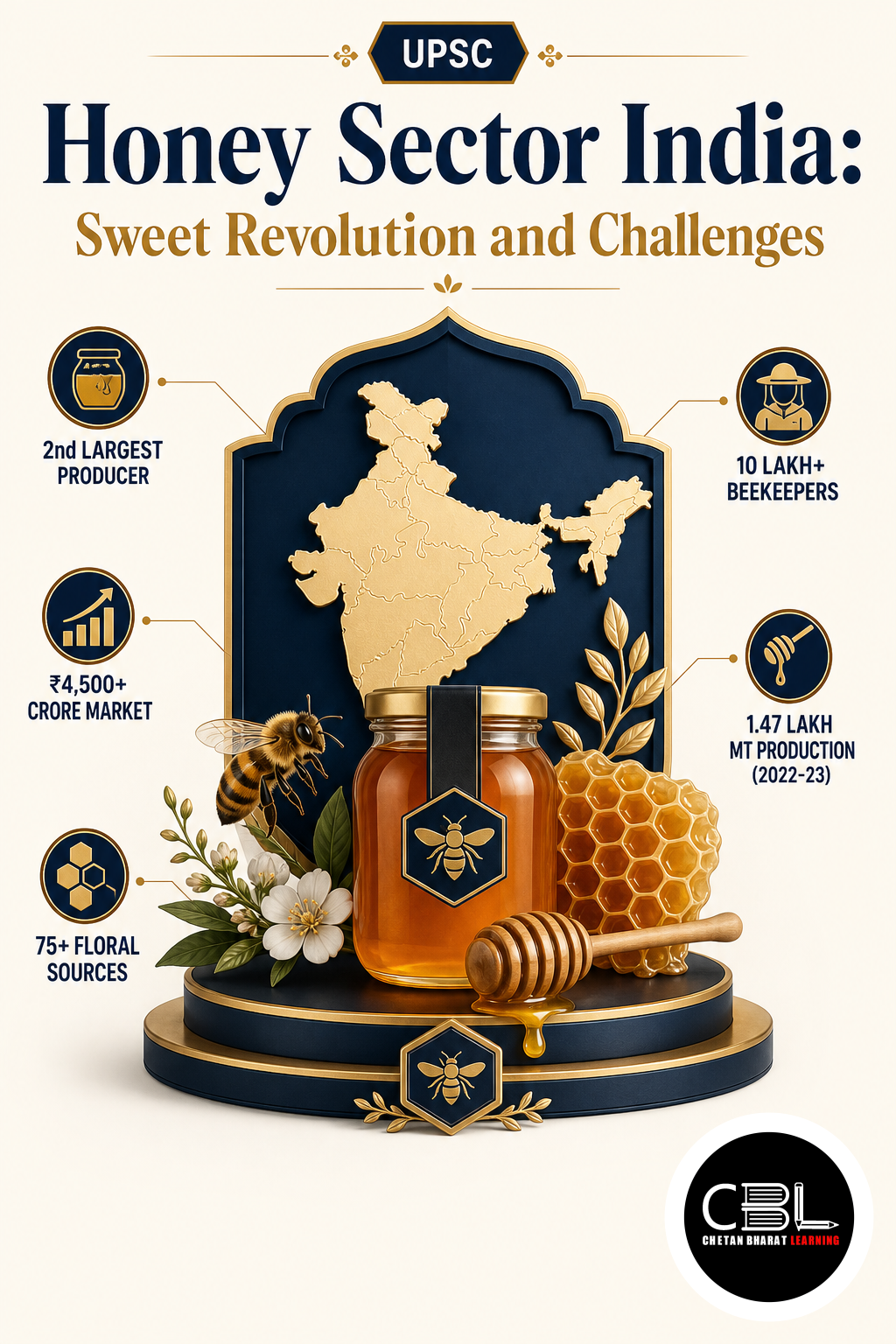
Honey Sector India encompasses beekeeping, honey production, processing, and export. India ranks second globally in honey production with 1,51,000 tonnes in 2025–26, and third by export value at $208 million. The U.S. absorbs 76% of Indian exports. Domestic consumption averages 37 grams per person annually, far below the global average of 244 grams.
The National Beekeeping and Honey Mission (NBHM), with a ₹500 crore budget, aims to modernise traditional apiculture into a scientific industry. The sector is also vital for crop pollination—bees contribute to agricultural productivity and biodiversity.
Why is Honey Sector India in News?
Honey Sector India is in the news following the Sweet Revolution that has doubled production since 2014–15. The government has launched initiatives like the Madhukranti Portal for supply traceability, a Minimum Export Price of $1,400 per metric ton, and cluster development under SFURTI.
However, challenges persist—adulteration (77% of leading brands fail NMR tests), low price realisation, and heatwave-driven harvest contraction (up to 20%). The sector also neglects the $12.7 billion global bee-byproduct market and marginalises indigenous bee species.
Key Features of Honey Sector India
- Production Growth: Doubled since 2014–15 to 1,51,000 tonnes.
- Export Potential: Third-largest exporter with $208 million in 2025–26.
- Government Support: NBHM with ₹500 crore budget, Madhukranti Portal, Minimum Export Price.
- Cluster Development: SFURTI groups rural apiarists into formal production clusters.
- Pollination Services: Bees underpin crop pollination and rural livelihoods.
Challenges in Honey Sector India
- Adulteration: Exempting domestic retail from NMR testing allows sugar syrups to adulterate 77% of leading brands.
- Low Price Realisation: Average export price of $1,858 per tonne is at the lower end of the global range.
- Revenue Shortfall: Absence of pollination-service revenue share (60% in advanced economies).
- Species Displacement: Focus on European honeybee marginalises indigenous Apis cerana indica.
- Storage Bottleneck: Slow deployment of cold storage forces distressed sales.
Way Forward for Honey Sector India
To strengthen Honey Sector India, domestic NMR testing must be mandated for all honey brands to curb adulteration and boost consumer trust. Establishing structured agricultural payment frameworks for pollination services can provide apiarists with an additional revenue stream.
Diversifying into bee-byproducts (royal jelly, beeswax, propolis) can tap the $12.7 billion global market. Protecting indigenous bee species and promoting sustainable beekeeping practices are essential. Expanding cold-storage networks and Farmer Producer Organisations can improve market access for rural apiarists.
Prelims Practice Corner
-
Q1. What is India’s global rank in honey production?
Show answer
Answer: (b) India ranks second globally, behind China.
-
Q2. What is India’s honey production in 2025–26?
Show answer
Answer: (b) Production reached 1,51,000 tonnes.
-
Q3. What is the budget of the National Beekeeping and Honey Mission?
Show answer
Answer: (b) The NBHM has a ₹500 crore budget.
-
Q4. Which country absorbs 76% of India’s honey exports?
Show answer
Answer: (c) The USA absorbs 76% of Indian exports.
-
Q5. What is the Minimum Export Price for natural honey?
Show answer
Answer: (b) The DGFT mandates a Minimum Export Price of $1,400 per metric ton.
Mains Practice Questions
Q1. Discuss the significance of the honey sector for India’s rural livelihoods and agricultural sustainability. What challenges does it face? (250 words, 15 marks)
Answer Structure:
- Intro: Introduce the Sweet Revolution and its achievements.
- Body: Discuss production growth, export potential, and pollination services. Analyse challenges: adulteration, low price realisation, species displacement, storage bottlenecks. Suggest reforms: NMR testing, pollination payment frameworks, diversification.
- Conclusion: Emphasise the need for a holistic approach to beekeeping.
Q2. What is the role of the National Beekeeping and Honey Mission in modernising India’s honey sector? (150 words, 10 marks)
Answer Structure:
- Intro: Define the NBHM and its objectives.
- Body: Discuss its three mini-missions: technology transition, livelihood generation, and cluster development. Mention the Madhukranti Portal for traceability and the Minimum Export Price.
- Conclusion: Conclude that the NBHM is key to professionalising the sector.
FAQs on Honey Sector India
What is India’s rank in global honey production?
India ranks second globally in honey production, behind China.
What is the National Beekeeping and Honey Mission?
It is a ₹500 crore mission to modernise beekeeping, promote scientific apiculture, and support rural livelihoods.
What are the major challenges in the honey sector?
Adulteration, low price realisation, species displacement, storage bottlenecks, and lack of pollination-service payments.
Related Current Affairs
Preparing for UPSC, PCS or HCS?
Talk to a mentor at Chetan Bharat Learning, Chandigarh. Free guidance on choosing the right exam and building a study plan.
Chat on WhatsAppCall 97793 53345UPSC / IAS / PCS coaching in Chandigarh · Trusted by aspirants across Punjab & Haryana
Leave a Reply
You must be logged in to post a comment.