
India Nepal relations entered a new phase after Nepal Prime Minister Balendra Shah’s Delhi visit, with a ₹15,000 crore package and a renewed focus on unresolved grievances. For background, see CBL’s earlier coverage of the visit and the international relations hub.
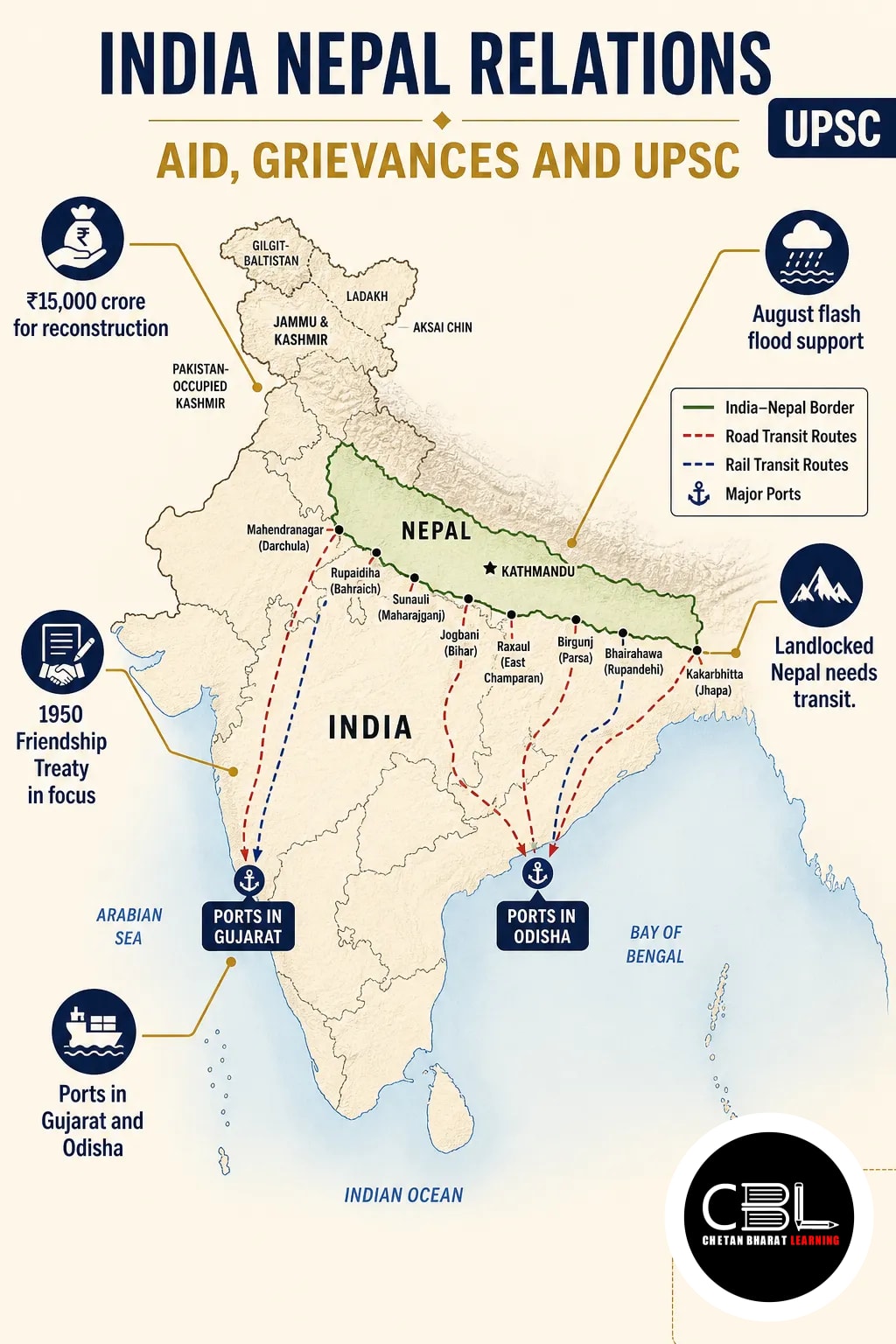
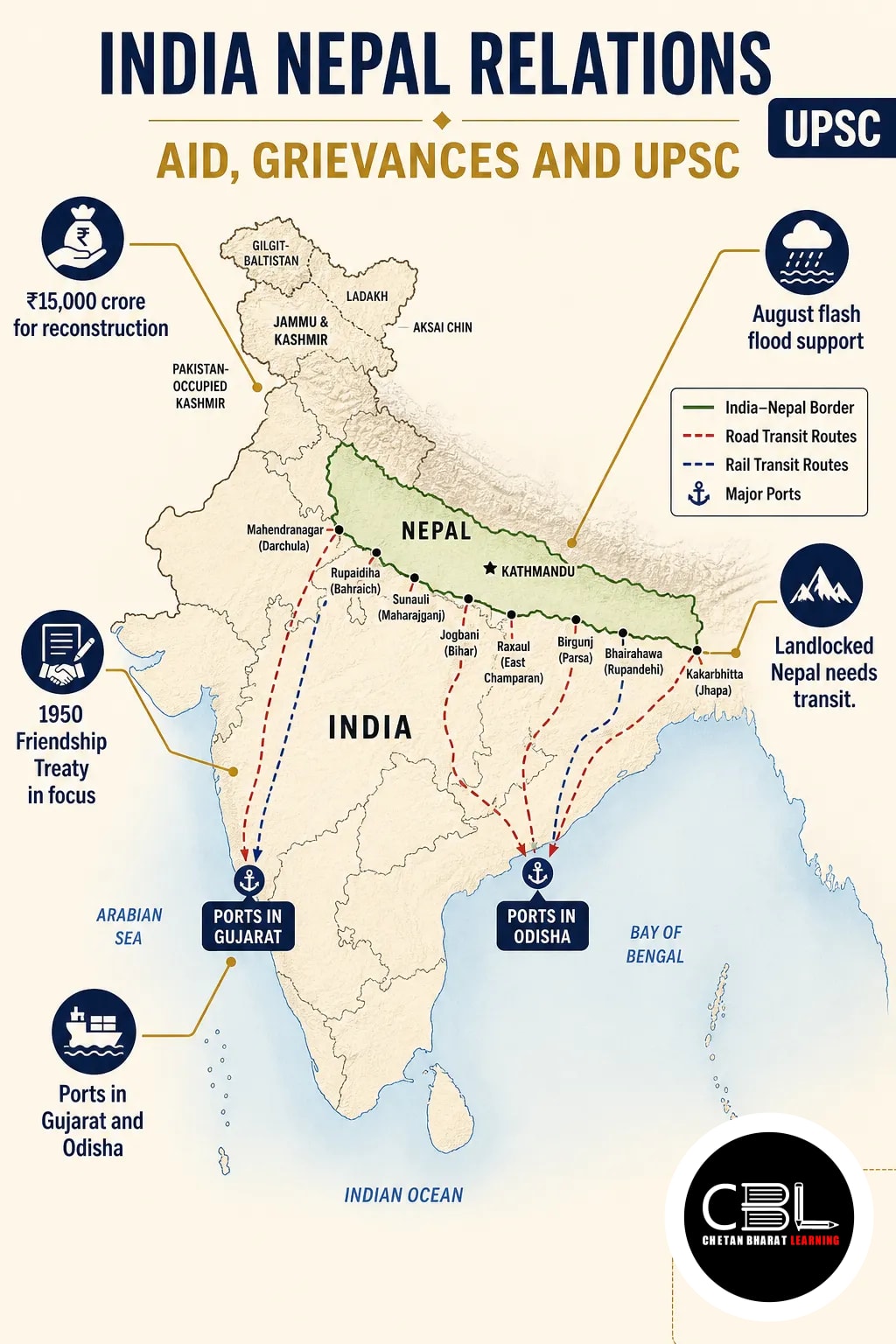
Quick answer: India Nepal relations gained momentum during Shah’s state visit to Delhi, where India announced ₹15,000 crore for reconstruction and development. India also offered access to ports in Gujarat and Odisha. However, boundary differences, airport overflight requests and disagreement over treaty review remain tests of the partnership.
What is the issue in India Nepal relations?
The central issue is whether development assistance can build lasting trust without addressing Nepal’s outstanding concerns. India’s support creates opportunities for cooperation; however, Kathmandu also seeks attention to sovereignty, transit and treaty-related questions.
The editorial argues for a neighbourhood policy that combines material assistance with attentive diplomacy. For Nepal, a landlocked country, dependable access through India has economic significance. Consequently, connectivity decisions can also carry political weight.
Why is the relationship in the news?
Shah’s first state visit to India produced development and connectivity announcements after a period of strained ties. The visit came eight months after his rise to power as leader of the Gen Z movement that displaced the previous government.
Relations had been tense under his predecessor, K.P. Sharma Oli, who travelled to Beijing without receiving a Delhi invitation more than a year into his term. Earlier, Shah’s comments on the boundary dispute and his refusal to confirm a meeting with Indian Foreign Secretary Vikram Misri preceded the cancellation of a May visit.
Following the August flash flood, however, India assisted Nepal with relief and rescue. Shah thanked India after talks with Prime Minister Narendra Modi; the visit then produced the joint statement Viksit Bharat and Samunnat Nepal: Re-imagining the Partnership.
| Announcement or issue | Key detail |
|---|---|
| Development cooperation | ₹15,000 crore for reconstruction and long-term development |
| Maritime access | India offered Nepal access to ports in Gujarat and Odisha |
| Connectivity and education | Inaugurations included bridges, roads, trains, energy and fuel lines, and an integrated check post; both sides also agreed to establish an Indian Institute of Technology campus |
| Outstanding matters | The joint statement referred broadly to resolving outstanding matters through dialogue and reviewing bilateral treaties |
What are the arguments for deeper cooperation?
Development, connectivity and disaster response give both countries practical reasons to strengthen cooperation.
- Reconstruction and development: The package can support recovery and longer-term projects; therefore, its value depends on effective implementation.
- Transit options: Access to additional Indian ports can help landlocked Nepal reach maritime trade routes. Moreover, reliable access can help rebuild confidence after the 2015 trade blockade.
- Physical connectivity: Bridges, roads, trains and an integrated check post can facilitate movement across the border. Similarly, energy and fuel lines can support economic links.
- Disaster cooperation: India’s relief and rescue assistance after the flash flood demonstrated a practical form of neighbourhood support. As a result, cooperation can build trust during emergencies.
- Education and people-to-people ties: The proposed campus adds an institutional dimension to the partnership. The Ayodhya–Janakpur rail initiative offers another example of cross-border connectivity.
What concerns could limit progress?
Unresolved political and practical disputes could weaken the gains from new projects.
- Boundary disagreement: Shah has repeatedly raised the issue; however, the joint statement did not address it directly. A general commitment to dialogue does not itself settle a territorial dispute.
- Airport overflight: Nepal has sought overflight access for two airports carrying significant debt. Moreover, the statement did not directly resolve that request.
- Treaty review: Both sides agreed to review bilateral treaties. Yet New Delhi considers the Eminent Persons Group report on proposed changes to the 1950 Friendship Treaty no longer relevant, while Kathmandu wants the treaty updated.
- Transit sensitivity: The 2015 trade blockade remains part of the relationship’s difficult background. Therefore, new port access must translate into dependable practical arrangements.
- Political asymmetry: India’s larger size and role in transit make sensitivity to Nepal’s concerns important. Otherwise, assistance alone may not address perceptions of unequal influence.
What should be the way forward?
A durable partnership needs project delivery alongside sustained discussion of differences.
- Maintain dialogue: Both governments should use the joint statement’s commitment to address boundary and other outstanding matters. Meanwhile, less public discussions can help keep difficult issues on the agenda.
- Review treaties constructively: The two sides should clarify their respective positions and discuss concerns about the 1950 treaty. However, review need not imply agreement on every proposed change.
- Assess overflight requests: India and Nepal should examine airport access through a structured bilateral process. Thus, technical and other concerns can be considered alongside Nepal’s connectivity needs.
- Track delivery: The partners should monitor reconstruction, port access and connectivity commitments. In addition, clear implementation arrangements can help turn announcements into benefits.
Useful for Essay and GS IV: Neighbourhood trust rests not only on the assistance offered, but also on the willingness to hear concerns.
Source: The Hindu Editorial, 25 November 2026
- Taleju Bhawani Temple: History, Architecture & UPSC (28 Oct 2026)
Asked in UPSC: Previous Year Questions
- UPSC CSE Prelims 2020 (GS Paper I): Which statements about India’s trade with Sri Lanka, Bangladesh and Nepal are correct, including Nepal’s position as India’s largest South Asian trading partner?
UPSC can link neighbourhood relations with trade patterns; therefore, revise economic ties as well as diplomatic issues.
Punjab PCS and Haryana HCS General Studies may test Nepal’s geography, bilateral treaties and India’s neighbourhood policy. For descriptive papers, compare development assistance with the need to address a neighbour’s stated concerns.
Prelims Practice Corner
Mains Practice Questions
Frequently Asked Questions
What package did India announce for Nepal?
India announced ₹15,000 crore for reconstruction and long-term development. The announcement followed Shah’s talks with Modi during the state visit.
Which issues remain unresolved between India and Nepal?
The boundary dispute, airport overflight access and questions surrounding treaty review remain unresolved. However, the joint statement referred broadly to dialogue on outstanding matters.
Why does Indian port access matter to Nepal?
Port access matters because Nepal is landlocked and needs routes to maritime trade. India offered access to ports in Gujarat and Odisha; moreover, dependable transit can help rebuild confidence.
What is the Eminent Persons Group report about?
The report suggested changes to the 1950 Friendship Treaty. However, New Delhi considers it no longer relevant, while Kathmandu remains keen to update the treaty.
Related Current Affairs
Preparing for UPSC, PCS or HCS?
Talk to a mentor at Chetan Bharat Learning, Chandigarh. Free guidance on choosing the right exam and building a study plan.
Chat on WhatsAppCall 97793 53345UPSC / IAS / PCS coaching in Chandigarh · Trusted by aspirants across Punjab & Haryana






Leave a Reply
You must be logged in to post a comment.