
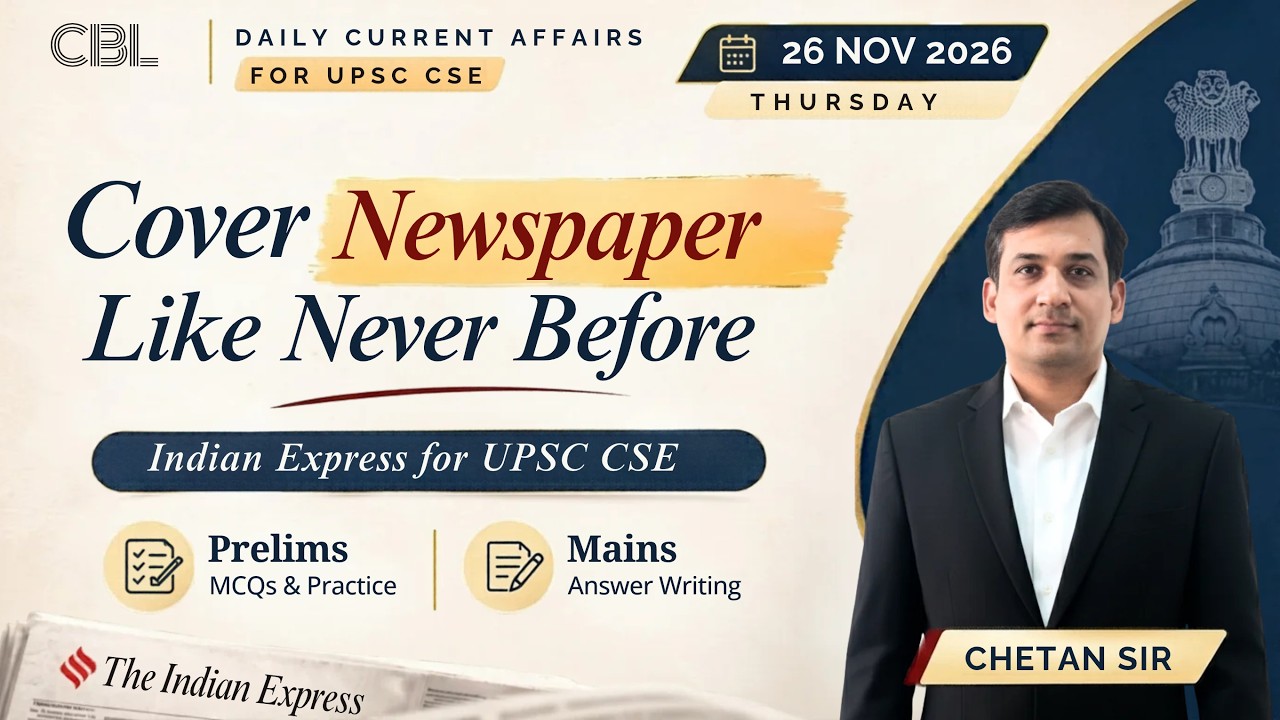
Constitution Day offers UPSC aspirants an opportunity to connect the history of the Indian Constitution with contemporary questions of equality and governance. This lesson links important dates, Ambedkar’s ideas and constitutional amendments to Indian polity preparation for Prelims and Mains.
Quick answer: Constitution Day is observed on 26 November to mark the Constituent Assembly’s adoption of the Indian Constitution on 26 November 1949. The Constitution came fully into force on 26 January 1950, celebrated as Republic Day. Constitution Day was officially notified in 2015.
Constitution Day and Ambedkar’s speech
Keep adoption and enforcement distinct: the Constituent Assembly adopted the Constitution on 26 November 1949, while it came fully into force on 26 January 1950. The notification of Constitution Day in 2015 coincided with the observance of Dr B. R. Ambedkar’s 125th birth anniversary.
In his concluding speech to the Constituent Assembly on 25 November 1949, Ambedkar contrasted political equality with social and economic inequality. The lesson highlights his warning that democracy could be endangered if this contradiction remained unresolved. It also discusses his criticism of the “grammar of anarchy”: when constitutional methods are available, unconstitutional methods lack justification.
For Mains and Essay, use these ideas to frame a discussion of democracy, protest or social justice. Explain the contrast between equal political rights and unequal social and economic conditions rather than treating the quotation as a substitute for analysis.
Constitutional amendments for UPSC Prelims
The lesson groups four amendments around representation and equality. Remember both the amendment and the institution or beneficiary associated with it.
| Amendment | Key point from the lesson |
|---|---|
| 102nd | Gave constitutional status to the National Commission for Backward Classes. |
| 103rd | Provided for up to 10% reservation for economically weaker sections. |
| 105th | Restored states’ power to identify their socially and educationally backward classes. |
| 106th | Provides a framework for one-third reservation for women in the Lok Sabha and state assemblies. |
A distinction in the video’s practice question concerns institutions: the 106th Amendment addresses the Lok Sabha and state assemblies, not panchayats. The lesson associates women’s reservation in panchayats with the 73rd Amendment.
Basic structure doctrine and constitutional amendment
The lesson connects the history of amendments with judicial limits on the amending power. It notes that the 24th Amendment followed the Golaknath judgment and that the 42nd Amendment attempted to make Parliament’s amending power unlimited during the Emergency.
In Kesavananda Bharati in 1973, the Supreme Court laid down the basic structure doctrine. In Minerva Mills in 1980, it struck down parts of the 42nd Amendment. For a balanced Mains answer, separate the constitutional facts from the political arguments in a newspaper column.
Inside the video
- 0:48 – Adoption, enforcement and Constitution Day
- 1:21 – Ambedkar on democracy and constitutional methods
- 2:28 – Amendments on equality and representation
- 3:03 – Basic structure and limits on amending power
- 28:44 – Amendment-based Prelims practice
Prelims Practice Corner
Mains Practice Questions
Frequently Asked Questions
Why is Constitution Day celebrated on 26 November?
It marks the Constituent Assembly’s adoption of the Constitution on 26 November 1949. Constitution Day was officially notified in 2015.
What is the difference between Constitution Day and Republic Day?
Constitution Day marks adoption on 26 November 1949. Republic Day marks 26 January 1950, when the Constitution came fully into force.
Which case established the basic structure doctrine?
The Supreme Court laid down the doctrine in the Kesavananda Bharati case in 1973. The lesson also discusses Minerva Mills, in which parts of the 42nd Amendment were struck down in 1980.
Related Current Affairs
Preparing for UPSC, PCS or HCS?
Talk to a mentor at Chetan Bharat Learning, Chandigarh. Free guidance on choosing the right exam and building a study plan.
Chat on WhatsAppCall 97793 53345UPSC / IAS / PCS coaching in Chandigarh · Trusted by aspirants across Punjab & Haryana





Leave a Reply
You must be logged in to post a comment.