
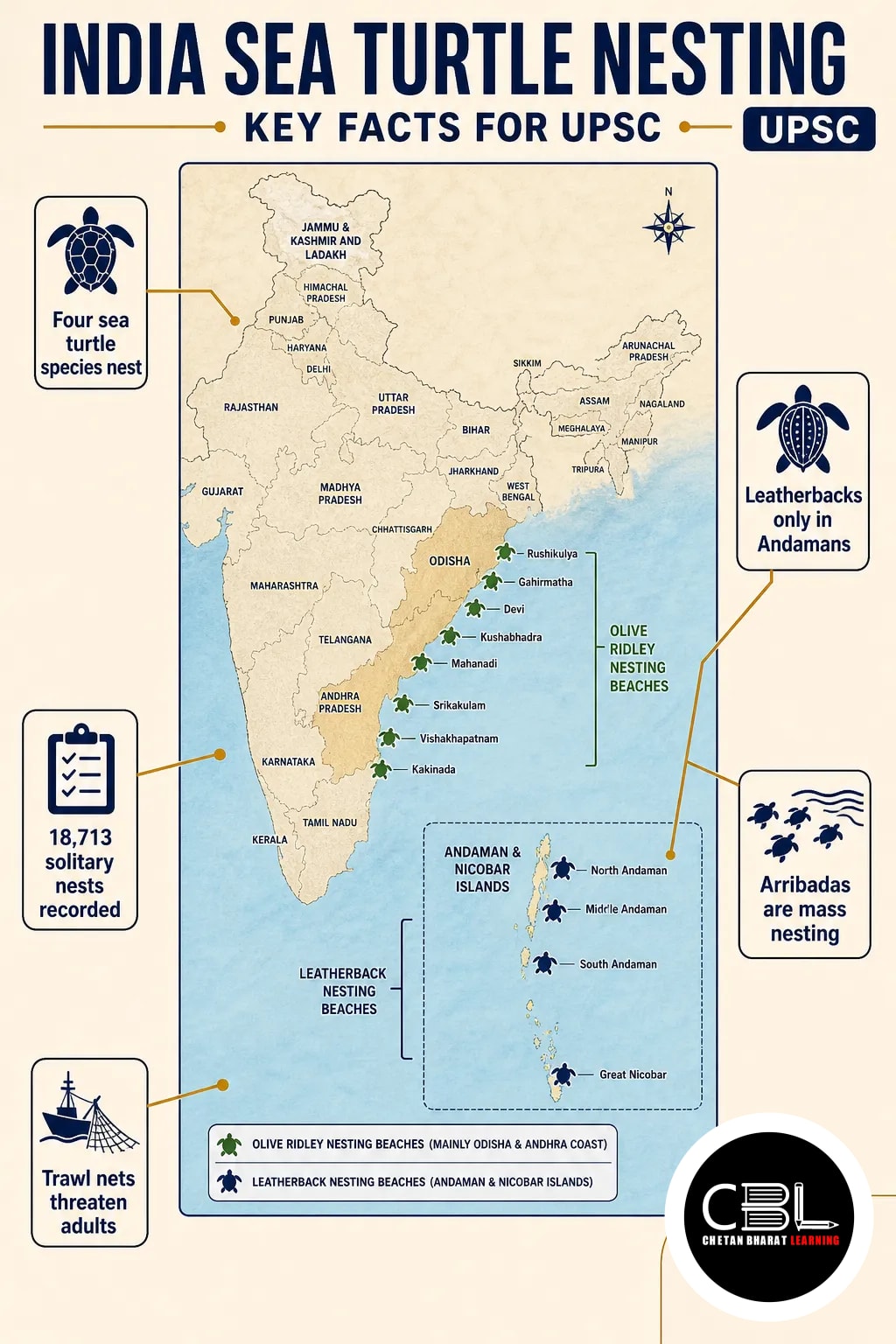

India sea turtle nesting involves four species, from the common olive ridley to the leatherback. Their nesting beaches and threats are relevant to environment and biodiversity preparation.
Quick answer: India sea turtle nesting includes olive ridley, green, hawksbill and leatherback turtles. Leatherbacks nest in India only in the Andaman and Nicobar Islands. In 2024–25, an assessment recorded 18,713 solitary olive ridley nests, excluding Odisha’s mass nesting events. Trawl nets, beach lighting and habitat changes threaten turtles.
Which sea turtles nest on Indian shores?
Four sea turtle species nest on Indian shores, with distinct features useful for identification. The leatherback is the largest turtle overall; in contrast, the green turtle is the largest hard-shelled sea turtle.
| Species | Key fact |
|---|---|
| Olive ridley | Most common of the four; among the smallest sea turtles |
| Green turtle | Largest hard-shelled sea turtle |
| Hawksbill | Rarest of the four on Indian shores |
| Leatherback | Largest turtle; nests in India only in the Andaman and Nicobar Islands |
What did the nesting assessment find?
The Wildlife Institute of India recorded 18,713 solitary olive ridley nests in 2024–25. It estimated that 7,500–8,000 mothers made these nests, with each coming ashore two or three times in a season.
The count excludes Odisha’s arribadas, or mass nesting events. During these events, lakhs of female olive ridleys come ashore together over a few nights. The solitary nests alone represent nearly two million eggs, according to the source.
Separately, in October 2025, the International Union for Conservation of Nature (IUCN) moved the green turtle from Endangered to Least Concern. That global assessment does not remove local threats to nesting beaches.
What threatens nesting turtles and hatchlings?
India sea turtle nesting faces threats on beaches and in the surrounding waters. One estimate suggests only about one hatchling in 1,000 survives to adulthood.
- Beach hazards: Feral dogs, jackals, crabs and storm tides take eggs; moreover, streetlights can draw hatchlings inland.
- Warmer sand: Higher sand temperatures can shift whole clutches towards females.
- Fishing nets: Trawl nets can drown adults; in January 2025, over 1,000 dead olive ridleys washed up along Chennai’s coast, most suspected to have drowned in nets.
- Habitat change: Closed river mouths have damaged Gujarat’s beaches, where olive ridley nesting has nearly stopped.
Meanwhile, Galathea Bay on Great Nicobar is the proposed site of a transhipment port. It is also India’s busiest monitored leatherback nesting beach.
Why does protecting nesting beaches matter?
Protecting beaches and nearby waters addresses threats at different stages of a turtle’s life. For India sea turtle nesting, the source identifies dark beaches, escape devices in trawl nets and protection of eggs where laid as possible measures.
For Prelims, distinguish solitary nesting from mass arribadas. Also remember that the 2024–25 nest count excludes the latter and should not be treated as a total for all nesting.
Source: The Indian Express, 26 November 2026
Punjab PCS and Haryana HCS General Studies can test sea turtle species, nesting locations and conservation threats. Therefore, revise the species–location pairs alongside basic biodiversity concepts.
Prelims Practice Corner
Mains Practice Questions
Frequently Asked Questions
Which sea turtles nest in India?
Four species nest on India’s shores: olive ridley, green, hawksbill and leatherback. Of these, the olive ridley is the most common.
Where do leatherback turtles nest in India?
Leatherbacks nest in India only in the Andaman and Nicobar Islands. In addition, Galathea Bay on Great Nicobar is their busiest monitored nesting beach in India.
What is an olive ridley arribada?
An arribada is a mass nesting event in which female olive ridleys come ashore together. In Odisha, lakhs of females can nest over a few nights.
Related Current Affairs
Preparing for UPSC, PCS or HCS?
Talk to a mentor at Chetan Bharat Learning, Chandigarh. Free guidance on choosing the right exam and building a study plan.
Chat on WhatsAppCall 97793 53345UPSC / IAS / PCS coaching in Chandigarh · Trusted by aspirants across Punjab & Haryana





Leave a Reply
You must be logged in to post a comment.