
MLC paper ballots returned to the spotlight after elections to 28 Legislative Council seats on 23 October 2026. The contest also raised a broader polity question: why do these polls use a different voting method from Assembly elections?
Quick answer: MLC paper ballots let electors rank candidates under the single transferable vote system. Conventional electronic voting machines record a single choice for first-past-the-post elections, not ranked preferences. The question gained attention after polling for 28 Legislative Council seats across four states on 23 October 2026.
Why are MLC paper ballots used?
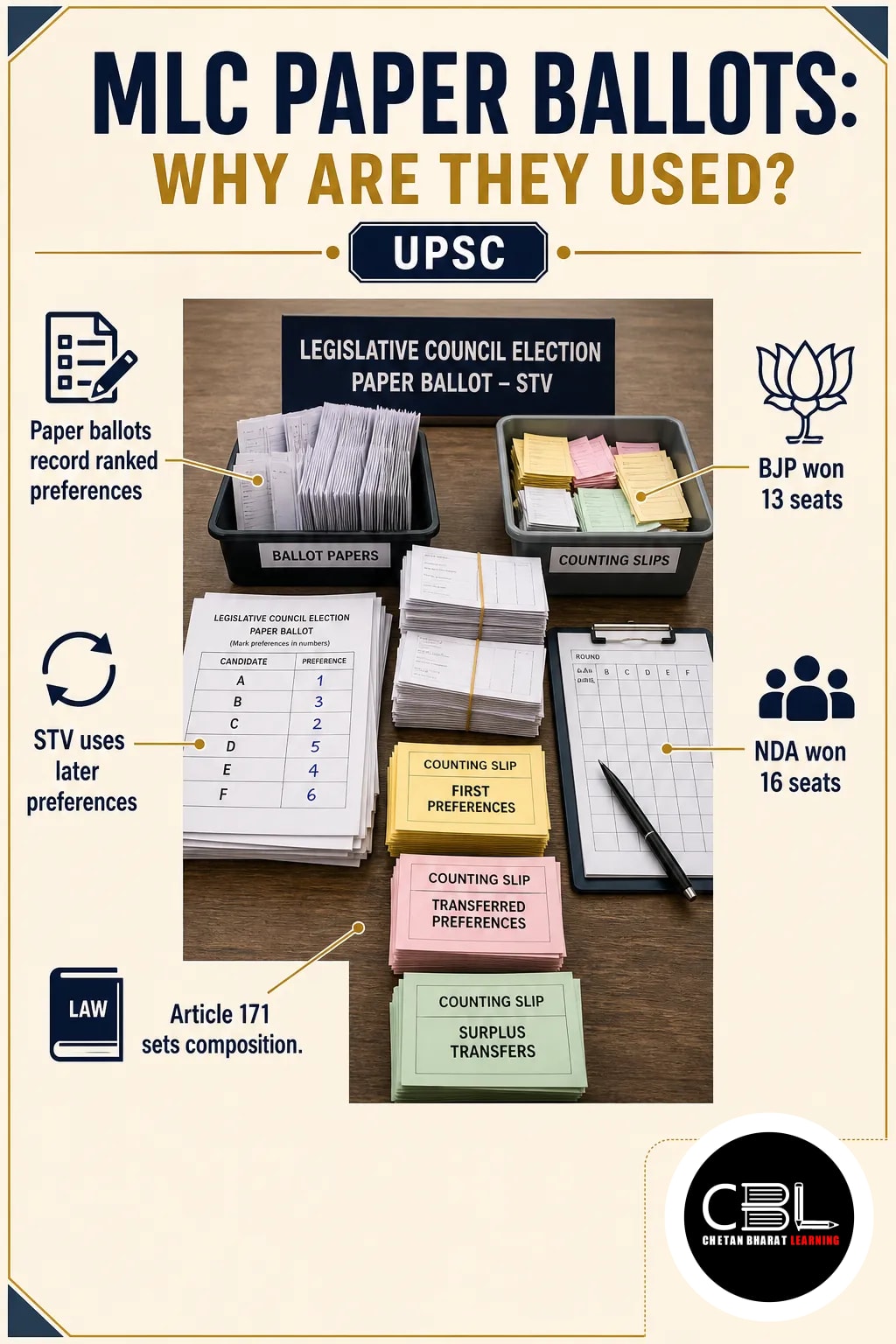
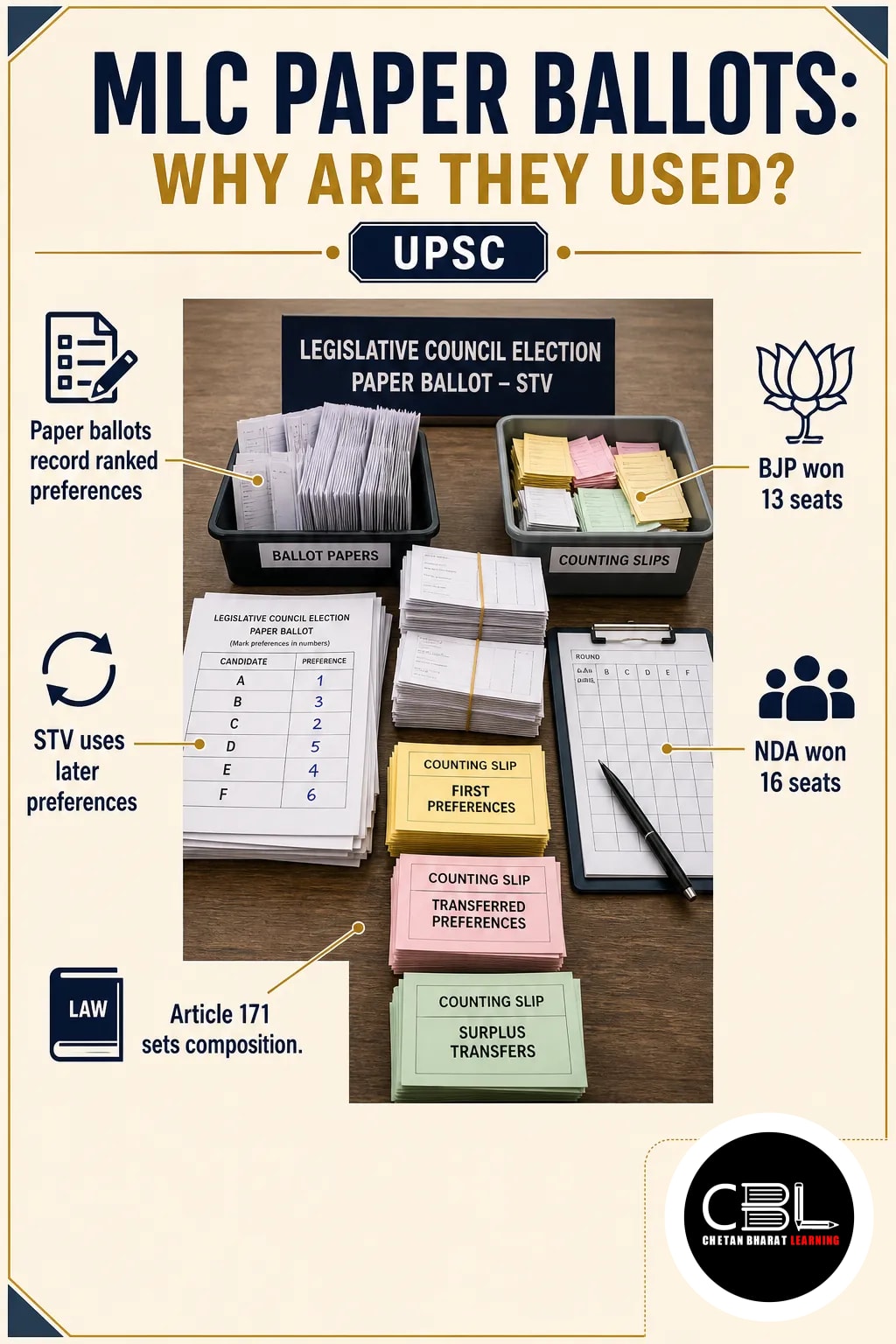
Paper ballots accommodate the ranked preferences required in Legislative Council elections. An elector marks candidates in order of preference rather than selecting just one candidate.
These elections use proportional representation by the single transferable vote (STV). Conventional electronic voting machines (EVMs), however, are designed to record a single choice in first-past-the-post contests. They do not record the sequence of preferences needed for STV counting.
The distinction concerns the voting system as well as the recording device. Therefore, a result in a paper-ballot Council election cannot by itself establish whether EVMs used in a different electoral system are reliable.
Why were Council elections in the news?
Elections to 28 Council seats across four states took place on 23 October 2026. The results also brought the debate over paper ballots and EVMs into public discussion.
| Result or event | Detail |
|---|---|
| Bharatiya Janata Party (BJP) | Won 13 seats |
| National Democratic Alliance (NDA) | Won 16 seats, including the BJP’s 13 |
| NDA partners | Shiv Sena (Eknath Shinde), Janata Dal (United) and Janata Dal (Secular) won one each |
| Congress | Won one seat in Maharashtra |
| Counting | Postal ballots for Uttar Pradesh graduate and teacher constituencies were counted in Lucknow on 27 October |
Prime Minister Narendra Modi criticised the Congress over its performance and its demand for a return to paper ballots. For the electoral mechanism, compare the Bihar Council poll and preference voting.
How does the single transferable vote work?
STV counts first preferences and can transfer votes according to later preferences. Its purpose is to translate preferences into representation rather than rely only on a single choice.
- Ranking: The voter marks a first preference and may indicate subsequent preferences.
- Quota: In a multi-seat contest, a candidate generally needs a prescribed quota to win.
- Transfers: Depending on the count, surplus votes of elected candidates or votes of eliminated candidates can move to the next available preference.
- Limit: A ballot cannot transfer further if it contains no usable later preference.
For example, a vote may move to a second preference when the first-preference candidate is eliminated, subject to the counting rules. Thus, the voter’s later choice can matter without giving the voter a separate vote for every candidate.
How does it differ from Assembly elections?
In a Legislative Assembly election, the candidate with the most votes in a constituency wins. This first-past-the-post system does not require a majority of all votes cast.
By contrast, STV uses preferences and transfers; its proportional effect is most evident when multiple seats are filled together. Moreover, graduate and teacher Council constituencies have defined electorates, unlike Assembly constituencies based on adult suffrage.
What does the Constitution say about Legislative Councils?
Articles 168, 169 and 171 provide the framework for state legislatures and Legislative Councils. Article 324 places the superintendence, direction and control of elections with the Election Commission of India.
| Provision | What it provides |
|---|---|
| Article 168 | A state legislature consists of the Governor and one or, where applicable, two Houses. |
| Article 169 | Parliament may create or abolish a Council by law after the Assembly passes the required special-majority resolution. |
| Article 171 | Sets out Council composition and provides for proportional representation by STV and secret ballot for elected members. |
| Article 172(2) | The Council is not dissolved; approximately one-third of its members retire every second year. |
| Article 324 | Entrusts election superintendence, direction and control to the Election Commission of India. |
Article 171 provides for members elected by local authorities, graduates, teachers and Legislative Assembly members. The Governor nominates the remainder from specified fields. Therefore, not every Member of the Legislative Council (MLC) enters the House through an election.
The Council ordinarily cannot exceed one-third of the Assembly’s strength or have fewer than 40 members. Article 171 also allows Parliament to provide otherwise by law.
What are the governance implications?
MLC paper ballots illustrate how electoral design balances representation, administrative complexity and voter confidence. The relevant issue is whether the method accurately records and counts the choices required by law.
- Representation: Preference transfers can reflect support beyond a candidate’s first-choice base, especially in multi-seat elections.
- Public understanding: Ranking and transfers are less intuitive than a single-choice contest; therefore, clear instructions matter.
- Counting safeguards: Paper handling and multi-stage counting require consistent procedures, supervision and transparent communication.
- Technology choice: Any proposed electronic alternative would need to record preferences and support the applicable counting rules; a standard single-choice EVM cannot simply substitute for it.
Accordingly, election authorities should explain valid preference marking and publish clear counting guidance. Training personnel and enabling candidates to understand each counting stage can also strengthen confidence without treating one contest as proof about another system.
Source: The Hindu, 31 October 2026
State PCS General Studies can test the creation of a Legislative Council under Article 169 and its composition under Article 171. Candidates should also distinguish Council preference voting from Assembly elections.
Prelims Practice Corner
Mains Practice Questions
Frequently Asked Questions
Why are paper ballots used in MLC elections?
Paper ballots record ranked candidate preferences. Conventional EVMs, however, record a single choice rather than the sequence needed for STV.
Which Article governs the composition of Legislative Councils?
Article 171 governs their composition. It also provides for STV and secret ballot in elections to Council seats.
Are all Legislative Council members elected?
No, because the Governor nominates some members under Article 171. The remaining members come from specified electorates.
How many seats did the NDA win in the October 2026 Council polls?
The NDA won 16 of the 28 seats. Of these, the BJP won 13 and three alliance partners won one each.
Related Current Affairs
Preparing for UPSC, PCS or HCS?
Talk to a mentor at Chetan Bharat Learning, Chandigarh. Free guidance on choosing the right exam and building a study plan.
Chat on WhatsAppCall 97793 53345UPSC / IAS / PCS coaching in Chandigarh · Trusted by aspirants across Punjab & Haryana

 Ananya RanaIAS · AIR 60
 Aditya SharmaIAS · AIR 70
 Ria Kaur SethiIPS · AIR 89
 Aman AloonIRS · AIR 295
 Sumer Singh VirkIRS · AIR 335
 Shivani PanchalIAS

Leave a Reply
You must be logged in to post a comment.