
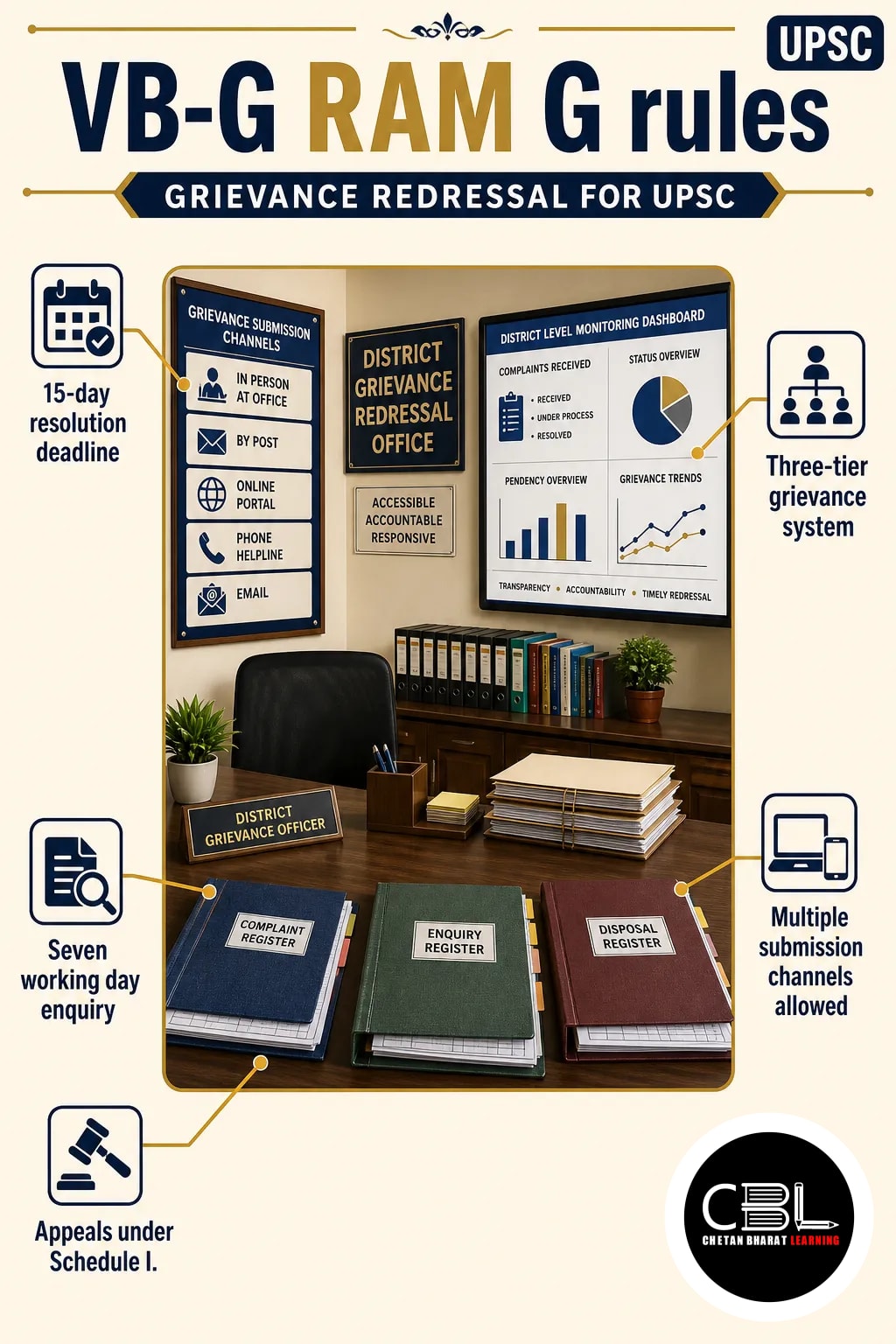
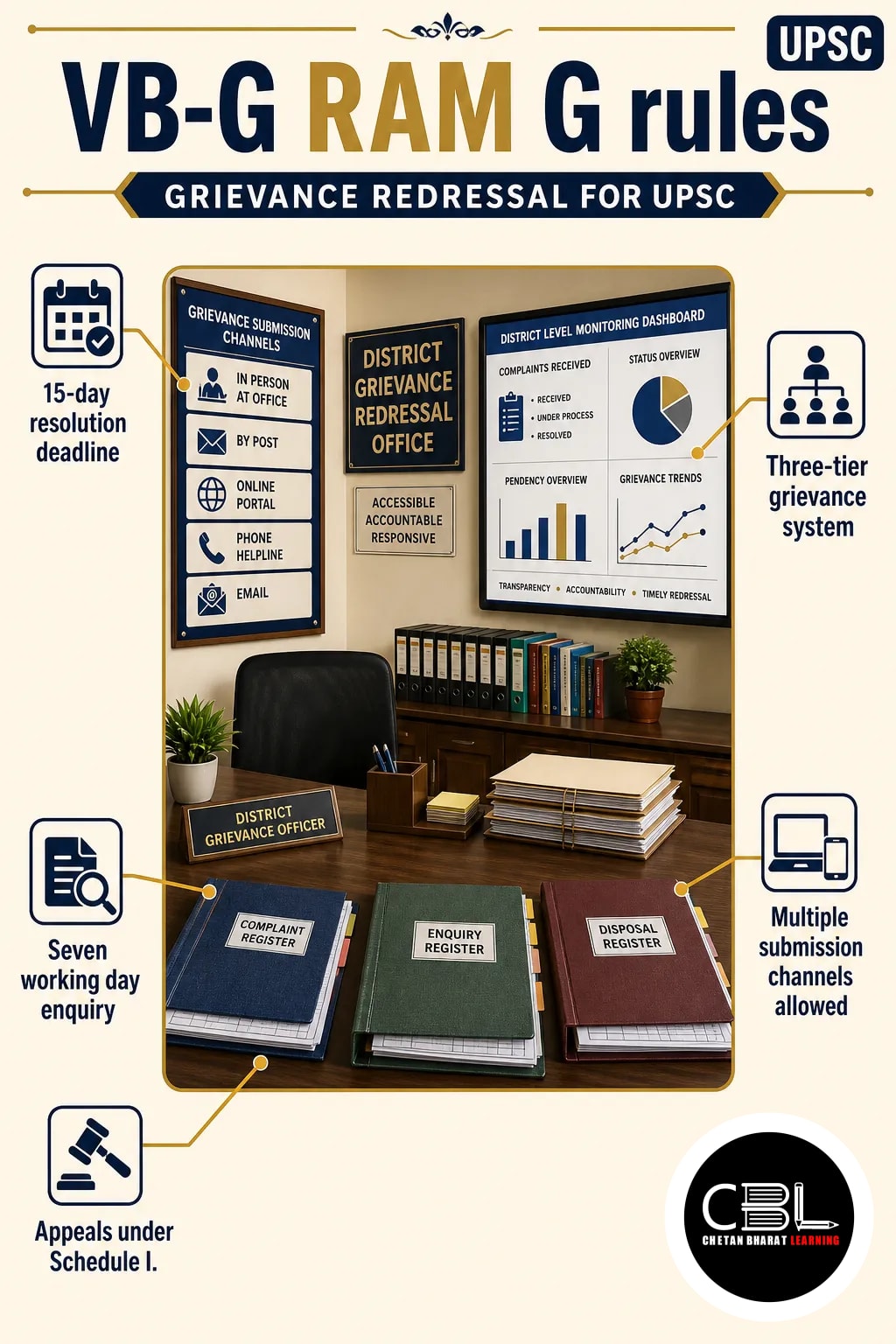
VB-G RAM G rules set a 15-day deadline for resolving complaints about the rural employment programme. The notification adds a grievance mechanism to the rural development governance framework.
Quick answer: The VB-G RAM G rules establish a three-tier grievance system at gram panchayat, block and district levels. Announced by the Rural Development Ministry on 2 November 2026, they require enquiries within seven working days and resolution within 15 days. Pending complaints escalate to the next higher level.
What do the VB-G RAM G rules provide?
The rules create a procedure for registering, investigating and resolving complaints about the rural employment scheme. They operate under the Viksit Bharat-Guarantee for Rozgar and Ajeevika Mission (Gramin) Act, 2025, which provides the programme’s statutory framework.
The Union Ministry of Rural Development notified the Grievance Redressal Rules, 2026. States must establish the three-tier mechanism; designated officers at each level receive, register, enquire into and dispose of complaints. For the broader reform context, see CBL’s earlier coverage of the rural employment reform.
How does the grievance process work?
The process combines multiple submission channels with registration, an enquiry and time-bound disposal. The following stages distinguish the enquiry deadline from the overall resolution deadline.
| Stage | Requirement |
|---|---|
| Submission | In person, by speed post, designated digital platform, telephone helpline or another state-approved mode |
| Registration | No refusal because of format, language, submission manner or procedural deficiency |
| Digital entry | Physical complaints entered on receipt day or, if not feasible, the next working day |
| Acknowledgement | Registration number, receipt date and designation of receiving authority |
| Enquiry | Completed within seven working days of receipt |
| Resolution | Within 15 days; unresolved cases escalate to the next higher level |
During an enquiry, the officer can seek records, documents, reports and electronic data from relevant authorities. Where necessary, the officer can also hear the complainant in person or electronically.
Escalated cases remain under electronic monitoring until disposal. In addition, the district programme coordinator oversees district-level grievance redressal and the designated digital infrastructure.
What legal safeguards and appeal provisions apply?
The rules prohibit procedural barriers to registration and provide for appeals under Schedule I of the parent Act. Therefore, an incorrectly formatted complaint or one submitted in a particular language cannot be refused registration on that ground.
The acknowledgement gives the complainant a reference for following up. However, escalation of an overdue complaint and an appeal against an order are distinct: the former addresses delay, while the latter concerns an order under the mechanism.
The source does not specify the appeal authority, filing deadline or consequences for missing the resolution deadline. Consequently, aspirants should not infer those details from the notification summary.
Why does the grievance mechanism matter?
The mechanism can make a statutory employment programme more accountable by giving citizens a defined route to raise implementation problems. Its effectiveness, however, depends on both access and the quality of disposal.
- Access: Multiple channels allow people to complain without relying exclusively on a digital platform.
- Traceability: Registration numbers and electronic monitoring can help officials follow a case through the system.
- Time-bound administration: Separate enquiry and resolution deadlines create identifiable stages for oversight.
- Federal delivery: The Centre sets the rules, while states establish the mechanism across local administrative levels.
- Fair hearing: An opportunity to be heard, where necessary, can improve the enquiry’s understanding of the grievance.
For governance analysis, digital entry is a tool rather than proof of a satisfactory outcome. A complaint can be closed quickly yet still require scrutiny of whether the underlying concern was addressed.
What implementation challenges need attention?
The main challenges concern staff capacity, meaningful access and consistent follow-through across the three tiers. These are implementation risks, not findings about the scheme’s performance.
- Front-line capacity: Officers need time and support to register complaints, gather records and complete enquiries promptly.
- Digital reliability: Physical submissions still require timely platform entry; therefore, local connectivity and data-entry support matter.
- Language and awareness: A formal prohibition on refusal must be matched by accessible information about where and how to complain.
- Quality of disposal: Deadline pressure may encourage superficial closure unless supervisors also examine the substance of responses.
- Escalation: Higher levels need to act on overdue cases; electronic monitoring alone cannot resolve them.
What should states prioritise?
States should make the new process accessible at the point of service and monitor both timeliness and outcomes. First, they can publicise submission channels and acknowledgement requirements through local offices.
Second, training can help officers handle complaints regardless of language or format. In addition, supervisors can review overdue cases and check whether enquiries address the actual complaint.
Finally, states can use digital records to identify recurring implementation problems while preserving an effective offline route. Such measures would connect individual remedies with improvements in programme administration.
Source: The Hindu, 2 November 2026
Asked in UPSC: Previous Year Questions
- UPSC CSE Mains 2024 (GS Paper II): E-governance involves interactions for transparency and accountability, not merely technology in service delivery. In this context, evaluate the role of the Interactive Service Model of e-governance.
UPSC connects digital service delivery with citizen interaction, transparency and accountability.
Punjab PCS and Haryana HCS aspirants can connect these rules with state administration and local delivery of rural welfare. In addition, compare the roles of gram panchayat, block and district levels in registering and overseeing complaints.
Prelims Practice Corner
Mains Practice Questions
Frequently Asked Questions
What is the grievance resolution deadline?
The deadline is 15 days. After that, an unresolved complaint escalates to the next higher level.
Can a person submit a grievance without using the digital platform?
Yes, because the rules also permit submission in person, by speed post and through telephone helplines. States may additionally prescribe other modes.
Can a grievance be rejected because of its language or format?
No, because the rules prohibit refusal of registration on those grounds. They also protect complaints against refusal for submission manner or procedural deficiency.
Is an appeal available against a grievance order?
Yes, appeals are provided for in accordance with Schedule I of the Act. However, the source summary does not specify the appeal authority or filing deadline.
Related Current Affairs
Preparing for UPSC, PCS or HCS?
Talk to a mentor at Chetan Bharat Learning, Chandigarh. Free guidance on choosing the right exam and building a study plan.
Chat on WhatsAppCall 97793 53345UPSC / IAS / PCS coaching in Chandigarh · Trusted by aspirants across Punjab & Haryana

 Ananya RanaIAS · AIR 60
 Aditya SharmaIAS · AIR 70
 Ria Kaur SethiIPS · AIR 89
 Aman AloonIRS · AIR 295
 Sumer Singh VirkIRS · AIR 335
 Shivani PanchalIAS

Leave a Reply
You must be logged in to post a comment.