
Sabarimala Case: Supreme Court Examines State’s Power Over Religious Practices
Important for:
UPSC, Haryana HCS, Punjab PCS
Prelims: Articles 25 & 26, Fundamental Rights, religious freedom
Mains: GS Paper 2 — Constitution, Judiciary, Rights vs Regulation
Why in News?
The Supreme Court, during hearings in the Sabarimala reference case, examined whether the State has the authority to regulate religious practices, especially when they conflict with constitutional principles like equality and social justice.
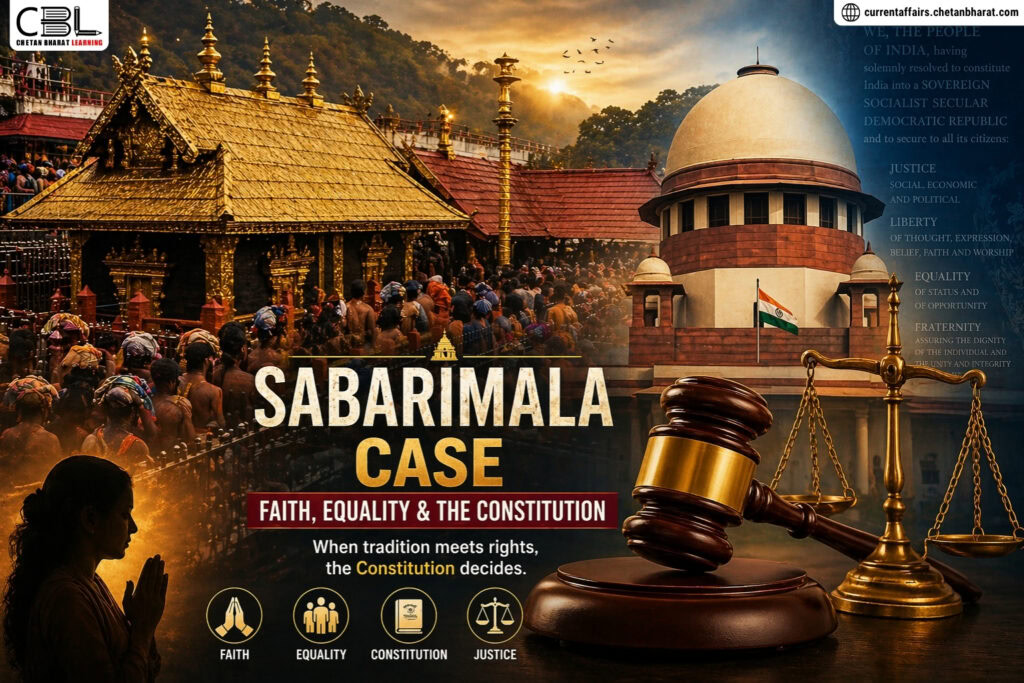
Background: Sabarimala Issue
- Linked to Sabarimala Temple
- Dedicated to Lord Ayyappa
- Earlier controversy:
✔️ Entry of women of certain age groups
Key Constitutional Provisions
Article 25 — Freedom of Religion
- Guarantees:
✔️Freedom of conscience
✔️ Right to practice, profess, propagate religion - Subject to:
- Public order
- Morality
- Health
Article 26 — Religious Denominations
- Right to:
- Manage religious affairs
- Own property
- Administer institutions
✔︎ Also subject to:
- Public order
- Morality
- Health
What Did the Supreme Court Say?
- Judicial review over religious practices should not be weakened
- Absolute autonomy to religious groups may:
✔︎ Lead to exclusion
✔︎ Violate equality
✔️Key concern:
Allowing unrestricted control may result in discriminatory practices
Core Constitutional Conflict
| Religious Freedom | Constitutional Morality |
| Article 25 & 26 | Equality (Article 14) |
| Denominational rights | Social justice |
| Autonomy | State regulation |
Important Legal Doctrine
Essential Religious Practices (ERP) Doctrine
- Courts decide:
✔︎ What is “essential” to religion
⚠️ Criticism:
- Judiciary interfering in religious matters
- Subjective interpretation
Key Concern Raised
The Court and Centre highlighted:
✔︎ If unchecked:
- Religious institutions may:
- Deny entry to Dalits
- Restrict access to certain groups
✔︎ This raises:
- Equality issues
- Social justice concerns
Quick Recap for Exam
- What: Supreme Court hearing on Sabarimala reference
- Core issue: State’s power to regulate religious institutions
- Key Articles: Article 25 & Article 26
- Debate: Religious autonomy vs constitutional values
- Concern: Absolute autonomy may lead to exclusion (e.g., Dalits, women)
PRELIMS PRACTICE QUESTIONS
Q1. Article 25 of the Constitution deals with:
A. Right to equality
B. Freedom of religion
C. Cultural rights
D. Freedom of speech
✅ Answer: B
Q2. Which of the following is correct about Article 26?
- It gives rights to religious denominations
- It is absolute in nature
- It is subject to public order, morality and health
A. 1 and 3 only
B. 2 only
C. 1 and 2 only
D. 1, 2 and 3
✅ Answer: A
Q3. Essential Religious Practices doctrine is decided by:
A. Parliament
B. Judiciary
C. Executive
D. Election Commission
✅ Answer: B
- Religious freedom
- Freedom of speech
- Right to equality
A. 1 only
B. 1 and 2 only
C. 1, 2 and 3
D. None
✅ Answer: C
Q5. Which Article ensures equality before law?
A. Article 19
B. Article 21
C. Article 14
D. Article 32
✅ Answer: C
Q6. Which of the following is NOT a valid ground to restrict religious freedom?
A. Public order
B. Morality
C. Health
D. Political convenience
✅ Answer: D
A. Executive review of laws
B. Legislature review of judiciary
C. Courts examining constitutionality
D. President reviewing laws
✅ Answer: C
CBL Mains Practice Question
“Balancing religious freedom with constitutional morality remains a persistent challenge in Indian democracy.”
Discuss in the context of recent judicial developments.
FAQs
1. What is the Sabarimala case about?
It deals with entry restrictions and rights of religious denominations vs equality.
2. What are Articles 25 and 26?
They guarantee religious freedom and rights of religious groups.
3. What is Essential Religious Practices doctrine?
A principle used by courts to determine what is essential to a religion.
4. Why can the state regulate religion?
To ensure public order, morality, and social justice.
5. Which GS paper covers this topic?
GS Paper 2 — Constitution and Governance.
Related Current Affairs
Preparing for UPSC, PCS or HCS?
Talk to a mentor at Chetan Bharat Learning, Chandigarh. Free guidance on choosing the right exam and building a study plan.
Chat on WhatsAppCall 97793 53345UPSC / IAS / PCS coaching in Chandigarh · Trusted by aspirants across Punjab & Haryana
Leave a Reply
You must be logged in to post a comment.