

UPSC Mapping
- Prelims: Indian Economy and Industrial Policy
- Mains: GS Paper III: Economy, Industry and Investment
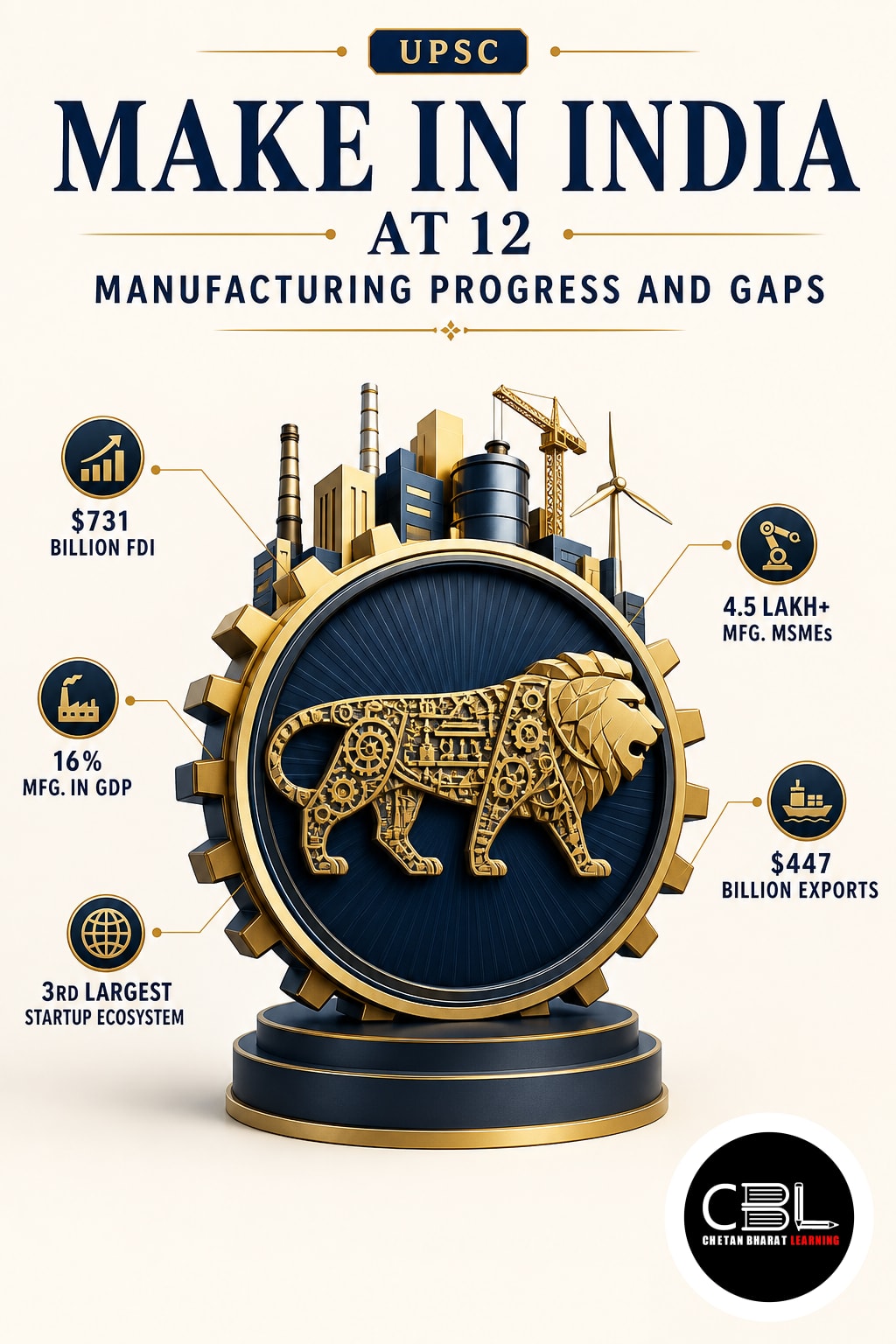
Make in India at 12: Manufacturing Progress and Gaps
What is Make in India?
Make in India is a national initiative launched in 2014 to strengthen domestic manufacturing and attract productive investment. The Department for Promotion of Industry and Internal Trade coordinates the programme under the Ministry of Commerce and Industry. It originally focused on 25 sectors, including automobiles, pharmaceuticals, electronics, defence manufacturing, textiles, railways and renewable energy.
The initiative rests on four broad pillars: new processes, infrastructure, sectors and mindset. New processes seek simpler regulations and improved ease of doing business. New infrastructure promotes industrial corridors, digital networks, logistics facilities and smart manufacturing clusters. The sectoral approach identifies industries capable of attracting capital, technology and employment. The new-mindset pillar asks the government to act as an investment facilitator rather than only a regulator.
Why is Make in India in News?
Make in India completed twelve years on 25 September 2026. The anniversary has encouraged an assessment of its contribution to manufacturing capacity, foreign investment, exports and employment. It also allows policymakers to examine whether improvements in selected industries have produced broad-based industrial development. The official national initiative portal presents its sectoral opportunities and investment-facilitation framework.
India has expanded production capabilities in mobile phones, electronics, pharmaceuticals, defence equipment and renewable-energy components. Subsequent programmes have reinforced the original vision through production-linked incentives, industrial corridors, logistics reforms and infrastructure investment. The anniversary also highlights unresolved concerns regarding manufacturing employment, research intensity, import dependence and the competitiveness of smaller enterprises. These mixed outcomes make the initiative important for evaluating India’s wider economic transformation.
Key Features
The initiative combines regulatory reform, investment promotion and sector-specific industrial development.
- Investment facilitation: Make in India provides investors with sector information, administrative guidance and support for resolving implementation barriers.
- Sectoral strategy: The programme identifies industries capable of generating employment, exports, technology transfers and domestic value addition.
- FDI liberalisation: India has progressively eased foreign-investment rules across several sectors while retaining safeguards in sensitive activities.
- Infrastructure integration: Industrial corridors, freight routes, logistics parks and digital systems support efficient manufacturing and market access.
- Collaborative federalism: States compete for investment through improved approvals, industrial policies, land systems and business-support mechanisms.
Several later reforms complement this framework without forming identical programmes. The Goods and Services Tax created a more unified domestic market, while the Insolvency and Bankruptcy Code established a time-bound resolution framework. PM Gati Shakti supports coordinated infrastructure planning, and the National Logistics Policy targets supply-chain efficiency. Production-linked incentive schemes reward incremental output in selected strategic sectors. The semiconductor mission, defence indigenisation measures and public procurement preferences also support domestic industrial capabilities.
Challenges
India must address persistent structural weaknesses to convert investment announcements into competitive production and stable employment.
- Limited manufacturing depth: Several industries still depend heavily on imported components, machinery, minerals and specialised technologies.
- Employment intensity: Capital-intensive production can raise output without creating enough formal jobs for India’s expanding workforce.
- MSME constraints: Smaller enterprises face expensive credit, delayed payments, technology gaps and difficulty meeting global quality standards.
- Logistics and compliance: Uneven infrastructure, regulatory variations and procedural delays continue increasing business costs across some states.
- Research deficit: Low private research expenditure restricts domestic innovation, advanced manufacturing and ownership of critical technologies.
India also competes with other emerging economies seeking investment diverted from concentrated global supply chains. Investors consider policy stability, electricity reliability, trade access, workforce productivity and contract enforcement before selecting production locations. Frequent tariff changes may protect domestic producers temporarily but can raise input costs for exporters. Environmental clearances and labour protections require efficient implementation rather than dilution. Chetan Bharat Learning’s daily current affairs archive provides further context on industrial and economic policy. India consequently needs a predictable manufacturing ecosystem instead of relying only on financial incentives.
Way Forward
The next phase of Make in India should prioritise domestic value addition, employment and technological capability. Authorities should evaluate incentives through additional production, exports, skilled jobs and reduced critical import dependence. Stable trade policies can help firms integrate into global value chains while retaining access to competitive inputs. India should also negotiate dependable market access and encourage multinational companies to develop local supplier networks.
The government must strengthen MSME financing, worker training, industrial research and university-industry collaboration. States should streamline approvals through transparent digital systems while enforcing environmental and labour standards consistently. Public investment in logistics, reliable electricity and urban infrastructure can improve the competitiveness of manufacturing clusters. The DPIIT portal can support transparent monitoring and investor coordination. A successful strategy must transform India from an assembly location into a centre for design, components, innovation and advanced production.
Prelims Practice Corner
Q1. The national manufacturing initiative discussed above was launched on which date?
(a) 15 August 2014 (b) 25 September 2014 (c) 26 January 2015 (d) 1 July 2017
Answer: (b) The Government launched the initiative on 25 September 2014.
Q2. Which department serves as the nodal agency for the initiative?
(a) Department of Economic Affairs (b) DPIIT (c) Department of Revenue (d) NITI Aayog
Answer: (b) DPIIT coordinates the programme under the Ministry of Commerce and Industry.
Q3. Which is not one of the initiative’s four broad pillars?
(a) New processes (b) New infrastructure (c) New sectors (d) Universal basic income
Answer: (d) Its pillars concern processes, infrastructure, sectors and government mindset.
Q4. Production-linked incentive schemes primarily reward eligible firms for which outcome?
(a) Incremental production (b) Reduced working hours (c) Agricultural procurement (d) Municipal taxation
Answer: (a) These schemes link financial incentives with additional output in selected sectors.
Q5. Consider the following statements:
1. The initiative originally covered 25 sectors.
2. It operates under the Ministry of Finance.
Which is correct?
(a) 1 only (b) 2 only (c) Both 1 and 2 (d) Neither 1 nor 2
Answer: (a) It originally covered 25 sectors and operates under the Commerce and Industry Ministry.
Mains Practice Questions
Q1. Assess India’s manufacturing transformation during the twelve years since the launch of its flagship industrial initiative. (250 words, 15 marks)
Answer Structure:
Intro: Mention the 2014 launch and the objective of building a global manufacturing centre.
Body: Examine sectoral gains, investment reforms, infrastructure, employment, import dependence, MSMEs and research gaps.
Conclusion: Recommend a shift towards deeper value addition, technology ownership and employment-intensive growth.
Q2. Financial incentives alone cannot create a globally competitive manufacturing ecosystem. Discuss. (150 words, 10 marks)
Answer Structure:
Intro: Recognise the role of incentives in attracting initial industrial investment.
Body: Cover logistics, skills, research, credit, policy stability, trade access and contract enforcement.
Conclusion: Support incentives within a wider framework of institutional and productivity-enhancing reforms.
FAQs on Make in India
What is the principal objective of the initiative?
It aims to strengthen domestic manufacturing, attract investment and create productive employment. It also seeks greater innovation, infrastructure quality and global competitiveness.
How is it different from production-linked incentive schemes?
The national initiative provides a broad manufacturing and investment framework. PLI schemes offer output-linked financial support to eligible firms in selected sectors.
Which factors will determine its long-term success?
Success depends on domestic value addition, skilled employment, technological innovation and competitive logistics. Stable policies and stronger MSME participation will also remain essential.
Related Current Affairs
Preparing for UPSC, PCS or HCS?
Talk to a mentor at Chetan Bharat Learning, Chandigarh. Free guidance on choosing the right exam and building a study plan.
Chat on WhatsAppCall 97793 53345UPSC / IAS / PCS coaching in Chandigarh · Trusted by aspirants across Punjab & Haryana
Leave a Reply
You must be logged in to post a comment.