

UPSC Mapping
- Prelims: Government Bodies, Drug Regulation and Health Policies
- Mains: GS Paper II – Health and Social Justice; GS Paper III – Pharmaceutical Industry
Article
What are Drug Pricing Mechanisms in India?
Drug Pricing Mechanisms refer to the legal and administrative arrangements through which the government regulates medicine prices, monitors price increases and protects consumers against overcharging.
The principal legal foundation is the Essential Commodities Act, 1955. Section 3 empowers the Central Government to regulate the production, supply and distribution of essential commodities, including medicines covered by the relevant legal framework.
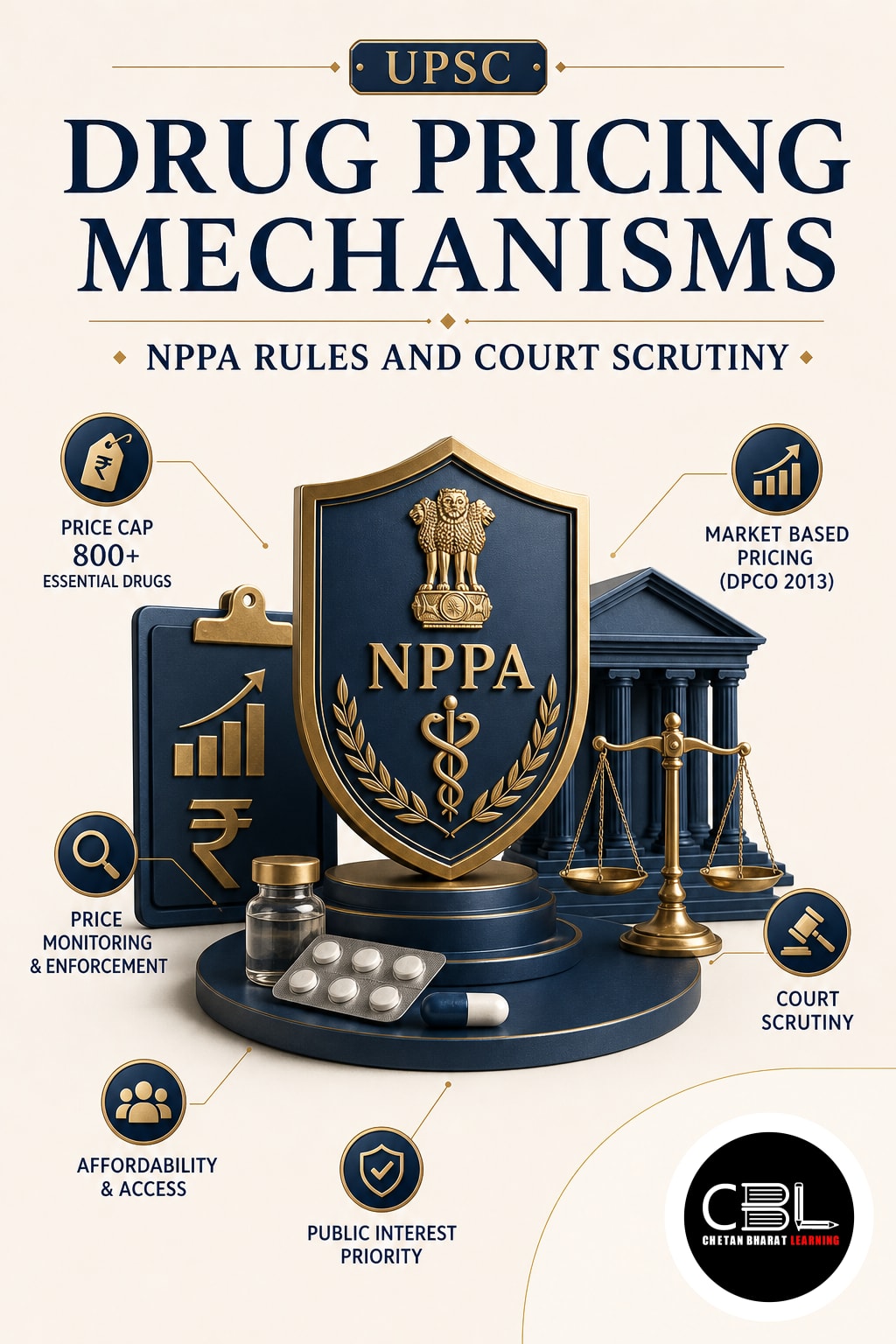
The Drugs (Prices Control) Order, 2013 (DPCO), issued under the Act, provides the operational framework for pharmaceutical price regulation. The National Pharmaceutical Pricing Authority (NPPA), functioning under the Department of Pharmaceuticals in the Ministry of Chemicals and Fertilizers, implements its pricing provisions.
A fundamental distinction exists between scheduled and non-scheduled formulations. Scheduled formulations are included in Schedule I of DPCO and subject to notified ceiling prices, whereas non-scheduled formulations are generally subject to price monitoring rather than routine ceiling-price fixation.
The National List of Essential Medicines (NLEM), prepared by the Ministry of Health and Family Welfare, provides the basis for Schedule I. The NLEM 2022 contains 384 listed essential medicines, while the operational schedule specifies formulations and strengths for price regulation.
Why in News?
In September 2026, a Supreme Court Bench comprising Justices Vikram Nath and Sandeep Mehta questioned the large difference between procurement and consumer prices of cancer medicines. One example presented during the proceedings involved a drug supplied to retailers for ₹2,700 and carrying a consumer price of ₹27,000.
The Court expressed serious concern about excessive margins and asked the Centre to examine whether stricter pricing controls should extend to medicines outside the existing scheduled framework. It also questioned arrangements that restrict hospital patients to purchasing medicines from designated or in-house pharmacies.
Subsequently, on 8 October 2026, the Department of Pharmaceuticals announced government approval for extending price protection to non-scheduled anti-cancer medicines through a 30% cap on trade margins measured against Maximum Retail Price (MRP). An expert committee under the Directorate General of Health Services was tasked with finalising the covered medicines.
Key Features
- Essential Commodities Act, 1955: Provides the statutory basis for regulating prices and availability of specified essential commodities, including medicines.
- DPCO, 2013: Establishes rules for ceiling prices, price monitoring, availability and action against overcharging.
- NPPA: Fixes and revises notified medicine prices, monitors compliance and can recover overcharged amounts.
- Scheduled formulations: Subject to notified ceiling prices calculated through a market-based formula plus 16% retailer margin.
- Non-scheduled formulations: Manufacturers determine initial prices but cannot increase MRP by more than 10% over the preceding 12 months.
- Extraordinary intervention: Paragraph 19 empowers price regulation in exceptional public-interest circumstances.
Scheduled vs Non-Scheduled Medicines
| Feature | Scheduled | Non-Scheduled |
|---|---|---|
| Coverage | Schedule I of DPCO | Outside Schedule I |
| Ordinary pricing | Ceiling price notified by NPPA | Manufacturer pricing with monitoring |
| Retailer margin | 16% in ceiling-price formula | No general ceiling formula |
| Price revision | WPI-linked under DPCO | MRP increase capped at 10% per year |
| Additional controls | Notified price enforcement | Special interventions, trade-margin caps |
Challenges
- High expenditure: Expensive medicines force households to borrow or cut consumption.
- Excessive margins: Large gaps between procurement and consumer prices.
- Limited direct control: Non-scheduled drugs lack routine ceiling prices.
- Hospital pharmacies: Restrict patient choice and competition.
- Right to health: Article 21 includes the right to life and health.
- Innovation vs affordability: Need balance between R&D incentives and access.
- Enforcement: Requires timely data, awareness and action on violations.
Way Forward
- Ensure transparent reporting of procurement prices, margins and MRPs.
- Regularly review NLEM and DPCO to address new treatments and burdens.
- Expand access to quality-assured generics and strengthen public procurement.
- Monitor trade-margin measures to ensure savings reach patients.
- Balance affordability with sustainable manufacturing and research.
Prelims Practice Corner
- Which legislation empowers DPCO 2013? (a) Drugs and Cosmetics Act, 1940 (b) Consumer Protection Act, 2019 (c) Essential Commodities Act, 1955 (d) Competition Act, 2002
- Consider: 1. NPPA under DoP. 2. Scheduled formulations have ceiling prices. 3. NPPA is constitutional under Article 21. Correct? (a) 1 & 2 only (b) 2 & 3 only (c) 1 & 3 only (d) All three
- Retailer margin in scheduled ceiling-price formula? (a) 10% (b) 12% (c) 20% (d) 16%
- Non-scheduled medicines: 1. Outside routine ceiling mechanism. 2. Can increase MRP freely. 3. Extraordinary interventions possible. Correct? (a) 1 only (b) 1 & 3 only (c) 2 & 3 only (d) All three
- October 2026 decision on non-scheduled anti-cancer medicines: (a) 16% profit cap (b) Abolition of private trade (c) 30% trade-margin cap vs MRP (d) Removal of NPPA powers
Mains Practice Questions
Q1. Affordable access to essential medicines is fundamental to equitable healthcare. Examine India’s drug-pricing framework and challenges of excessive trade margins. (15 marks)
Q2. Discuss the relationship between pharmaceutical price regulation, Article 21 and the State’s responsibility to ensure affordable healthcare. (10 marks)
Frequently Asked Questions
What is the role of NPPA in regulating medicine prices?
The NPPA fixes and revises ceiling prices of scheduled medicines, regulates retail prices of new formulations, monitors non-scheduled drugs and enforces DPCO 2013 provisions against overcharging.
What is the difference between scheduled and non-scheduled medicines?
Scheduled formulations fall under Schedule I of DPCO 2013 and have notified ceiling prices. Non-scheduled medicines have manufacturer-determined prices but face annual MRP-increase limits and possible special interventions.
Why did the Supreme Court question cancer medicine prices in 2026?
The Court raised concerns about alleged tenfold mark-ups—for example, a drug supplied at ₹2,700 and sold at ₹27,000—highlighting affordability and hospital-pharmacy practices.
Related Current Affairs
Preparing for UPSC, PCS or HCS?
Talk to a mentor at Chetan Bharat Learning, Chandigarh. Free guidance on choosing the right exam and building a study plan.
Chat on WhatsAppCall 97793 53345UPSC / IAS / PCS coaching in Chandigarh · Trusted by aspirants across Punjab & Haryana
Leave a Reply
You must be logged in to post a comment.