
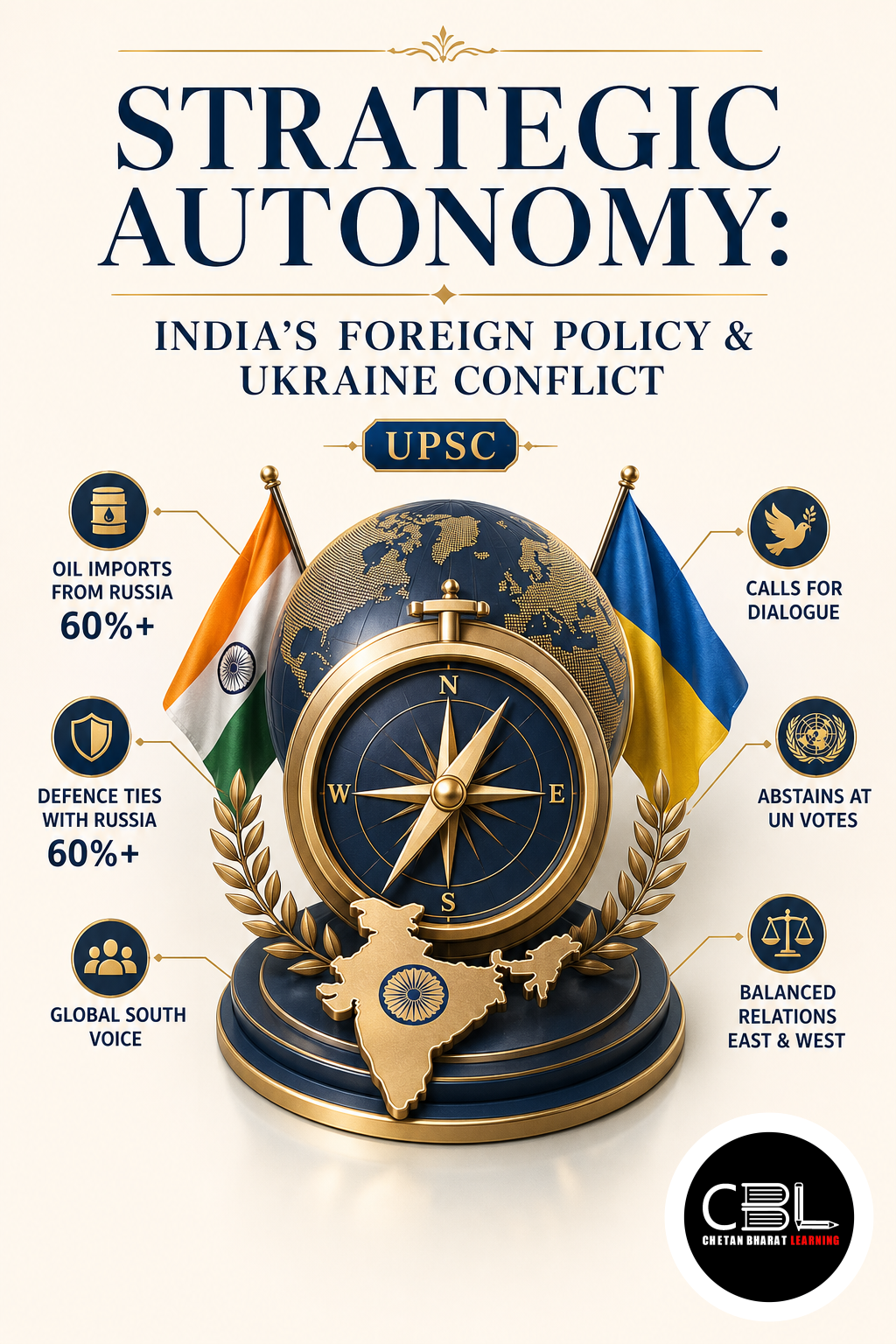

UPSC Mapping
| Prelims | International Relations |
|---|---|
| Mains | GS Paper 2 (IR) |
| Core Principle | National interest prioritization |
|---|---|
| Diplomatic Approach | Multi-aligned engagement |
| Key Partners | Russia, USA, EU, Ukraine |
Article
What is strategic autonomy?
The concept of strategic autonomy allows India to make independent foreign-policy choices based on national interests without joining fixed geopolitical camps. It represents an evolution from the historical Non-Aligned Movement, adapting to a multipolar world order. This principle dictates that New Delhi will engage with all nations but remain dependent on no single power. It empowers the country to navigate complex global dynamics while safeguarding its sovereign decision-making space.
This framework operates on the premise of selective alignment based on specific issue areas. For instance, India maintains deep historical ties with Russia for defence, nuclear energy, and space cooperation. Simultaneously, it cultivates robust partnerships with the United States and the European Union for technology, trade, and Indo-Pacific security. This dual-track diplomacy ensures that India maximizes its national advantages across diverse sectors.
Why is strategic autonomy in News?
The application of strategic autonomy recently gained prominence as India actively engaged with both Russia and Ukraine to help end the ongoing war. New Delhi has consistently called for dialogue and diplomacy while maintaining political engagement and providing humanitarian assistance to Ukraine. This balanced approach highlights India’s refusal to be drawn into a binary Cold War-style confrontation.
Furthermore, the conflict has generated wider consequences that directly impact the Global South. Issues like civilian casualties, mass displacement, inflation, and energy insecurity dominate international discourse. Disruptions to global food and fertiliser supplies make this conflict critically important for developing nations. India’s strategic autonomy enables it to advocate effectively for these vulnerable nations on the global stage, positioning New Delhi as a credible mediator rather than a partisan actor.
Key Features
The operational framework of strategic autonomy incorporates several distinct diplomatic and economic dimensions.
- Multi-aligned Approach: India engages with all major power centers, aligning selectively on specific issues without formal military alliances.
- Diversified Partnerships: The policy balances historical ties with Russia against growing technological and trade partnerships with the West.
- Global South Advocacy: India consistently highlights the disproportionate impact of global conflicts on developing nations regarding food and energy security.
- Humanitarian Diplomacy: New Delhi provides direct humanitarian assistance to conflict zones while maintaining open diplomatic channels with all belligerents.
- Independent Decision Making: The framework strictly protects India’s sovereign right to formulate policies based solely on domestic national interests.
Challenges
Despite its clear benefits, maintaining strategic autonomy faces several structural and operational hurdles in the current geopolitical climate.
- Balancing Competing Partnerships: Managing the delicate equilibrium between Western expectations and historical Russian ties requires immense diplomatic finesse.
- Supply Chain Disruptions: Global conflicts severely disrupt energy and fertiliser supplies, creating domestic inflationary pressures that are hard to manage.
- Nuclear Escalation Risks: The potential for nuclear escalation in ongoing conflicts threatens global stability and complicates India’s energy security calculations.
- Western Pressure: Developed nations frequently exert diplomatic pressure on India to explicitly condemn certain actions, testing its independent foreign-policy space.
- Domestic Perception: Explaining the nuances of multi-alignment to the domestic audience can be challenging amidst polarized global media narratives.
Way Forward
To maximize the effectiveness of strategic autonomy, the government must prioritize the strengthening of indigenous defence and energy manufacturing. Reducing dependency on imported military hardware and fossil fuels will inherently expand India’s diplomatic freedom. Strengthening the technical capabilities of domestic supply chains will also insulate the economy from global shockwaves. The government must actively promote Atmanirbhar Bharat initiatives in critical sectors.
Additionally, India should leverage its G20 presidency momentum to institutionalize the voice of the Global South in global governance. Policymakers must establish clear guidelines to mandate transparent reporting of international agreements. A robust, transparent, and inclusive system will ultimately drive India’s strategic autonomy forward, with continuous academic research further refining operational guidelines for diplomatic engagements.
Prelims Package
Prelims Practice Corner
Q1. With reference to India’s strategic autonomy, consider the following statements:
1. It allows India to make foreign-policy choices based on national interests.
2. It requires India to join fixed geopolitical camps during global conflicts.
3. It involves engaging with all nations while depending on no single power.
Which of the statements given above is/are correct?
- (a) 1 only
- (b) 1 and 3 only
- (c) 2 and 3 only
- (d) 1, 2 and 3
Answer: (b) Statement 2 is incorrect because strategic autonomy explicitly avoids joining fixed geopolitical camps.
Q2. Which of the following sectors represents a traditional area of cooperation between India and Russia?
- (a) Semiconductor manufacturing
- (b) Defence and nuclear energy
- (c) Financial services
- (d) Agricultural exports
Answer: (b) Defence, nuclear energy, space cooperation, and energy supplies remain core pillars of India-Russia relations.
Q3. The ongoing global conflict impacts the Global South primarily through:
- (a) Increased foreign direct investment
- (b) Disruptions to food and fertiliser supplies
- (c) Reduction in global inflation
- (d) Enhanced technological transfers
Answer: (b) The war creates severe disruptions to global food and fertiliser supplies, disproportionately affecting developing nations.
Q4. India’s diplomatic approach to the Ukraine conflict is best described as:
- (a) Strict political neutrality
- (b) Active military alignment with NATO
- (c) Multi-aligned engagement advocating dialogue
- (d) Complete economic isolation of all belligerents
Answer: (c) India follows a multi-aligned approach, engaging with all sides to advocate for dialogue and diplomacy.
Q5. Consider the following pillars of India’s strategic autonomy: 1. Diversified partnerships 2. Global South advocacy 3. Independent decision making. Which of the above are correct?
- (a) 1 and 2 only
- (b) 2 and 3 only
- (c) 1 and 3 only
- (d) 1, 2 and 3
Answer: (d) All three are fundamental pillars that define and sustain India’s strategic autonomy in global affairs.
Mains Package
Mains Practice Questions
Q1. Discuss the significance of strategic autonomy in India’s foreign policy, especially in the context of the Russia-Ukraine conflict. (150 words, 10 marks)
Answer Structure:
- Intro: Define strategic autonomy as the principle of making independent foreign-policy choices based on national interests.
- Body: Discuss significance (multi-aligned approach, balancing Russia-West ties, Global South advocacy, humanitarian diplomacy) and its role in the Ukraine conflict.
- Conclusion: Suggest a way forward focusing on strengthening indigenous capabilities to sustain this autonomy long-term.
Q2. The major challenge for India is balancing strategic partnerships while protecting sovereignty and national interest. Critically analyze this statement. (250 words, 15 marks)
Answer Structure:
- Intro: Contextualize the complexity of modern geopolitics and India’s position as a pivotal swing state.
- Body: Analyze the challenges (Western pressure, supply chain disruptions, nuclear risks, domestic perception) and the mechanisms used to balance them (selective alignment, diversified trade, independent voting at UN).
- Conclusion: Conclude that true strategic autonomy requires continuous investment in domestic resilience and agile, principle-based diplomacy.
FAQs
How does strategic autonomy differ from non-alignment?
While non-alignment historically meant avoiding military blocs during the Cold War, strategic autonomy is a dynamic, modern concept. It allows India to actively engage and form issue-based partnerships with multiple powers without becoming dependent on any single one.
What is India’s official stance on the Russia-Ukraine conflict?
India maintains a multi-aligned approach, calling for immediate dialogue and diplomacy. It provides humanitarian assistance to Ukraine while preserving its historical defence and energy ties with Russia, refusing to join Western sanctions.
Why is strategic autonomy important for the Global South?
Strategic autonomy allows India to act as an independent voice for developing nations. It enables New Delhi to highlight issues like food insecurity, inflation, and supply chain disruptions without being constrained by the geopolitical agendas of major power blocs.
Related Current Affairs
Preparing for UPSC, PCS or HCS?
Talk to a mentor at Chetan Bharat Learning, Chandigarh. Free guidance on choosing the right exam and building a study plan.
Chat on WhatsAppCall 97793 53345UPSC / IAS / PCS coaching in Chandigarh · Trusted by aspirants across Punjab & Haryana
Leave a Reply
You must be logged in to post a comment.