
The Madurai hill lamp controversy has moved from a Supreme Court order to a question of compliance. After the Court permitted a one-time ceremony at the disputed pillar, the festival lamp was lit instead at its customary location. The development also raises wider constitutional governance questions.
Quick answer: The Madurai hill lamp was not lit at the contested stone pillar on 24 November 2026, despite a Supreme Court interim direction permitting a one-time ceremony there. Tamil Nadu instead lit the customary festival flame. Therefore, compliance and possible contempt may require judicial examination; no finding of contempt has been reported.
What did the Supreme Court order?
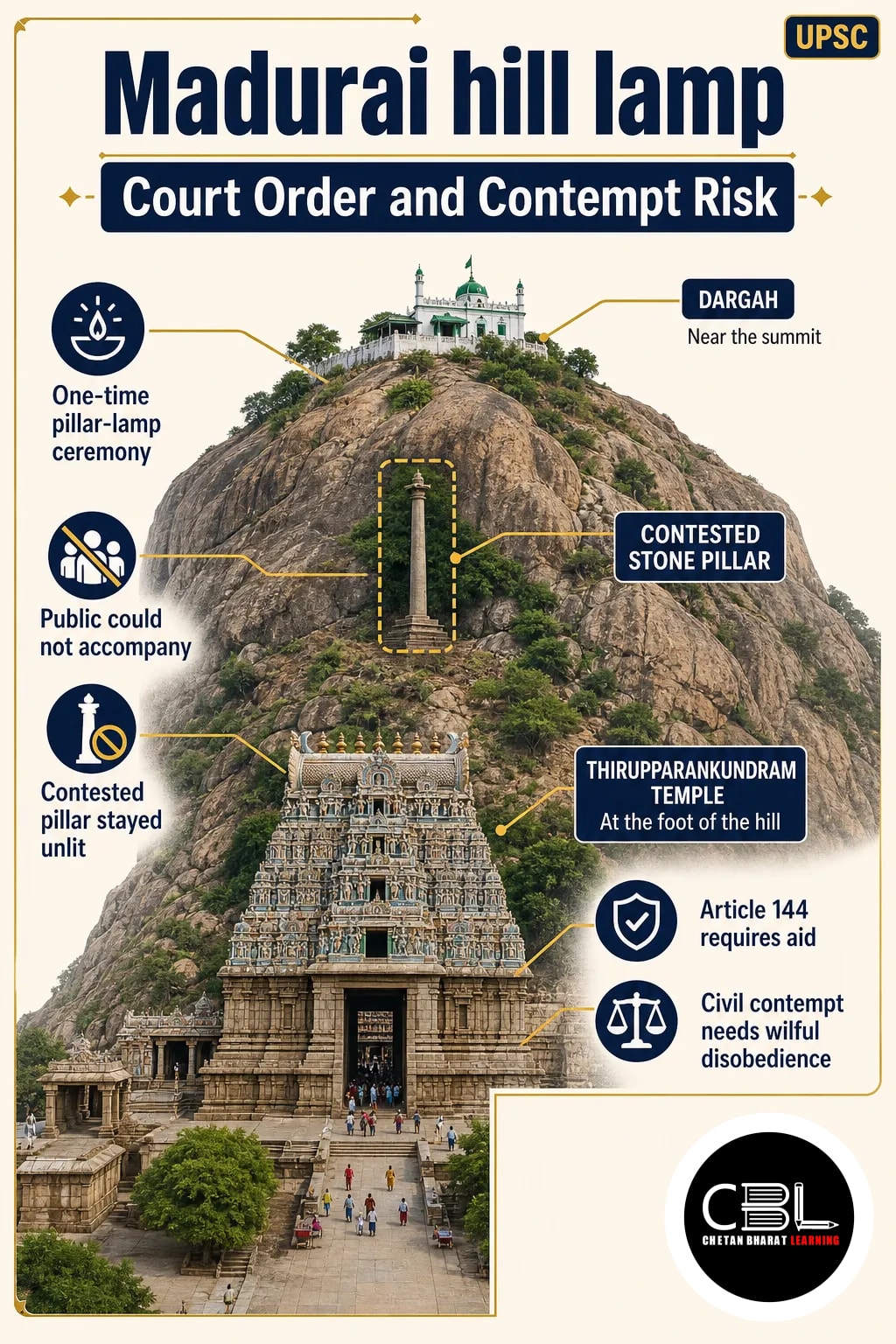
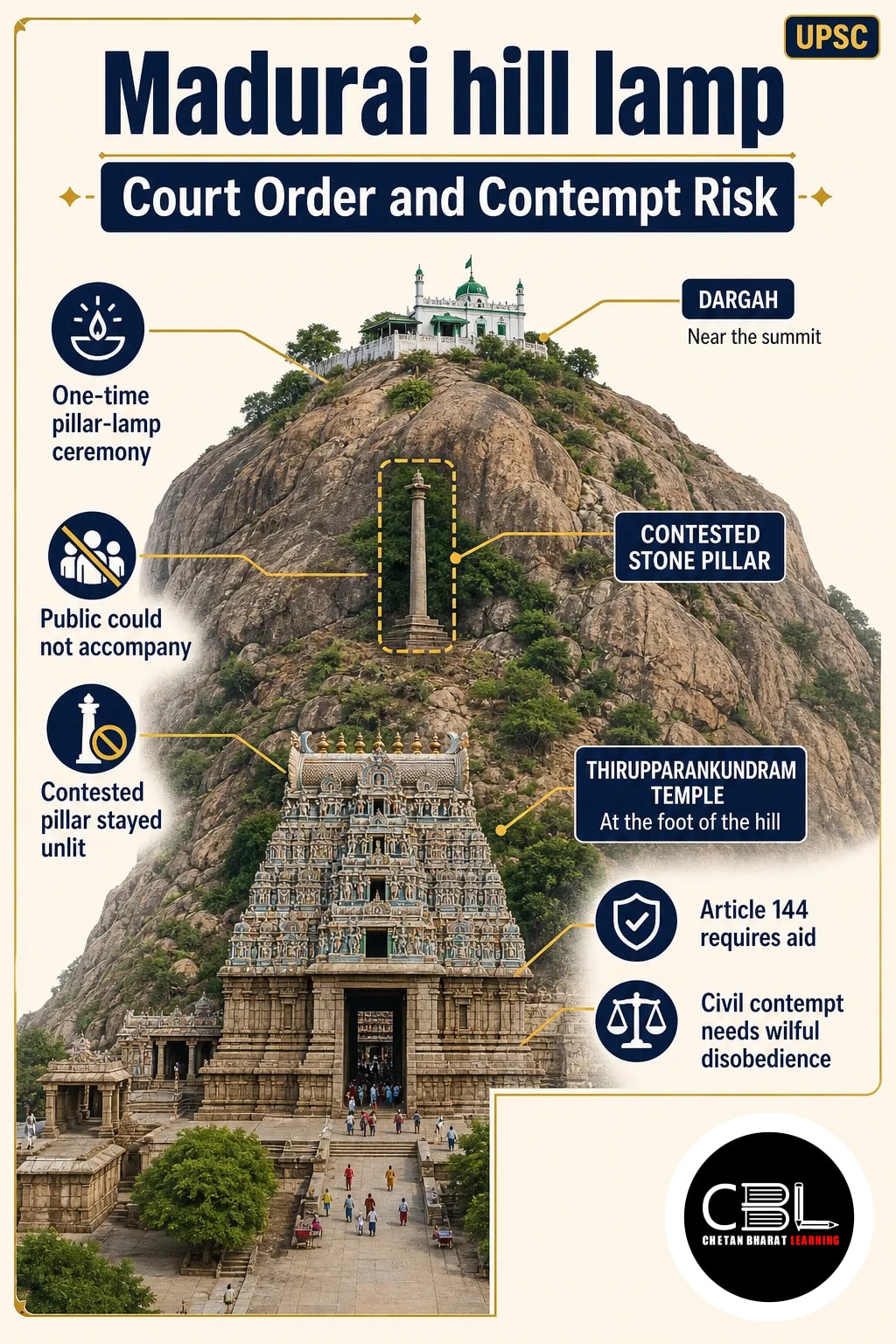
On 20 November, the Supreme Court directed authorities to permit a small temple-authorised team to light the pillar lamp as a one-time arrangement. However, the public could not accompany the team.
Justices Aravind Kumar and Vipul Pancholi also stayed the findings of the Madras High Court judgment of 6 January. The interim arrangement did not settle ownership or establish a customary right to worship at the pillar.
Moreover, the Court appointed Madurai Collector Nishant Krishna as nodal officer. He was to report compliance within three days of the festival.
What happened at the Madurai hill lamp ceremony?
On 24 November, the festival flame was lit at its customary location near the Uchi Pillaiyar temple, while the contested pillar remained unlit. Earlier that day, the Collector told the Madurai Bench of the Madras High Court that the administration was taking steps to comply.
The High Court reminded the Collector of his responsibility under the Supreme Court order. Meanwhile, the state had sought review through its Hindu Religious and Charitable Endowments Commissioner, but had not secured a hearing and stay before the festival.
The distinction between the two locations is central. The Arulmigu Subramaniaswamy Temple stands at the hill’s foot, while the Sikandar Badusha Dargah is near the summit. The contested stone pillar stands about 50 metres from the dargah.
Police deployed around 6,000 personnel across Madurai and near the hill. In addition, they prohibited drones, and a copper cauldron, cotton wick and ghee went up the hill under police escort.
How did the dispute reach this stage?
The present proceedings followed an earlier High Court direction to light the pillar lamp. The sequence separates the earlier litigation from the limited interim order.
| Stage | Development |
|---|---|
| Earlier proceedings | A single judge directed lighting at the pillar; a division bench subsequently upheld the direction. |
| 20 November 2026 | The Supreme Court stayed the High Court’s findings but directed a restricted, one-time ceremony. |
| State review | The state argued that performing the ritual once would change the factual record of past practice. |
| 24 November 2026 | The customary lamp was lit; the pillar lamp was not. |
Which constitutional and legal provisions matter?
The Constitution protects judicial authority and religious freedom, while the law specifies what constitutes civil contempt. These provisions must be read together rather than as an automatic answer to the dispute.
| Provision | Relevance |
|---|---|
| Article 129 | Makes the Supreme Court a court of record with power to punish for contempt of itself. |
| Article 144 | Requires civil and judicial authorities throughout India to act in aid of the Supreme Court. |
| Articles 25 and 26 | Protect religious freedom and denominational rights, subject to constitutional limitations, including public order. |
| Contempt of Courts Act, 1971 | Defines civil contempt to include wilful disobedience of a court order. |
For civil contempt, wilful disobedience matters; an unlit lamp alone does not establish liability. A court must assess the order, the conduct of those concerned and any explanation. Also, filing a review petition does not by itself suspend an operative order.
Why does the case matter for governance?
The case tests how officials implement an interim judicial direction in a sensitive religious setting. It also shows why the scope of such a direction matters.
- Rule of law: Officials must address an operative order through lawful compliance or seek appropriate judicial relief.
- Limited interim relief: A one-time arrangement can regulate an immediate event without deciding the final rights of either side.
- Public order: Because the sites are close, authorities must plan security without treating community concerns as a substitute for court directions.
- Administrative accountability: A designated nodal officer creates a clear channel for implementation and reporting.
Political parties supporting the state government opposed a second lamp at the pillar. However, political disagreement does not itself alter the terms of an operative court order.
What should administrators do in such disputes?
Administrators should follow operative orders while promptly placing genuine implementation difficulties before the appropriate court. They should also document instructions and actions for the compliance report.
First, officials can seek clarification or a stay where necessary, rather than assume that a pending review changes the order. Second, they should plan security and communicate the order’s limited scope to affected groups. Finally, courts can examine disputed rights separately from questions of interim compliance.
Source: The Indian Express, 25 November 2026
Asked in UPSC: Previous Year Questions
- UPSC CSE Mains 2024 (GS Paper II): Discuss India as a secular state and compare it with the secular principles of the US Constitution.
UPSC also tests secularism comparatively, so revise religious freedom alongside public order.
Punjab PCS and Haryana HCS may test the Collector’s role in implementing court directions and maintaining public order. Also revise Articles 25, 26, 129 and 144 for state General Studies.
Prelims Practice Corner
Mains Practice Questions
Frequently Asked Questions
What did the Supreme Court permit at Thirupparankundram?
A one-time pillar-lamp ceremony by a small temple-authorised team. However, the public could not accompany the team.
Has a court found Tamil Nadu in contempt over the lamp?
No finding of contempt has been reported in the source. Moreover, civil contempt requires judicial assessment of wilful disobedience.
Did the interim order settle ownership of the pillar site?
No, the order did not settle ownership or customary worship rights. Instead, it provided for a restricted ceremony on one occasion.
Does a review petition automatically stay a court order?
No, a review petition does not itself suspend an operative order. Therefore, a party seeking suspension must obtain an appropriate stay.
Related Current Affairs
Preparing for UPSC, PCS or HCS?
Talk to a mentor at Chetan Bharat Learning, Chandigarh. Free guidance on choosing the right exam and building a study plan.
Chat on WhatsAppCall 97793 53345UPSC / IAS / PCS coaching in Chandigarh · Trusted by aspirants across Punjab & Haryana






Leave a Reply
You must be logged in to post a comment.