
Karnataka recruitment law has been struck down by the Supreme Court, bringing legislative power and recruitment integrity into focus. For constitutional context, explore CBL’s polity current affairs.
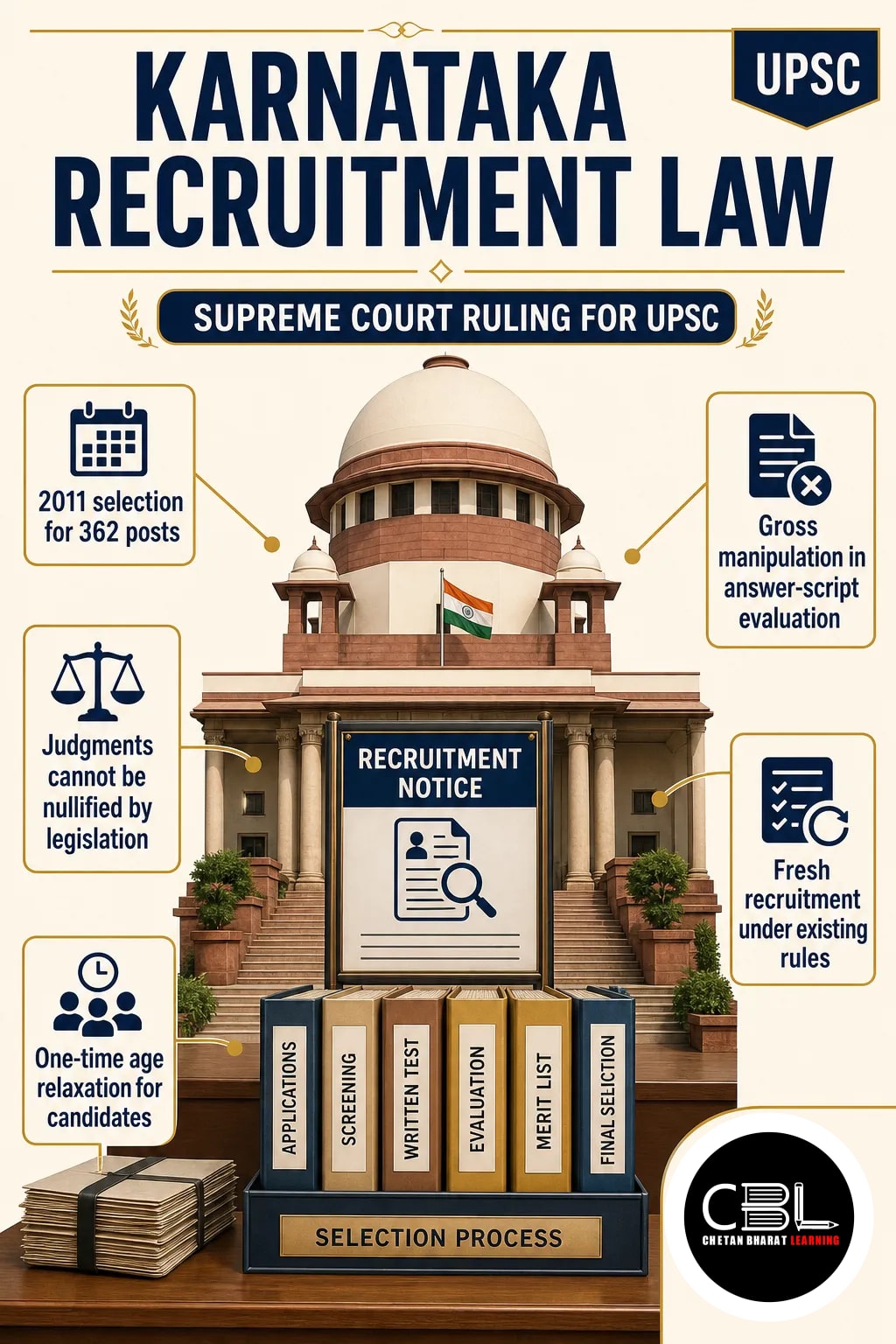
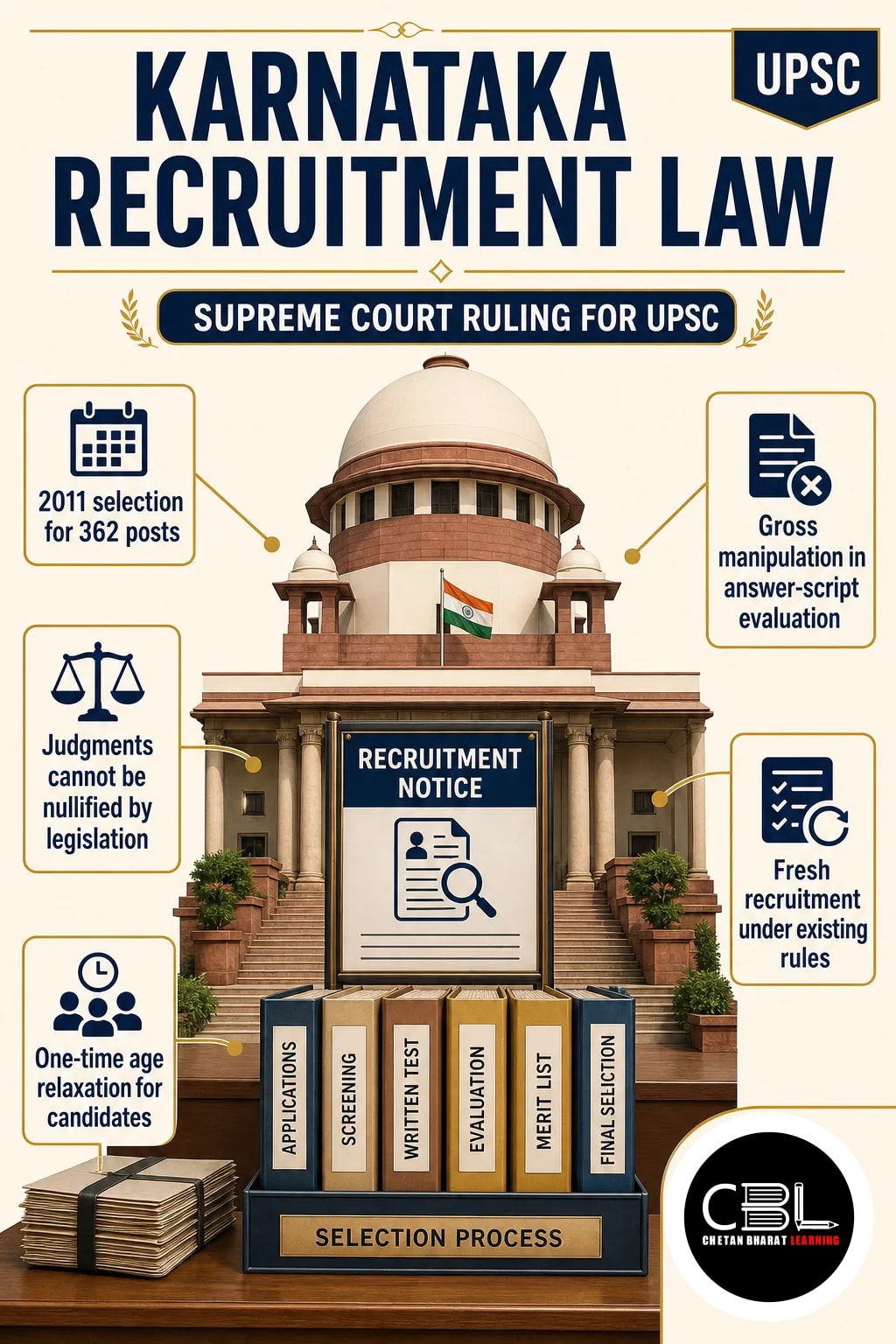
Quick answer: On 29 October 2026, the Supreme Court struck down the Karnataka recruitment law validating the 2011 selection for 362 posts. Earlier, the Karnataka High Court and Supreme Court had upheld cancellation of the process. The bench held that the legislature could not nullify those judgments by legislation.
What did the Supreme Court hold?
The Supreme Court held the Karnataka recruitment law unconstitutional because it sought to countermand earlier judicial decisions. Justices J.B. Pardiwala and K. Vinod Chandran heard the case.
The bench upheld cancellation of the entire selection for Group A and B posts. Consequently, appointments made under the 2022 Act would also end, including those of successful candidates not found tainted.
The court directed Karnataka to notify recruitment for the vacant posts under existing rules. It also granted a one-time age relaxation to specified candidates, rather than protecting their earlier appointments.
Background of the recruitment case
The dispute arose from the Karnataka Public Service Commission’s 2011 selection of Gazetted Probationers. The process attracted 1,38,307 applications for 362 posts.
In 2013, a Criminal Investigation Department (CID) inquiry found gross manipulation, including serious irregularities in answer-script evaluation. Subsequently, the High Court and Supreme Court upheld cancellation of the entire process.
In 2022, Karnataka enacted the Karnataka Civil Services (Validation of Selection and Appointment of 2011 Batch Gazetted Probationers) Act. The court held that this law attempted to undo the judgments. Meanwhile, the state had changed its position over the years, leaving candidates facing prolonged uncertainty.
Which constitutional provisions are relevant?
Equality, judicial review and constitutional provisions on public services frame the dispute.
| Provision | What it says |
|---|---|
| Article 14 | Guarantees equality before the law and equal protection of laws. |
| Article 16 | Provides equality of opportunity in public employment, subject to constitutional provisions. |
| Article 141 | Makes law declared by the Supreme Court binding on all courts in India. |
| Article 309 | Permits legislation and, subject to it, rules governing recruitment and service conditions. |
| Articles 315 and 320 | Provide for Public Service Commissions and set out their functions, including recruitment examinations. |
These provisions provide a framework for analysis; the source does not identify each as a specific ground of the judgment. In addition, judicial review allows constitutional courts to examine legislation against constitutional limits.
What are the implications for legislative power?
The ruling distinguishes law-making from directly annulling judicial decisions.
- Finality of judgments: The legislature could not simply reverse cancellation after constitutional courts had upheld it.
- Scope for valid legislation: A legislature may change the legal basis underlying a decision, subject to constitutional limits. However, it cannot merely declare a judgment ineffective.
- Recruitment integrity: A selection marked by widespread manipulation can undermine equal opportunity. Therefore, the court upheld cancellation of the whole process in this case.
- Institutional accountability: Recruitment bodies need credible evaluation and oversight. For a broader discussion, see independent institutions in democracy.
The decision does not mean that every recruitment irregularity requires wholesale cancellation. Instead, the appropriate remedy depends on the facts and the applicable law.
How did the court address affected candidates?
The court offered a fresh opportunity to specified candidates, but not automatic appointment.
Age relaxation applies once to appointed candidates not found tainted, the six appellants before the Supreme Court, and petitioners before the Karnataka Administrative Tribunal. However, they must participate in the fresh recruitment process.
If selected, their seniority will run from their actual appointment date. Moreover, they will receive neither back wages nor notional appointment from an earlier date.
This remedy balances competing concerns: preserving a compromised selection would affect recruitment integrity, while prolonged litigation has disadvantaged candidates. Nevertheless, age relaxation alone cannot recover lost time or guarantee selection.
What reforms can strengthen recruitment?
Transparent evaluation and timely dispute resolution can reduce the risk of similar disputes.
- Evaluation controls: Commissions should maintain verifiable records and audit trails for answer-script handling and assessment.
- Early response: Authorities should investigate credible complaints promptly and publish reasoned decisions, subject to legal safeguards.
- Candidate protection: Clear timelines and timely notice can limit uncertainty. Where courts permit, targeted relief can address disadvantage without assuming selection.
- Legislative scrutiny: Before validating a process, lawmakers should examine existing judgments and the constitutional basis for the proposed remedy.
Together, these measures can support fair access while respecting judicial decisions. Transparency also depends on lawful access to records; see CBL’s analysis of the Right to Information framework.
Source: The Hindu, 29 October 2026
- Independent Institutions in Democracy: UPSC Analysis (28 Oct 2026)
- RTI Act at 21: Achievements, Challenges and Reforms (28 Oct 2026)
Asked in UPSC: Previous Year Questions
- UPSC CSE Mains 2026 (GS Paper II): Compare separation of powers in India with the US presidential model, and the actual authority of the Indian Prime Minister with that of the US President.
UPSC tests separation of powers through institutional roles and comparisons, so connect this ruling with checks and balances.
Punjab PCS and Haryana HCS may test State Public Service Commissions, equality in public employment and judicial review. Also, use the case to examine how states can protect recruitment integrity while addressing candidate hardship.
Prelims Practice Corner
Mains Practice Questions
Frequently Asked Questions
Why did the Supreme Court strike down the Karnataka recruitment law?
Because it sought to undo judgments upholding cancellation of the 2011 selection. The court held that the legislature could not nullify those judgments through legislation.
How many posts were involved in the Karnataka recruitment case?
There were 362 Group A and B posts. In addition, 1,38,307 people applied for the 2011 selection.
Did the court grant age relaxation to affected candidates?
Yes, specified candidates received a one-time age relaxation for fresh recruitment. However, selection will not entitle them to back wages or an earlier notional appointment.
Can a legislature change a law after a court judgment?
Yes, it may change the legal basis of a decision within constitutional limits. However, it cannot simply annul a judgment by declaring it ineffective.
Related Current Affairs
Preparing for UPSC, PCS or HCS?
Talk to a mentor at Chetan Bharat Learning, Chandigarh. Free guidance on choosing the right exam and building a study plan.
Chat on WhatsAppCall 97793 53345UPSC / IAS / PCS coaching in Chandigarh · Trusted by aspirants across Punjab & Haryana
Leave a Reply
You must be logged in to post a comment.