
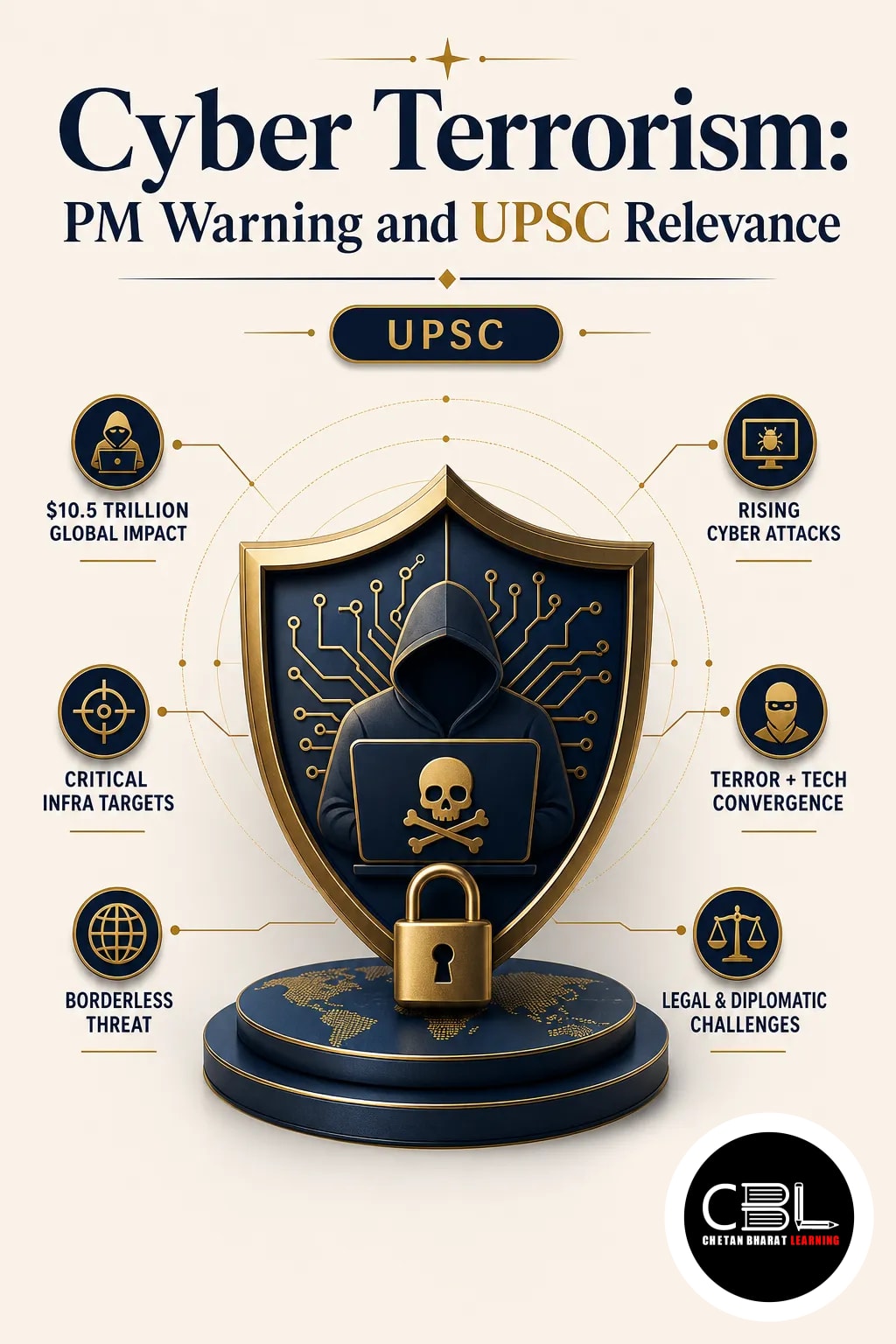

Cyber terrorism has become a sharper internal security concern after the Prime Minister warned that modern conflicts are not limited to physical weapons. For India, this debate connects digital infrastructure, national security, and state capacity in a connected economy. Read this with our coverage on tackling cyber threats in security planning.
What is cyber terrorism?
Cyber terrorism refers to the use of computer networks, digital tools, or online systems to create fear, disrupt services, or harm public safety. It can target government systems, financial networks, communications, or critical infrastructure. In Indian law and policy, the concern overlaps with cybercrime, sabotage, and threats to national security.
The issue matters because digital systems now support governance, commerce, transport, and defence coordination. A coordinated cyber attack can create panic without crossing a physical border. That is why the phrase cyber terrorism has entered national security discussions alongside traditional terrorism.
Why in News?
The Prime Minister’s warning highlighted that wars today are not fought with weapons alone. The statement draws attention to how hostile actors can use the digital domain to weaken institutions and public confidence.
For UPSC, the development is relevant to internal security, cyber governance, and the protection of critical infrastructure. It also reinforces the need for stronger coordination among law enforcement agencies, technical institutions, and digital service providers.
Key Features
- Non-kinetic threat — Cyber terrorism can cause disruption without using conventional arms or explosives.
- Wide attack surface — It may target power grids, banking systems, telecom networks, transport systems, or government portals.
- High psychological impact — Even limited attacks can create fear, uncertainty, and mistrust among citizens.
- Cross-border nature — Offenders can operate from outside the affected territory, complicating investigation and attribution.
- Links with hybrid warfare — It may accompany misinformation, espionage, and digital sabotage in broader security strategies.
Challenges
- Attribution difficulty — Tracing the real source of an attack remains technically and legally complex.
- Rapid technological change — Security systems often lag behind evolving attack methods and tools.
- Institutional fragmentation — Different agencies may handle cyber incidents, intelligence inputs, and criminal cases separately.
- Low public awareness — Weak digital hygiene and poor verification habits increase vulnerability to manipulation.
- Dependence on digital systems — Greater reliance on online platforms raises the impact of even small-scale attacks.
Way Forward
India needs a layered response that combines technology, law, and public awareness. Security agencies should strengthen threat detection, incident response, and real-time information sharing across critical sectors. Public institutions also need regular cyber drills and resilience planning.
Legal and administrative systems must keep pace with digital threats. The state should invest in cyber forensics, specialised training, secure-by-design infrastructure, and clear protocols for crisis communication. Public awareness on safe digital behaviour is equally important, because resilience starts with everyday users.
Source: Indian Express India, 2026-10-25
Cyber terrorism is relevant for state administration because police, disaster management, and utility services increasingly depend on digital systems. In state PCS exams, it can be linked to internal security, cyber policing, and protection of public infrastructure. It also fits questions on federal coordination in handling emerging security threats.
FAQ
Is cyber terrorism the same as cybercrime?
Not always. Cybercrime may aim at theft, fraud, or sabotage, while cyber terrorism focuses on fear, disruption, or coercion with security consequences. The two can overlap when attacks hit public systems or critical infrastructure.
Why does cyber terrorism matter for UPSC?
It links to internal security, governance, technology, and critical infrastructure protection. The topic also helps in answers on hybrid warfare and institutional resilience.
What should India prioritise against cyber terrorism?
India should strengthen cyber defences, improve coordination among agencies, and expand cyber forensics capacity. Public awareness and secure digital design are equally important.
Related Current Affairs
Preparing for UPSC, PCS or HCS?
Talk to a mentor at Chetan Bharat Learning, Chandigarh. Free guidance on choosing the right exam and building a study plan.
Chat on WhatsAppCall 97793 53345UPSC / IAS / PCS coaching in Chandigarh · Trusted by aspirants across Punjab & Haryana
Leave a Reply
You must be logged in to post a comment.