
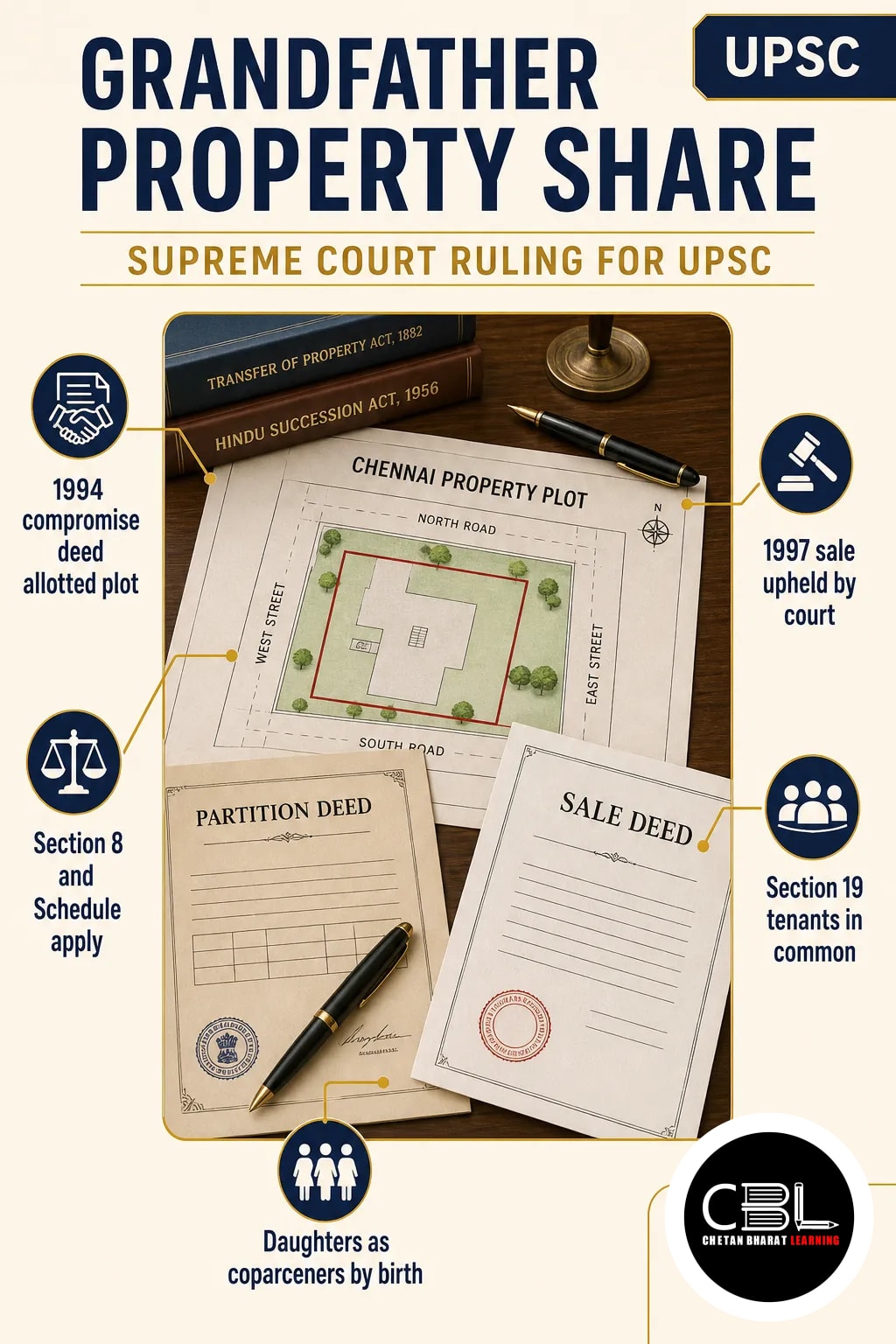

Grandfather property share claims depend on how the property devolved, the Supreme Court has clarified. The ruling offers a case study for polity and legal studies.
Quick answer: In a case concerning a Chennai property, the Supreme Court held that a grandson could not claim a grandfather property share by birth in the plot allotted to his father. The grandfather’s estate passed to Class I heirs, and a 1994 partition made the father’s allotted share his individual property.
What did the Supreme Court hold?
The Supreme Court held that Rajesh could not claim a birthright in the plot allotted to his father, M Kumaran. Justices Augustine George Masih and Sunita Agarwal upheld the decision permitting Kumaran’s sale.
The court distinguished succession under Section 8 from a birthright in a Mitakshara coparcenary. A coparcenary is a body within a Hindu joint family whose members hold an interest in coparcenary property by birth. Here, however, the grandfather’s property passed to his Class I heirs, and the partition gave Kumaran an individual share.
Under Section 8, a living son’s son is not a Class I heir of the grandfather. Therefore, the court rejected Rajesh’s claim to the allotted plot based solely on his birth.
What was the background of the case?
The dispute arose from the estate of N Ramakrishnan and a later sale by his son. The timeline shows why the status of the property mattered.
| Year | Event |
|---|---|
| 1993 | Ramakrishnan’s daughter filed a partition suit. |
| 1994 | A February compromise deed allotted Kumaran a plot. |
| 1997 | Kumaran sold the plot in April. |
| Later litigation | Rajesh sued his father and the buyers, claiming a coparcenary interest. |
A Chennai trial court initially granted Rajesh a preliminary partition decree. However, an appellate court reversed it, and the Madras High Court and Supreme Court upheld that reversal.
The grandfather’s exact death date was not recorded. Nevertheless, the court found that succession opened before Rajesh’s birth and before the 1993 suit. Rajesh was therefore not a surviving coparcener when succession opened.
Which provisions govern the inheritance claim?
The Hindu Succession Act, 1956, distinguishes intestate succession from rights in Mitakshara coparcenary property. Intestate means dying without a valid will.
| Provision | What it says |
|---|---|
| Section 8 and Schedule | A Hindu male’s intestate property first devolves on Class I heirs, including a son, daughter, widow and mother. The son of a predeceased son is also included. |
| Section 19 | Multiple heirs inherit as tenants in common, not joint tenants; each holds an individual share. |
| Section 6 | It concerns devolution of interests in Mitakshara coparcenary property; the 2005 amendment recognised daughters as coparceners by birth. |
Before the 2005 amendment, Section 6 generally provided for survivorship among coparceners when a male coparcener died. However, an exception applied when he left a specified female Class I heir, such as a widow or daughter; his interest then passed by succession.
In this case, the court applied Section 8 and treated the heirs as tenants in common under Section 19. Consequently, the later partition identified the plot as Kumaran’s individual property. Rajesh also invoked Section 29A, a provision introduced to grant daughters coparcenary rights, but the court rejected his argument on the case facts.
How do Mitakshara and Dayabhaga differ?
Mitakshara recognises a birth interest in coparcenary property, while Dayabhaga does not generally give a son such an interest by birth. Dayabhaga is followed in West Bengal and Assam; Mitakshara applies across the rest of India.
Under Mitakshara, a coparcener can seek partition of coparcenary property. However, the mere fact that property belonged to a grandfather does not establish that every later holder retains it as coparcenary property.
For a grandfather property share claim, the distinction is crucial: first identify the nature of the property, then determine when succession opened and whether a partition changed the relevant holding. The 2005 amendment also means that coparcenary cannot be understood as an exclusively male category.
What are the implications and concerns?
The ruling clarifies the consequences of the particular succession and partition before the court. It does not erase birthrights in every Mitakshara coparcenary.
- Individual control: Because Kumaran received an individual share, he could sell the allotted plot.
- Heir classification: A predeceased son’s son and a living son’s son occupy different positions under the Class I Schedule.
- Evidence matters: Death, succession and partition records help establish who held rights and when.
- Gender dimension: The 2005 amendment makes daughters’ coparcenary rights essential to any assessment of family property.
However, family relationships alone may not reveal a property’s legal character. Missing records or assumptions about ancestral ownership can complicate claims. For a wider perspective, see the discussion of women farmers and recognition.
What should guide property-rights disputes?
Property-rights disputes require careful examination of the estate, the applicable law and the relevant documents. First, identify whether the holding was coparcenary property or an individually inherited share. Next, verify the heirs at the time succession opened and examine any partition deed or decree.
Moreover, legal awareness should cover both daughters’ statutory rights and the limits of claims based on birth. The broader relationship between personal laws and reform also features in the debate on a Uniform Civil Code.
Source: Indian Express Explained, 13 November 2026
- Women Farmers: Closing India’s Recognition Gap (24 Sep 2026)
- Uniform Civil Code: State Powers and Legal Debate (16 Sep 2026)
Punjab PCS and Haryana HCS may test inheritance rules, coparcenary and the role of partition records in General Studies. Therefore, distinguish statutory succession from rights arising by birth.
Prelims Practice Corner
Mains Practice Questions
Frequently Asked Questions
Can a grandson automatically claim his grandfather’s property?
No, birth alone does not establish every such claim. The outcome depends on the property’s character, applicable succession rules and relevant partition.
Is a predeceased son’s son a Class I heir?
Yes, because the Schedule includes the son of a predeceased son among Class I heirs. In contrast, it does not include the son of a living son in that category.
Can daughters be Mitakshara coparceners?
Yes, because the 2005 amendment to Section 6 recognised daughters as coparceners by birth. Therefore, coparcenary rights are not confined to sons.
Related Current Affairs
Preparing for UPSC, PCS or HCS?
Talk to a mentor at Chetan Bharat Learning, Chandigarh. Free guidance on choosing the right exam and building a study plan.
Chat on WhatsAppCall 97793 53345UPSC / IAS / PCS coaching in Chandigarh · Trusted by aspirants across Punjab & Haryana









Leave a Reply
You must be logged in to post a comment.